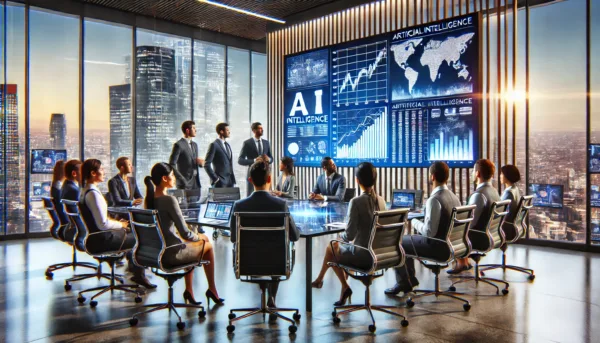



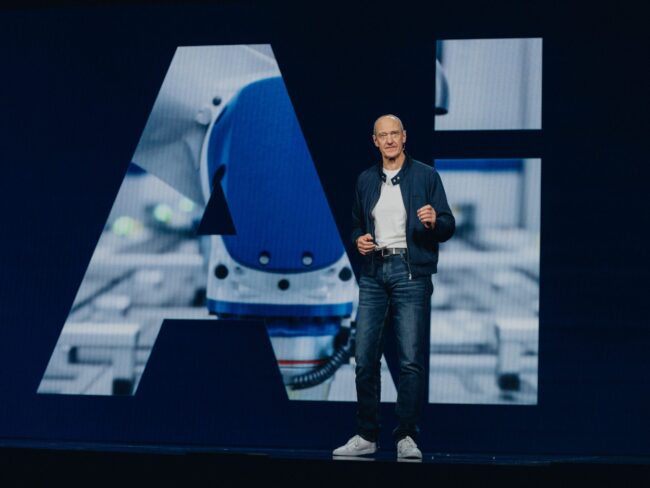
Siemens AG (ETR: SIE) used CES 2026 to unveil an aggressive expansion of its industrial AI strategy, announcing a new operating system developed with NVIDIA Corporation (NASDAQ: NVDA), the launch of its Digital Twin Composer software, and deployment of nine industrial copilots across its portfolio. These moves signal Siemens’ intent to embed AI-native capabilities deep into the industrial value chain—from design and production to supply chain and factory operations—positioning itself as a central player in the race for AI-driven automation across infrastructure and manufacturing.
How does the Siemens–NVIDIA Industrial AI Operating System shift the balance in automation and digital twin ecosystems?
The expansion of Siemens AG’s long-standing partnership with NVIDIA Corporation reflects a coordinated bid to consolidate control over the infrastructure layer powering the industrial metaverse. Their jointly developed “Industrial AI Operating System” aims to reimagine the full lifecycle of industrial systems using NVIDIA’s AI computing stack and Siemens’ embedded industrial software ecosystem. The OS is expected to orchestrate design, simulation, production, and real-time operations with a closed-loop feedback system leveraging digital twins and autonomous learning.
What distinguishes this platform play from prior digital twin architectures is the emphasis on real-world execution at scale. Unlike simulation-first environments, Siemens and NVIDIA plan to deploy AI-fueled adaptive manufacturing sites, beginning with Siemens’ Electronics Factory in Erlangen, Germany. The strategic implication is clear: by integrating NVIDIA’s generative AI models (like NIM and Nemotron) into core electronic design automation workflows, Siemens is aiming to collapse the simulation-to-production gap that has long hindered industrial scalability.
The collaboration also reinforces NVIDIA’s pivot into B2B infrastructure layers beyond graphics and gaming. With its full-stack AI platform now embedded into semiconductor, automotive, and industrial edge environments, NVIDIA gains an early-mover advantage in verticalized AI infrastructure.
How will Siemens’ Digital Twin Composer redefine simulation-driven decision-making for enterprises?
At the center of Siemens’ CES 2026 showcase was the upcoming Digital Twin Composer, set to launch on the Siemens Xcelerator Marketplace by mid-2026. This offering is designed to integrate real-time engineering data with NVIDIA Omniverse simulations, enabling enterprises to build high-fidelity digital twins that not only visualize but also anticipate outcomes across the product lifecycle.
The Digital Twin Composer lets users model a product, facility, or process in 3D, apply environmental and engineering variables, and simulate outcomes before committing capital. Early adopters like PepsiCo Inc. are already using the tool to digitally mirror warehouse operations. By replicating every physical asset such as conveyors, operator paths, and machine states with physics-level precision, PepsiCo reported a 20 percent increase in throughput and capital expenditure savings of up to 15 percent through better design validation.
The broader implication is that Siemens is building a feedback-rich industrial metaverse not just for monitoring but for proactive change management. Enterprises could iterate plant upgrades, test design alternatives, and simulate supply chain disruptions virtually, slashing lead times and reducing costly retrofits.
How are Siemens’ industrial copilots designed to embed AI across product development and manufacturing operations?
Siemens also announced nine new industrial copilots, building on its partnership with Microsoft Corporation. These AI copilots are being embedded in tools like Teamcenter, Polarion, and Opcenter to streamline product data navigation, automate compliance, and optimize shop-floor execution.
This marks a strategic shift from AI as an add-on analytics layer to AI as embedded operational infrastructure. By automating complex compliance workflows and reducing data retrieval friction in product lifecycle management, Siemens aims to cut regulatory delays and accelerate time to market.
However, the challenge lies in execution. Embedding copilots at scale across multiple software modules requires harmonization of data models, user interfaces, and domain-specific training. This is a non-trivial task given the diverse industry verticals Siemens serves. Integration fatigue and cross-platform inconsistencies could hamper adoption unless tightly coordinated across product teams and verticals.
Still, Siemens’ use of Microsoft’s CoreAI stack gives it an interoperability advantage over more siloed PLM players, especially for hybrid cloud deployments and compliance-heavy sectors like aerospace, pharmaceuticals, and automotive.
Can Siemens’ AI life sciences push challenge existing players in digital drug discovery?
Through its acquisition of Dotmatics and the integration of the Luma platform, Siemens is positioning itself to compete in the rapidly expanding field of AI-powered drug discovery. Luma enables life sciences customers to unify research data across instruments and labs, feeding it into Siemens’ simulation and modeling workflows for candidate screening and scale-up planning.
This plays to Siemens’ strengths in simulation fidelity and process automation, potentially reducing the cycle time for bringing therapies to market by up to 50 percent. However, the competitive terrain is crowded. Players like Schrödinger, NVIDIA’s BioNeMo, and Recursion Pharmaceuticals are also racing to become the orchestration layer of choice for AI drug design.
Siemens’ differentiator is its ability to virtualize both the molecule and the manufacturing process. This dual-layer modeling could appeal to CDMOs and large pharma players seeking to cut both R&D and capital expenditure exposure.
What are the broader industrial and consumer implications of Siemens’ AI deployment beyond the factory floor?
Siemens extended its AI strategy to wearable and hands-free formats by collaborating with Meta Platforms on integrating industrial AI into Ray-Ban smart glasses. These AR-enabled glasses are being designed to provide real-time guidance, safety alerts, and workflow prompts for frontline workers. The goal is to empower shop floor personnel with instant access to AI copilots, eliminating the latency and friction of traditional interfaces.
While still in pilot phase, this move signals Siemens’ ambition to dominate not just centralized automation but edge intelligence, where decisions must happen in real-time at the point of action. The form factor and interface challenges remain significant, but the partnership with Meta gives Siemens access to hardware ecosystems it historically lacked.
Meanwhile, Siemens is also targeting future energy applications through its partnership with Commonwealth Fusion Systems, using digital twin modeling and simulation platforms to accelerate fusion reactor design. In automotive, its PAVE360 system-level digital twin was on display in a real autonomous vehicle demonstration, underscoring the convergence of AI, simulation, and hardware design.
What execution risks and competitive pressures could undermine Siemens’ AI platform strategy?
Despite the momentum, Siemens’ AI platform strategy faces several material risks. First, integration risk across its vast software portfolio could dilute performance or slow rollout timelines. The diversity of industries and regulatory environments demands high configurability, which can become a bottleneck if not modularized effectively.
Second, competitive pressure from hyperscalers and specialist AI infrastructure firms may intensify as industrial customers become more comfortable with cloud-native stacks.
Third, capital allocation will come under scrutiny as Siemens transitions from incremental upgrades to more platform-scale investments. Maintaining shareholder confidence while pursuing multi-year AI infrastructure builds will require clear articulation of payback cycles and defensible margins.
Still, Siemens’ dual positioning as both the digital orchestrator and hardware enabler gives it a moat that few pure-play software companies can match. If it succeeds in converting these technologies into recurring revenue streams and deep customer lock-in, the upside could be transformational.
Key takeaways: what Siemens’ CES 2026 announcements mean for the future of industrial AI
- Siemens AG and NVIDIA Corporation are jointly developing an Industrial AI Operating System to close the gap between simulation and execution across manufacturing.
- The new Digital Twin Composer, set to launch mid-2026, brings together simulation, real-time engineering data, and physics-based modeling in one platform.
- PepsiCo’s use of Siemens’ AI-powered digital twins has already boosted throughput by 20 percent and reduced capital expenditure by up to 15 percent, validating early ROI.
- Siemens is deploying nine industrial copilots across its Teamcenter, Polarion, and Opcenter platforms, embedding AI into compliance, PLM, and operations workflows.
- In life sciences, the Dotmatics Luma platform is being combined with Siemens simulation tools to accelerate AI-based drug discovery and production scale-up.
- Siemens is exploring AR applications through Meta Ray-Ban smart glasses to extend AI copilots to the factory floor in real-time, hands-free environments.
- Execution risk remains high due to integration complexity, competitive pressure from cloud-native rivals, and the need to sustain capital investment cycles.
- If successful, Siemens could define the reference architecture for industrial AI—becoming the infrastructure layer for digital manufacturing, energy, and healthcare.
Discover more from Business-News-Today.com
Subscribe to get the latest posts sent to your email.