




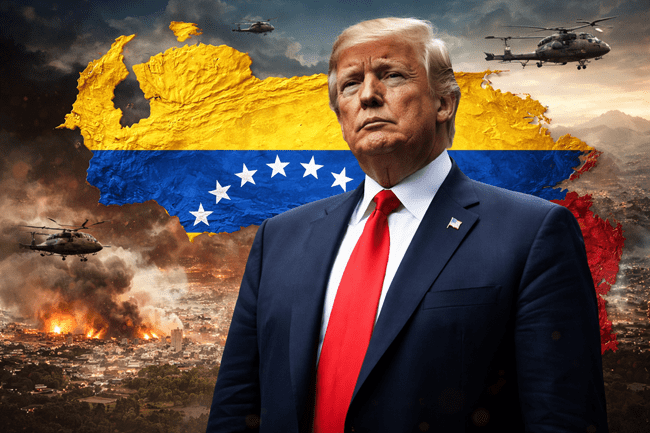
President Donald Trump has confirmed that the United States will temporarily govern Venezuela following the capture of President Nicolás Maduro, signaling the boldest foreign policy move of his second term. The announcement follows a coordinated military operation that led to the seizure of Maduro and First Lady Cilia Flores, with Trump stating, “We are going to run the country” until a stable, just, and democratic transition can be assured.
This marks a fundamental redefinition of U.S. posture in Latin America, moving from sanctions and proxy diplomacy to full-scale, U.S.-managed regime transition. For energy markets, global institutions, and constitutional scholars alike, the implications are immediate and far-reaching. Venezuela’s vast oil reserves are now squarely in the crosshairs of U.S. reconstruction plans—and with them, decades of contested sovereignty and political instability.
Why has Trump committed the U.S. to direct governance of Venezuela—and what’s the endgame?
Trump’s declaration that the U.S. will oversee Venezuela’s government is not merely rhetorical. Sources within the administration confirmed that civil-military control mechanisms are being drafted to oversee ministries, infrastructure, and resource management. The explicit objective is to “prevent a power vacuum,” as unnamed senior officials told Reuters, and to stabilize key energy infrastructure under U.S. protection.
The rationale leans heavily on three justifications: the pre-existing federal indictments against Maduro and inner circle members; the narco-terrorism designation of the regime; and a broader campaign to reassert U.S. influence in a region where Chinese and Russian presence has expanded rapidly. However, none of these rationales were debated in Congress prior to the strikes.
Instead, the Trump administration is operating under a broadened interpretation of executive war powers, citing national security emergencies and international law loopholes regarding criminal fugitives and failed states. No official timetable has been released for withdrawal or handover to civilian Venezuelan leadership.
What does U.S. occupation mean for Venezuela’s oil industry, and which American firms could benefit?
At the center of this intervention is Venezuela’s collapsing but resource-rich oil sector. With the Orinoco Belt among the largest untapped reserves in the world, Trump has openly stated that U.S. oil companies will be invited to help restart production and rebuild export capacity. Chevron Corporation and Halliburton Company, previously active under sanctions waivers, are seen as frontrunners for early reentry.
Venezuela’s oil production stood below 700,000 barrels per day in late 2025, a fraction of its early-2000s output. Years of underinvestment, expropriation, and infrastructure decay have rendered much of the country’s refining and pipeline networks inoperable. However, U.S. engineers with asset-specific expertise—particularly those with past PDVSA joint venture experience—are reportedly preparing initial assessment teams.
Yet this is no guaranteed windfall. Legal exposure remains high, with bondholders, ICSID arbitration claims, and expropriated partners all likely to file recovery actions. U.S.-managed oversight may ease operational risk but could increase reputational and litigation risk unless structured under a multinational stabilization framework.
How are global powers and multilateral institutions responding to Trump’s unilateral action?
The United Nations Security Council will convene Monday in response to the U.S. intervention, following strong statements from China and Russia condemning what they called an “illegal occupation.” Russia, a longstanding military and financial backer of Maduro, has denounced the capture as a violation of international norms. China has warned that it sets “a dangerous precedent.”
Western allies have issued more tempered responses. The United Kingdom has distanced itself from the operation but welcomed the prospect of a stable post-Maduro Venezuela. French President Emmanuel Macron described the event as “an inflection point,” while German officials emphasized the need for multilateral oversight and democratic institution-building.
In Latin America, reactions are sharply divided. Colombia and Brazil have expressed support, particularly with regards to regional security coordination and counter-narcotics enforcement. Mexico and Chile, however, have voiced concern over U.S. overreach and the lack of regional consensus. The Organization of American States (OAS) has called for an emergency session to assess legal frameworks and aid pathways.
What are the political risks for Trump, and how does this redefine second-term doctrine?
This is the most aggressive foreign policy action of Trump’s second term—and arguably the riskiest bet of his presidency to date. Strategists view it as an effort to consolidate geopolitical strength, shore up energy leverage, and rally his political base around muscular nationalism ahead of the 2026 midterms.
The domestic backlash, however, is mounting. Democratic leaders have accused Trump of bypassing congressional authority, calling it a violation of the War Powers Resolution. Even within the Republican Party, voices from the isolationist wing, particularly Senators aligned with the Freedom Caucus, have raised alarms over open-ended military governance.
Trump, for his part, appears unfazed. Speaking in Florida, he reiterated that “Venezuela will become a success story,” and vowed that American soldiers “would come home proud of what they did.” His remarks suggest that this will not be a short-term deployment, but rather a cornerstone project to “rebuild freedom and prosperity in our backyard.”
What happens next in Venezuela—and what metrics will define success or failure?
Trump’s team has yet to announce a provisional governing council or timeline for elections. While reports indicate that U.S. military forces are coordinating with remaining elements of Venezuela’s National Guard, it remains unclear whether a new political coalition is being assembled or if an international transitional authority is under negotiation.
Humanitarian aid delivery and civil infrastructure repair are expected to begin immediately. USAID and military engineers are reportedly en route to Caracas and Maracaibo, with additional staging in Curaçao and Colombia.
But key uncertainties remain. Will Maduro loyalists regroup and launch asymmetrical resistance? Will global financial institutions recognize contracts signed under U.S. interim rule? And most importantly, will the U.S. public and its allies support a military-led nation-building project at a time of increasing global fatigue toward open-ended deployments?
The answers may define not just Venezuela’s future—but the shape of U.S. power projection in the post-pandemic, resource-fractured geopolitical order.
What are the key takeaways from President Trump’s decision to govern post-Maduro Venezuela?
- President Donald Trump confirmed that the United States will govern Venezuela until a secure transition is achieved, following the military capture of Nicolás Maduro.
- The intervention reflects a hard break from prior U.S. policies toward Latin America, with oil, security, and regime change now openly linked.
- Major U.S. oil companies are being positioned to reenter Venezuela’s energy sector under American-led stabilization.
- Global responses range from condemnation by China and Russia to cautious support from European and Latin American partners.
- No clear exit strategy or civilian governance plan has been released by the Trump administration as of January 4, 2026.
- Legal risk, political blowback, and operational challenges could derail early gains unless international legitimacy is secured.
- Trump is framing the operation as a legacy-defining act of leadership and a rebuke to multilateral paralysis.
- The success or failure of this intervention will likely influence future U.S. interventions and geopolitical strategy under Trump’s second term.
Discover more from Business-News-Today.com
Subscribe to get the latest posts sent to your email.