


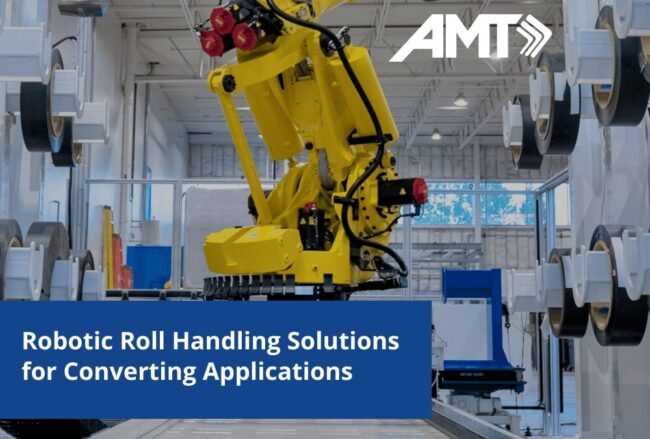
Applied Manufacturing Technologies, North America’s automation engineering specialist, is rolling out its latest solution for one of the most stubborn pain points in the converting industry: manual coil and roll handling. In December 2025, Applied Manufacturing Technologies (often known as AMT in industry circles, but here using its full name for clarity) announced the deployment of four advanced robotic roll handling systems at a prominent Midwest packaging converter, signaling a push to transform how converters manage their most physically demanding workflows.
This deployment, which comes at a time of rapid change for manufacturers facing persistent labor shortages and rising safety expectations, marks a pivotal shift for the region’s packaging sector. Applied Manufacturing Technologies’ systems are engineered to deliver a safer, more productive alternative to the manual handling of heavy, awkward rolls—a task long known to challenge both plant managers and health-and-safety teams. For packaging converters, where roll movement can mean anything from feeding massive film rolls to transferring finished products, the promise of consistent automation is no small offer.
Industry observers note that roll and coil handling has resisted the type of automation that has revolutionized other areas such as palletizing, machine tending, or end-of-line packing. While robots have quietly invaded other parts of the factory, this part of the workflow has typically lagged, often because of the sheer variety of roll sizes, pallet configurations, and unpredictable production schedules. As a result, safety incidents and productivity bottlenecks remain common in plants across North America.
What’s different about Applied Manufacturing Technologies’ approach to robotic roll handling and why does it matter for converters?
Applied Manufacturing Technologies is positioning its new systems as flexible, safety-driven solutions designed for the complex realities of today’s converting operations. According to Craig Salvalaggio, President at Applied Manufacturing Technologies, the goal was to reduce the physical burden on plant workers while freeing up skilled labor for higher-value tasks. He has emphasized that these systems are “engineered to improve throughput and allow customers to redeploy labor where it matters most,” reflecting a strong focus on practical impact rather than flashy tech for its own sake.
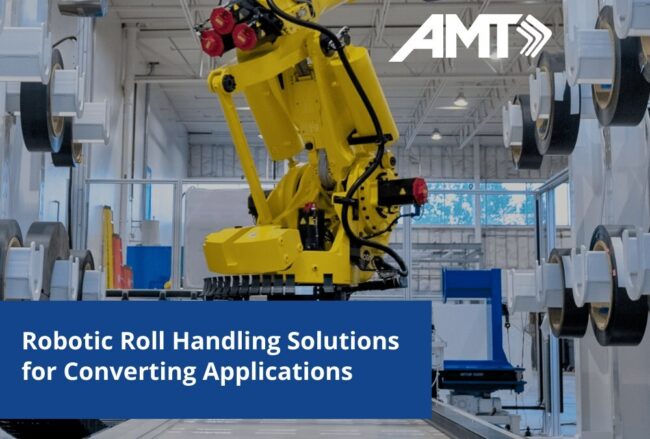
The system’s flexibility is a critical selling point. Tom Marx, Sales Account Manager at Applied Manufacturing Technologies, has stated that the roll handling systems were “designed to support the real-world demands of production,” handling a wide variety of roll types and pallet formats, and allowing for seamless changeovers without the need for specialized engineering. Each installation reportedly comes with programmable control options—either via a human-machine interface or pendant—and supports automatic tool-changers, barcode scanning, machine vision, and integration with infeed or outfeed equipment.
For operators and plant engineers, this level of adaptability means fewer headaches when production needs to shift on the fly. Optional integration with autonomous mobile robots (AMRs), conveyors, or even forklifts means that converters can build around their existing operations, rather than redesign entire lines to accommodate the robots.
How is Applied Manufacturing Technologies’ automation push changing the economics and labor profile of roll handling?
Analysts following the manufacturing automation sector believe this move is likely to accelerate a broader transition in the packaging and converting space. Historically, manual roll handling has been a notorious source of workplace injuries and high staff turnover, especially in high-volume operations. By automating these processes, Applied Manufacturing Technologies is not just selling a robot—it is offering converters a potential boost in both safety metrics and operating margins.
The company’s broader track record is also coming into focus. With over 25,000 automation systems deployed worldwide and more than 600 customers since its founding in 1989, Applied Manufacturing Technologies has built a reputation for tackling complex material handling challenges. The firm’s status as a FANUC Level V Authorized System Integrator further strengthens its credibility, particularly for manufacturers looking to future-proof their automation investments.
The new roll handling systems build on Applied Manufacturing Technologies’ experience in applications such as thermoformed product handling, line-side transfer, and machine tending—fields where the interplay of robotics, sensing, and motion control is crucial for success. For packaging converters trying to justify capital investment in automation, this pedigree matters.
What’s the market outlook for robotic roll handling as more converters chase efficiency and safety gains?
With the first four systems now in production at a major Midwest converter, momentum appears to be building for wider adoption. Market watchers expect demand for robotic roll handling to rise as manufacturers prioritize both safety and the need to make more efficient use of scarce labor. There is also growing interest in systems that can quickly adapt to new product formats or respond to shifting market trends—something that Applied Manufacturing Technologies is explicitly targeting with its “designed for your facility, not around it” approach.
The firm’s decision to exhibit at the 2026 Converters Expo in Green Bay, Wisconsin, underscores its ambitions to capture a larger share of the North American market. By showcasing real-world deployments and system features, Applied Manufacturing Technologies is betting that its blend of proven engineering and customer-focused design will resonate with plant managers under pressure to deliver results.
How are investors and industry insiders reacting to Applied Manufacturing Technologies’ latest move in automation?
While Applied Manufacturing Technologies remains a private company, institutional sentiment in the automation sector is increasingly upbeat as manufacturers push for smarter, safer, and more scalable solutions. The firm’s focus on flexible, user-friendly systems—rather than bespoke, high-maintenance installations—has drawn particular praise from industry consultants who see this as the likely direction for next-generation automation.
Some industry analysts believe that, as North American packaging converters compete to attract and retain labor, investments in systems like these could become standard, not optional, by the end of the decade. The broader sector is also likely to benefit as lessons learned from roll and coil handling migrate to other “last mile” automation bottlenecks in manufacturing and logistics.
What’s next for Applied Manufacturing Technologies and the converting industry as roll-handling automation scales up?
Looking ahead, the next six to twelve months will be pivotal for Applied Manufacturing Technologies as its roll handling systems undergo more extensive real-world testing at customer sites. Feedback from operators, maintenance teams, and plant managers will determine whether the firm’s focus on flexibility and ease of use pays off at scale. Success could see Applied Manufacturing Technologies expand its reach beyond the Midwest, potentially setting new standards for roll and coil handling across North America and internationally.
Applied Manufacturing Technologies’ booth at the upcoming 2026 Converters Expo in Green Bay will serve as a high-profile stage to demonstrate its latest innovations and engage with new customers. If the initial systems prove their worth, industry momentum may finally tip in favor of automated roll handling—a win for safety, productivity, and the bottom line.
Key takeaways: How Applied Manufacturing Technologies is changing roll handling in the converting sector
- Applied Manufacturing Technologies has introduced four robotic roll handling systems for the packaging and converting industry, targeting manual material handling bottlenecks that have long plagued converters.
- The new systems are operational at a leading Midwest packaging converter and are designed to handle diverse roll sizes, pallet types, and integrate with a range of automation, including autonomous mobile robots and conveyors.
- These solutions are engineered for flexibility and ease of use, enabling operators to manage changeovers and support production demands without needing extra engineering resources.
- Applied Manufacturing Technologies is leveraging decades of experience in robotics, palletizing, and machine tending to bring robust automation to a workflow area traditionally dominated by manual labor.
- By automating roll and coil handling, the firm aims to improve safety, increase throughput, and allow manufacturing plants to redeploy labor to higher-value roles—addressing a key risk area for workplace injuries.
- Market analysts highlight that roll handling has been one of the last holdouts in factory automation due to its complexity, but Applied Manufacturing Technologies is betting on a scalable, user-friendly solution to break this pattern.
- The company’s reputation as a FANUC Level V Authorized System Integrator, with over 25,000 automation systems delivered worldwide, bolsters confidence in its new offering.
- Industry sentiment is positive, with experts predicting that as labor shortages and safety standards tighten, more converters will adopt advanced automation for roll movement.
- Applied Manufacturing Technologies will showcase these robotic roll handling systems at the 2026 Converters Expo in Green Bay, signaling its intent to accelerate industry adoption and engage new customers.
- The next year will be pivotal as these systems face real-world production demands, and their success could set a new benchmark for automation in roll and coil handling across North America.
Discover more from Business-News-Today.com
Subscribe to get the latest posts sent to your email.