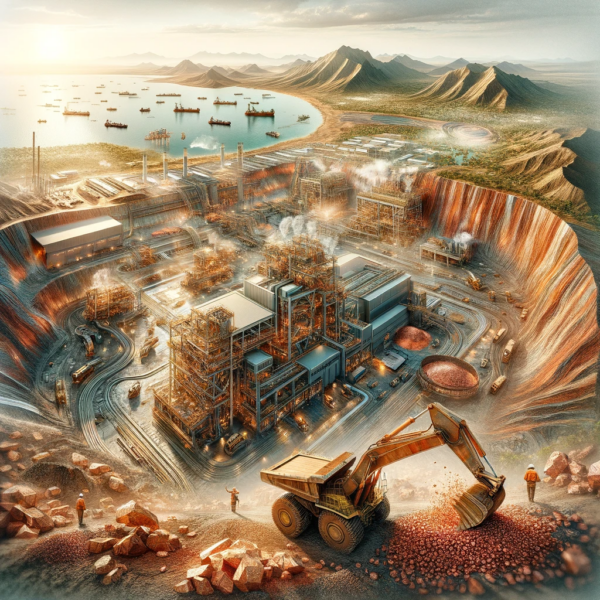




Global mining major Rio Tinto plc (LSE: RIO) used its 2025 Capital Markets Day to unveil a sweeping strategic reset built around operational simplification, disciplined capital allocation, and selective growth across its iron ore, copper, aluminium, and lithium divisions. The revised framework, positioned as making the mining group “stronger, sharper and simpler,” aims to unlock shareholder value by increasing productivity, exiting underperforming units, and accelerating development of high-potential projects like Simandou and Rincon.
Rio Tinto Chief Executive Simon Trott said the mining group was streamlining its global operations into three product-based verticals—iron ore, copper, and aluminium and lithium—while trimming non-core projects and tightening project discipline. Analysts following the miner believe this refocused structure could help drive sustained outperformance in an industry increasingly shaped by geopolitical risk, commodity price volatility, and decarbonisation mandates.
Rio Tinto’s stock price reflected cautious investor optimism. As of 14:34 GMT on December 4, the shares were trading at GBX 5,505, up 0.02 percent. While the day’s move was marginal, the broader trend is more telling. The miner’s shares have gained over 15 percent since mid-September, climbing from under GBX 4,800 to over GBX 5,500, as seen in the trailing twelve-month chart.
What long-term production gains and capital unlocks is Rio Tinto targeting through 2030?
Rio Tinto is projecting a compound annual production growth rate of 3 percent through the end of the decade, with a 7 percent increase expected in 2025 alone. This expansion is being driven by the staged ramp-up of strategic developments including the Oyu Tolgoi copper mine in Mongolia, the long-delayed Simandou iron ore project in Guinea, and lithium projects across Argentina.
Over the next five years, the miner expects to unlock between $5 billion and $10 billion in capital from its existing asset base. This monetisation will focus on infrastructure, land, and processing units where third-party funding can outperform Rio Tinto’s own cost of capital. Management confirmed that ongoing strategic reviews of the Iron and Titanium and Borates businesses are progressing, with the next phase involving direct market testing.
Executives emphasized that this is not a fire-sale, but a disciplined approach to value extraction. Commercial, partnership, and divestment options are being considered to rebalance risk and ensure that cash flow from mature assets can be redeployed into higher-return growth opportunities.
How is Rio Tinto transforming project execution across copper, lithium and iron ore?
Rio Tinto’s capital allocation strategy now revolves around three key operating themes: operational excellence, project execution, and capital discipline. The first wave of benefits is already visible. The company estimates $650 million in annualised productivity gains delivered within just three months of implementing its new structure.
These gains have been achieved by collapsing management layers, restructuring into three main product lines, and devolving accountability to asset-level teams. This has been accompanied by rigorous cost reviews and the discontinuation of lower-priority projects, studies, and programs.
In copper, Rio Tinto has raised its 2025 consolidated production guidance to 860–875 kilotonnes, up from 780–850 kilotonnes previously. The group also revised its unit cost guidance to 80–100 cents per pound, improving significantly from the earlier 110–130 cents per pound range.
The company’s lithium portfolio is being geared for medium-term scale. Ongoing projects are expected to deliver nearly 200 kilotonnes per annum of lithium carbonate equivalent capacity by 2028. Additional capital will only be committed if market conditions and return thresholds are favorable. Rio Tinto has committed to pacing lithium capex to avoid overbuild and safeguard margins.
What are Rio Tinto’s updated capex and production plans for 2025 and 2026?
For 2025, Rio Tinto expects to spend approximately $11 billion in capital expenditure. This figure remains unchanged for 2026, although the company emphasized that it intends to reduce mid-term annual capex to below $10 billion by 2028.
Rio Tinto has outlined updated production expectations across its key commodity verticals for both 2025 and 2026. Iron ore sales from the Pilbara region are projected at 323 to 338 million tonnes in both years, maintaining steady output as core infrastructure investments stabilize. The Simandou development in Guinea is expected to commence its first phase of production in 2026, contributing an estimated 5 to 10 million tonnes. Meanwhile, production from the Iron Ore Company of Canada has been revised downward for 2025, with the updated range now between 9.0 and 9.5 million tonnes. However, a rebound is projected for 2026, with guidance raised to 15 to 18 million tonnes on a 100 percent basis.
In the bauxite segment, Rio Tinto expects production in 2025 to exceed its earlier guidance of 59 to 61 million tonnes, suggesting improved operational throughput and stronger market alignment. Alumina production for 2025 is forecast in the range of 7.4 to 7.8 million tonnes, while aluminium output is projected to reach the upper end of the 3.25 to 3.45 million tonne guidance range for both 2025 and 2026, reflecting steady demand and operational resilience across Rio Tinto’s refining and smelting portfolio.
For lithium, Rio Tinto has released its first formal production guidance for 2026, estimating output at 61 to 64 kilotonnes of lithium carbonate equivalent. This forecast underscores the group’s growing ambition in energy transition materials and affirms the scale-up potential of projects like Rincon and the Arcadium joint venture in Argentina.
What structural changes is Rio Tinto making to balance emissions and capital deployment?
Rio Tinto has revised down its 2030 capital spending estimate for decarbonisation from the previous $5–6 billion to just $1–2 billion. This significant reduction is attributed to improved access to third-party renewable energy infrastructure and a more disciplined approach to funding emissions-reduction projects.
The company confirmed it will focus its capital spending on initiatives with clear return visibility, while allowing time for more complex decarbonisation technologies to mature. This conservative stance has been well received by institutional investors, many of whom view the move as a pragmatic balancing of ESG commitments and shareholder value.
The miner continues to target a 50 percent reduction in emissions by 2030 but intends to rely more heavily on energy developers to build the renewable capacity required to support this goal.
How does Rio Tinto plan to deliver stronger earnings and maintain shareholder returns?
Rio Tinto projects that its EBITDA could rise by as much as 40 to 50 percent by 2030, underpinned by 20 percent growth in copper-equivalent production volumes, improved asset productivity, and strong capital discipline. A key part of this upside will be earnings diversification, with a growing contribution from copper and aluminium.
Importantly, the group has reaffirmed its 40 to 60 percent shareholder payout ratio, a policy that has remained consistent for nine consecutive years. A conservative net debt position provides room for flexibility across cycles, allowing Rio Tinto to navigate commodity price swings without compromising its capital programs.
Investors are also watching closely for signals that Simandou will remain on schedule, and that lithium development will continue to match market demand. The combination of project reliability and earnings balance is viewed as key to attracting long-term institutional capital.
What is the institutional sentiment and share performance outlook for Rio Tinto plc?
As of December 4, 2025, shares of Rio Tinto plc were trading at GBX 5,505, reflecting a flat daily move but a strong upward trend over the past three months. The stock has rebounded from levels below GBX 4,800 in September to current highs, signaling renewed investor confidence.
Foreign institutional investors have gradually increased exposure in recent weeks, particularly on the back of the copper guidance upgrade and lithium strategy. Domestic institutional sentiment remains cautiously optimistic, with many funds holding steady allocations while waiting for first-half 2026 project updates.
Consensus analyst ratings for Rio Tinto currently skew toward a buy or accumulate position, with forward price targets ranging from GBX 5,800 to GBX 6,100. Analysts have flagged Simandou execution, lithium ramp timelines, and any potential spin-offs from the Borates or Titanium assets as key variables that could drive the next leg of share performance.
What are the key takeaways from Rio Tinto’s 2025 Capital Markets Day strategy?
- Rio Tinto plc unveiled a streamlined three-pillar strategy focused on operational excellence, disciplined capital allocation, and reliable project execution.
- The miner has consolidated operations into three world-class business verticals: Iron Ore, Copper, and Aluminium & Lithium, with a sharper focus on productivity and de-layered organizational structures.
- 2025 production growth is expected at 7 percent, with a longer-term compound annual growth rate of 3 percent projected through 2030, led by Oyu Tolgoi, Simandou, and lithium projects.
- The company expects to unlock $5–10 billion in capital from its existing asset base by divesting or restructuring underperforming assets, including its Iron and Titanium and Borates units.
- Copper production guidance for 2025 has been upgraded to 860–875 kilotonnes, while unit costs have been revised down to 80–100 cents per pound.
- First formal lithium production guidance issued for 2026 at 61–64 kilotonnes of lithium carbonate equivalent, with 200ktpa capacity targeted by 2028.
- Simandou iron ore output is expected to begin in 2026, contributing 5–10 million tonnes annually, as part of Rio Tinto’s long-term iron ore diversification strategy.
- Total group capital expenditure is forecast at approximately $11 billion for both 2025 and 2026, with mid-term annual capex targeted below $10 billion starting in 2028.
- The company has revised down its 2030 emissions reduction capital estimate from $5–6 billion to $1–2 billion, leveraging third-party renewable infrastructure.
- Earnings before interest, tax, depreciation and amortisation (EBITDA) is forecast to rise by 40–50 percent by 2030, supported by 20 percent copper-equivalent production growth and continued capital discipline.
- Rio Tinto reaffirmed its 40–60 percent shareholder payout policy and maintains a conservative net debt position, reinforcing financial resilience through commodity cycles.
- Institutional sentiment remains positive to neutral, with analysts highlighting copper, aluminium, and lithium as key drivers for medium-term upside, while watching project execution timelines for Simandou and Borates divestment.
Discover more from Business-News-Today.com
Subscribe to get the latest posts sent to your email.