





A breakthrough 529-metre intercept from Hot Chili Limited’s La Verde site in coastal Chile has reignited geological and investor attention toward a region long overshadowed by the high Andes. The so-called coastal porphyry belt, running parallel to the Andes along the Pacific margin, may be entering a new phase of relevance for copper and gold exploration. As global demand for both metals accelerates amid energy transition tailwinds and declining ore grades from legacy assets, the potential of Chile’s coastal range to deliver scalable, dual-metal systems is being re-evaluated.
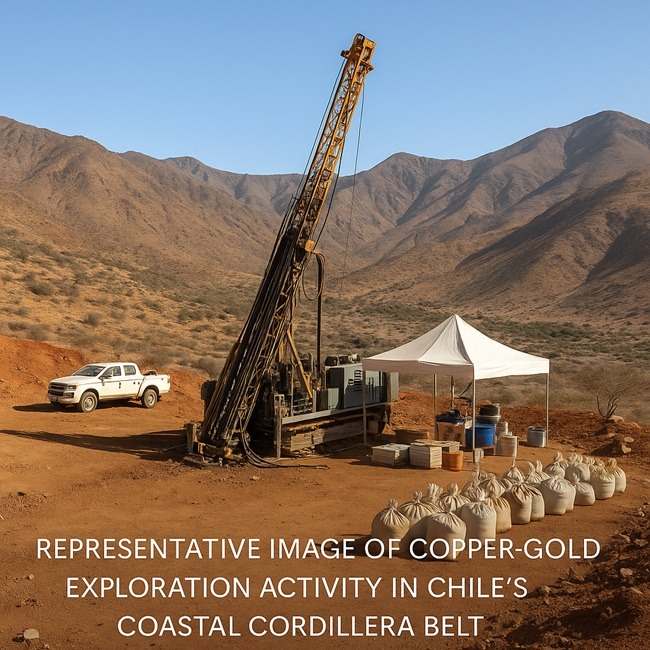
The latest drilling from La Verde confirms a significant copper-gold system, with diamond drillhole DKD032 returning 0.41 percent copper and 0.21 grams per tonne gold from 41 metres to 569.9 metres. Within that interval, Hot Chili Limited reported 148 metres grading 0.60 percent copper and 0.30 grams per tonne gold. These results extend both the vertical and lateral footprint of the mineralised system, building upon earlier reverse circulation drilling and confirming the presence of porphyry-style mineralisation over a broad footprint. All six diamond holes drilled into La Verde to date have intersected similar styles of mineralisation, suggesting a robust, vertically continuous system with potentially scalable tonnage.
This renewed success raises broader questions about whether Chile’s coastal porphyry belt is transitioning from a secondary geological curiosity into a primary target for future copper and gold production.
Why the coastal cordillera of Chile is gaining strategic interest for copper-gold exploration
The geological foundation of Chile’s coastal range differs meaningfully from the more widely known high Andean porphyry systems. The Coastal Cordillera, which extends along the country’s Pacific-facing margin, hosts a series of Jurassic to Cretaceous arc-related intrusions that are prospective for porphyry copper, iron-oxide copper-gold (IOCG), and stratabound copper deposits. Unlike the giant, deeply buried porphyry systems found in the central Andes, many coastal deposits are emplaced at shallower crustal levels. This structural distinction can translate to more accessible ore, lower stripping ratios, and reduced development timelines.
Historically, the coastal belt played an important role in Chile’s early copper development. However, as world-class discoveries such as Chuquicamata, Escondida, and El Teniente captured market and investor attention, exploration shifted decisively to the higher Andes. This pivot left large parts of the coastal range underexplored for deeper porphyry systems, particularly those with strong gold credits. The resurgence of interest in this belt reflects a growing recognition that these coastal systems may offer economically attractive alternatives to their high-altitude counterparts, especially in an environment where capital costs, environmental approvals, and development risk are all under intense scrutiny.
Exploration teams are increasingly prioritising near-coast projects that offer shorter logistical paths to port infrastructure, lower elevation operating environments, and less complex permitting compared to remote mountain jurisdictions. For Hot Chili Limited, whose Costa Fuego hub lies just 30 kilometres north of La Verde, the proximity of a new potential copper-gold satellite offers meaningful synergies in both processing and project sequencing. The La Verde result may therefore be more than a local win. It may be a broader indicator that Chile’s coastal porphyry belt is ready for a new era of dual-metal exploration focus.
How Hot Chili Limited’s La Verde result validates the coastal porphyry belt’s potential
The La Verde intercept is notable not just for its thickness but also for its consistency and high gold-to-copper ratio. The twin diamond drillhole DKD032 extended the original discovery made by reverse circulation hole DKP002 by 221 metres, confirming a deepening and strengthening of the mineralised zone. The final sample collected before the hole was prematurely terminated due to mechanical reasons still returned 0.53 percent copper and 0.20 grams per tonne gold, suggesting that the mineralisation continues at depth.
Importantly, the current footprint of the La Verde system, as defined by drilling to date, now spans approximately 1,000 metres by 750 metres laterally and over 400 metres in depth. Mineralisation remains open in multiple directions, both at depth and along strike. This supports the emerging view among exploration geologists that coastal systems can possess both vertical continuity and horizontal scale.
In addition to geological continuity, La Verde enjoys several infrastructural and strategic advantages. Its location within Chile’s Atacama region provides proximity to road access, power infrastructure, and port facilities. Moreover, its relationship to Costa Fuego offers integration potential into Hot Chili Limited’s processing and logistics strategy. The company has already indicated that material from La Verde could potentially be included at the front end of Costa Fuego’s 20-year mine schedule, providing higher-grade feed in the early years of production and improving project cash flows.
While further drilling is required to convert the discovery into a defined resource, the structural and metallurgical characteristics of La Verde align well with industry criteria for viable porphyry development. The project also benefits from dual-commodity exposure, offering both copper as a transition metal and gold as a countercyclical revenue hedge. This dual-metal composition is increasingly sought after by institutional investors looking for projects that combine energy transition fundamentals with long-term economic resilience.
Why investor appetite for coastal copper-gold plays is gaining ground
The La Verde case fits into a broader context of changing investor preferences. The traditional appeal of giant, remote Andean porphyries is being tempered by the realities of cost escalation, permitting delays, water scarcity, and geopolitical headwinds. In contrast, coastal projects offer a faster path to resource definition and, potentially, shorter development timelines.
The re-emergence of the coastal belt is also timely given current market conditions. Copper prices remain structurally supported by long-term supply deficits and rising electrification demand, while gold has proven resilient amid macroeconomic uncertainty. Dual-metal projects like La Verde that offer scalable copper with meaningful gold credits are increasingly viewed as high-value strategic assets.
Beyond Hot Chili Limited, other explorers are now targeting the coastal range. For example, Great Southern Copper has recently identified porphyry-style alteration and high-grade copper-gold-silver surface samples at its Viuda prospect, located in the coastal belt north of La Serena. These early-stage results point to growing interest in the belt not just from established players but also from new entrants.
Moreover, the concentration of smaller-scale deposits within the coastal corridor raises the possibility of future consolidation. Juniors with adjacent tenements could benefit from shared infrastructure, pooled capital, or joint development agreements. Investors have started to position ahead of such developments, favouring companies with extensive coastal land packages, proven mineralisation, and processing optionality.
What are the limitations and risks facing the coastal porphyry revival?
Despite growing optimism, the coastal belt is not without its challenges. One of the main constraints historically has been the limited scale of individual deposits. While systems like La Verde are proving that deeper porphyry targets exist, they may not rival the billion-tonne potential of deposits in the high Andes. As such, coastal projects may need to be aggregated or sequenced to reach comparable economic thresholds.
Geologically, the belt can also present complexity. Faulting, variable alteration patterns, and sedimentary cover can obscure the true extent of mineralised systems. Exploration success will depend on precise geophysical targeting, structural modeling, and step-out drilling strategies that can test the continuity and geometry of the porphyry bodies.
From a development standpoint, coastal proximity does not automatically eliminate environmental or community risk. Projects located near coastal ecosystems may face heightened environmental oversight, particularly around water use, biodiversity, and emissions. However, lower elevation, existing infrastructure, and the potential for seawater desalination provide some mitigation paths compared to more isolated inland sites.
Another key factor will be timing. For projects like La Verde to be fully de-risked and developed, a sustained favourable commodity cycle and consistent exploration success will be necessary. Any reversal in copper or gold prices could delay development timelines or reduce investor willingness to fund feasibility-stage studies.
Could the coastal belt emerge as a new supply pillar for the energy transition?
If drilling success continues and if resource conversion can be achieved at scale, the coastal belt may evolve into a second-tier supply engine that complements but does not directly compete with the high Andes. Its strengths lie in simplicity, access, dual-metal composition, and strategic proximity to export routes.
Hot Chili Limited appears well-positioned to capitalise on this shift. The company’s hub-and-spoke development model with Costa Fuego as a central hub and La Verde as a potential satellite mirrors successful strategies seen in other multi-asset districts. This setup allows for modular development, capital efficiency, and flexible mine planning that can respond to changing market conditions.
The market will closely watch the next batch of assays from La Verde, particularly those that extend mineralisation deeper or demonstrate lateral expansion. Investors will also be watching for resource updates, metallurgy results, and any signs of corporate interest or strategic partnerships.
If Chile’s coastal porphyry belt continues to deliver discoveries like La Verde, it could catalyse a broader reassessment of what constitutes a tier-one development opportunity in the global copper-gold landscape. The energy transition will demand a diversified and resilient supply base. Coastal Chile, long a geological footnote, may yet take centre stage in the next chapter of strategic metals exploration.
Share this:
Discover more from Business-News-Today.com
Subscribe to get the latest posts sent to your email.


