


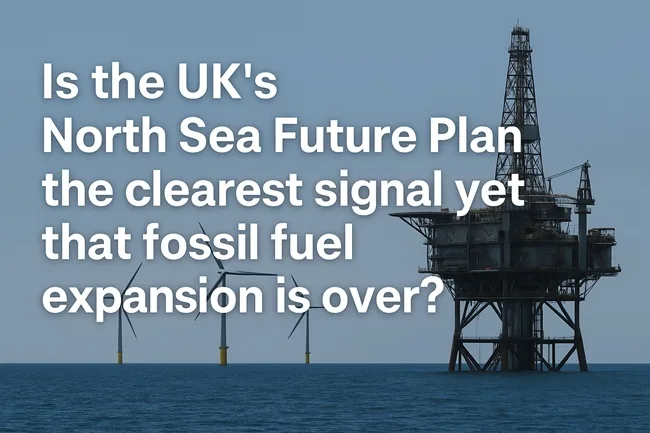
In one of the most consequential energy policy shifts in recent British history, the United Kingdom government has released the North Sea Future Plan, a sweeping strategy to manage the decline of the nation’s oil and gas industry while catalyzing long-term industrial transformation. The plan, unveiled on 26 November 2025 by the Department for Energy Security and Net Zero, formally confirms the UK’s decision to stop issuing new offshore exploration licences. At the same time, it introduces a transitional framework that aims to protect existing jobs and scale clean energy industries with more than £125 billion in combined public and private investment.
The North Sea Future Plan outlines a multi-decade commitment to managing the end-of-life production from existing oil and gas fields, boosting clean power capacity, and retraining fossil fuel workers to enter high-growth sectors like advanced manufacturing, defence, construction, and life sciences. According to Energy Secretary Ed Miliband, the plan is not only a climate-aligned strategy but also an industrial revival programme, designed to ensure that the North Sea remains an energy powerhouse for the 21st century.
The plan follows years of pressure from climate scientists, union leaders, and industry stakeholders who have sought clarity on the UK’s direction for its offshore energy sector. With fossil fuel production from the North Sea already in long-term decline, the new strategy marks a structural shift in the basin’s purpose — from extraction to transition.
What does the end of new North Sea exploration mean for UK energy security?
The government’s ban on new oil and gas exploration licences is now officially in force and covers both offshore fields in the UK Continental Shelf and new onshore oil and gas licensing in England. This includes a confirmed legislative ban on fracking and high-volume hydraulic fracturing for shale gas.
However, limited oil and gas production will still be allowed under a new mechanism called Transitional Energy Certificates. These certificates will apply only to projects that can be developed without new exploration and are linked to already licensed fields or adjacent areas through existing infrastructure tiebacks. The government has emphasized that such production must be essential to a managed, secure, and economically viable transition, not an expansion of fossil fuel activity.
This policy approach reflects an emerging consensus among climate institutions that new fossil fuel exploration is incompatible with the global 1.5°C warming limit, while acknowledging that some legacy production is still needed in the near term to manage energy supply, grid reliability, and employment in affected regions.
How the UK is linking fossil phaseout with industrial regeneration
Beyond the headline ban on new exploration, the North Sea Future Plan is focused on safeguarding workers and communities that have historically relied on oil and gas production. Over 70,000 jobs were lost in the North Sea oil and gas sector between 2016 and 2023, according to data from Offshore Energies UK. That backdrop has shaped the design of a new national career transition programme — the North Sea Jobs Service.
This programme will offer end-to-end support for workers shifting into new roles, including training, credentialing, and direct placement assistance in sectors that overlap with the oil and gas workforce’s skillsets. The Energy Skills Passport, which was initially piloted in Aberdeen, will now be expanded to include additional sectors like offshore wind, nuclear decommissioning, and electricity networks. Backed by up to £20 million in funding from both the UK and Scottish governments, the initiative seeks to avoid the kind of abrupt dislocation seen in past transitions.
Government analysis of Skills England data finds that 70 percent of the existing oil and gas workforce already occupies roles that are directly applicable to clean energy and other high-growth industries. In Scotland alone, the Clean Energy Jobs Plan forecasts a rise from 20,000 clean energy jobs in 2023 to 60,000 by 2030.
To institutionalize labour protections in this transition, the government will also roll out a new Fair Work Charter. This will apply to offshore wind developers and other publicly supported energy players, ensuring fair wages, strong workplace rights, and union representation as new projects come online.
What scale of investment is backing the North Sea’s industrial future?
The UK government is positioning the North Sea not as a site of decline but as the industrial engine of its clean energy ambitions. Since July 2024, over £62 billion in private capital has already been committed across the energy sector. To match that momentum, the government has pledged £63 billion in public spending through this Parliament, delivering what it calls the largest state-led clean energy investment cycle in British history.
Flagship areas of investment include carbon capture, hydrogen, offshore wind, port infrastructure, gigafactories, and green steel production. The government is allocating £9.4 billion for carbon capture, utilization, and storage, with major funding already committed to the Acorn and Viking projects in Scotland and the Humber. A further £500 million is earmarked for hydrogen infrastructure, including a regional hydrogen network targeted for operation by 2031.
Through the National Wealth Fund, at least £5.8 billion has been set aside for future-ready infrastructure, spanning ports, advanced manufacturing hubs, and zero-carbon transport nodes. Complementing these investments is the government’s modern Industrial Strategy, designed to support 1.1 million new well-paid jobs by 2035, especially in regions affected by the fossil fuel wind-down.
To help the private sector plan, the government has released a five-year North Sea infrastructure and supply chain pipeline, offering long-term project visibility for manufacturers, developers, and subcontractors.
What role will the North Sea Transition Authority now play?
The North Sea Transition Authority is being given a modernized mandate to align with the evolving nature of the basin. Historically focused on maximizing oil and gas recovery, the regulator’s mission will now be centered around three primary goals. First, to maximize economic value for society; second, to support the Secretary of State in meeting net-zero targets; and third, to secure long-term benefits for North Sea workers, supply chains, and coastal communities.
Chief Executive Stuart Payne described the new framework as a “next chapter” for the North Sea, noting that the regulator would now act as an enabling body to facilitate investment, retraining, and transition outcomes.
To oversee implementation, a new minister-led delivery board is being established, bringing together representatives from trade unions, industry bodies, and clean energy stakeholders. This board will meet regularly to coordinate progress, assess policy outcomes, and maintain cross-sector alignment.
How is this plan being received by unions, industry, and investors?
Early sentiment from unions has been cautiously optimistic, particularly in light of the Jobs Service and Fair Work Charter. Union leaders have long called for a national transition plan that centers workers rather than relegating them to afterthoughts. By embedding career retraining directly into the transition architecture, the plan appears to respond to that demand.
From an investment standpoint, clean energy developers have welcomed the plan’s clarity on supply chain timelines and the absence of policy whiplash. The certainty provided by the end of new exploration, combined with support for existing infrastructure-linked projects, gives developers and operators a more predictable regulatory environment.
Institutional investors focused on ESG mandates are likely to view the strategy as a climate-positive signal. However, some fossil-heavy asset managers have voiced concerns about accelerated decline scenarios for their North Sea holdings, particularly if tieback economics become unsustainable without new drilling.
Could the UK’s North Sea transition model influence other mature basins?
The UK joins a small but growing group of countries including Denmark, Ireland, and France that have legislated restrictions on new fossil fuel exploration. However, the North Sea Future Plan may stand out for its focus on industrial strategy and workforce integration rather than just environmental targets.
By embedding clean energy expansion, manufacturing investment, and job retraining into a single transition framework, the UK may offer a policy model for other mature producers looking to manage decline without economic collapse. Countries such as Norway and the Netherlands, which also rely on the North Sea basin, may take note of the UK’s attempt to make fossil fuel phaseout politically and economically durable.
Whether the North Sea can be transformed from an oil province into a hub for offshore wind, green hydrogen, and next-gen industrial ecosystems remains to be seen. But with the release of the North Sea Future Plan, the UK has taken a decisive step toward redefining the purpose of its offshore assets — from depletion to deployment.
What are the key takeaways from the UK’s North Sea Future Plan?
- The United Kingdom has officially ended the issuance of new oil and gas exploration licences in the North Sea and onshore England, including a legislative ban on fracking.
- Limited oil and gas output will continue under new Transitional Energy Certificates, which apply only to fields tied to existing infrastructure and do not require new exploration.
- The UK government has launched the North Sea Jobs Service to help fossil fuel workers transition into clean energy, defence, manufacturing, and life sciences roles, backed by £20 million in retraining funds.
- The Energy Skills Passport will be expanded to cover sectors like offshore wind, nuclear decommissioning, and network operations, helping workers shift between industries.
- The government has committed £63 billion in clean energy investment through this Parliament and has already unlocked over £62 billion in private sector capital since July 2024.
- The North Sea Transition Authority’s remit has been updated to prioritize societal economic value, net-zero goals, and long-term community and workforce benefits.
- A new minister-led delivery board will coordinate transition efforts, involving trade unions, industry experts, and clean energy developers to oversee implementation.
- Offshore wind developers receiving public funding will be subject to a new Fair Work Charter to ensure job quality, workplace rights, and union involvement.
- Scotland is projected to gain up to 60,000 clean energy jobs by 2030 under the Clean Energy Jobs Plan, tripling its 2023 workforce in the sector.
- The plan is being seen as a potential international model for other mature offshore basins managing fossil fuel decline, including Norway and the Netherlands.
Discover more from Business-News-Today.com
Subscribe to get the latest posts sent to your email.