




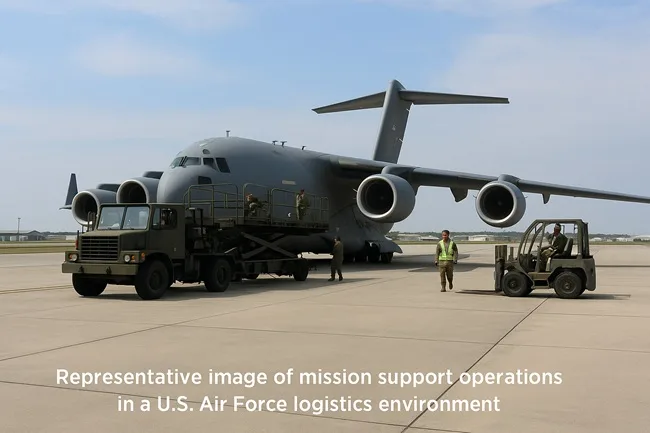
Why the $252 million Air Force deal could signal a turning point for mission support in U.S. defense
V2X Inc. (NYSE: VVX), a mid-cap American defense services integrator, has secured a $252.05 million contract from the United States Air Force, highlighting a strategic pivot in military procurement toward large-scale, outsourced mission support. The award, confirmed in November 2025, marks one of the company’s most significant wins of the year and positions V2X Inc. firmly within a rapidly expanding segment of the government services industry.
While headline-grabbing contracts are not unusual in the aerospace and defense ecosystem, this particular award suggests a broader trend is unfolding. U.S. defense customers are steadily shifting non-combat support functions such as base operations, logistics, and supply chain management to civilian contractors. Mission support, long treated as a background capability, is now emerging as a growth engine in its own right.
How V2X Inc. is capitalizing on the outsourcing of non-combat military operations
V2X Inc. has framed its services as delivering end-to-end solutions across the “mission lifecycle,” including base operations, logistics, engineering support, and digital modernization. The $252.05 million Air Force contract reinforces this positioning by confirming that U.S. military branches are increasingly relying on private sector providers for operational continuity outside of combat zones.
This shift is not merely about cost control. As military readiness becomes increasingly complex in a multi-domain threat environment, the ability to manage support services efficiently and at scale has become a strategic imperative. For V2X Inc., which emerged from the 2022 merger of Vectrus and Vertex Aerospace, the contract strengthens its posture as a prime player in the global defense logistics and mission support arena.
This latest award adds depth to an already robust backlog. As of mid-2025, V2X Inc. was managing a contract backlog valued at approximately $11.3 billion. Recent strategic moves, including its August 2025 acquisition to expand into cyber mission support, indicate that the company is diversifying beyond traditional logistics into high-priority, digitally-driven defense functions.
Why mission support services are gaining long-term strategic value in defense budgets
Several factors are converging to elevate mission support as a priority area for government defense spending. First, military leadership is increasingly focused on operational resilience, both in peacetime and conflict. As adversaries target infrastructure and supply chains as part of hybrid warfare strategies, mission support is no longer a secondary concern. It is now central to mission assurance.
Second, the Department of Defense continues to pursue a broader trend of contractor-enabled services, outsourcing functions that do not require uniformed personnel but are critical to maintaining readiness. These include facility management, IT infrastructure, maintenance, and logistics. In each of these areas, private contractors offer scalability, cost predictability, and increasingly, technological innovation.
Another factor is that as defense modernization efforts increasingly focus on artificial intelligence, predictive analytics, and digital command-and-control systems, contractors that can embed these technologies into mission support services are likely to gain a clear competitive edge. V2X Inc. has already begun positioning itself along these lines, with offerings that bridge physical and cyber domains across operational theaters.
Finally, mission support contracts tend to be longer-term and geographically dispersed, offering recurring revenue profiles that are appealing to investors, even if margins are tight. While net margins for many defense services firms remain in the low single digits, predictability of cash flow and backlog conversion often support favorable institutional sentiment.
What investors should know about execution risk, contract types, and margin sensitivity
Despite the scale and headline appeal of this Air Force contract, analysts remain cautious about the structural challenges that companies like V2X Inc. face in converting top-line contract wins into meaningful earnings growth. Net profit margins for the company remain narrow, hovering around 1.6 percent as per recent financial filings.
Execution risk is central to this business model. Labor-intensive contracts in multiple geographies introduce potential for schedule slippage, subcontractor disputes, and compliance exposure. For V2X Inc., with more than 14,000 employees and operational presence in over 200 locations across 28 countries, managing complexity is an operational challenge as well as a growth enabler.
Contract structure is another key variable. Awards under cost-plus contracts provide some cushion against inflation and supply chain volatility. However, firm-fixed-price contracts, while often larger in award size, leave little room for cost overruns. Investors will closely monitor the terms and performance metrics associated with the Air Force deal to assess whether V2X Inc. is capable of extracting incremental value without margin erosion.
This contract also comes at a time when federal appropriations remain uncertain, and defense budgets are undergoing increased scrutiny. Even with growing global tensions, sustained growth in mission support spending is not guaranteed. That puts added pressure on companies to show strong program execution, cash flow discipline, and contract renewal momentum.
How V2X Inc. compares with peers in the mission support services landscape
V2X Inc. operates in a competitive segment alongside other mid-sized integrators and diversified government contractors. These include KBR Inc., Amentum Services Inc., Parsons Corporation, and Science Applications International Corporation. What distinguishes V2X Inc. is its exclusive focus on mission support functions rather than weapon systems or hardware production.
While defense primes like Lockheed Martin or Northrop Grumman dominate combat systems, companies like V2X Inc. are focused on the logistical and operational layers that underpin day-to-day readiness. This specialization could become increasingly valuable as the Department of Defense looks for partners that can streamline and digitize base-level operations without the baggage of traditional defense manufacturing cycles.
At the same time, the firm faces structural headwinds. Compared to some of its better-capitalized peers, V2X Inc. carries lower operating margins and has faced scrutiny over insider selling activity. These concerns have weighed on the stock’s valuation, which remains modest relative to the size of its backlog.
To change that narrative, the company must deliver consistent margin improvement while scaling its offerings into emerging areas such as cyber logistics, AI-based predictive maintenance, and integrated sustainment platforms.
What signals will analysts and investors look for in the next V2X Inc. earnings cycle to judge whether mission support is translating into profitable growth?
Following the award, market observers will look for clear disclosures from V2X Inc. on the scope, timeline, and profitability profile of the new Air Force contract. This includes whether the contract introduces labor cost escalators, digital transformation elements, or subcontracting layers that affect margin contribution.
The next quarterly earnings call will likely offer updates on backlog composition, burn rate, and progress in converting awarded deals into recognized revenue. Investors will also track the company’s commentary on future bids, task orders under existing IDIQ vehicles, and whether the company is gaining traction in adjacent areas like intelligence mission support.
Crucially, investors will be watching for signs that V2X Inc. can turn backlog into margin expansion, not just revenue growth. In a sector where execution is everything, the company’s ability to outperform on deliverables while managing cost will define its trajectory through 2026 and beyond.
Discover more from Business-News-Today.com
Subscribe to get the latest posts sent to your email.