



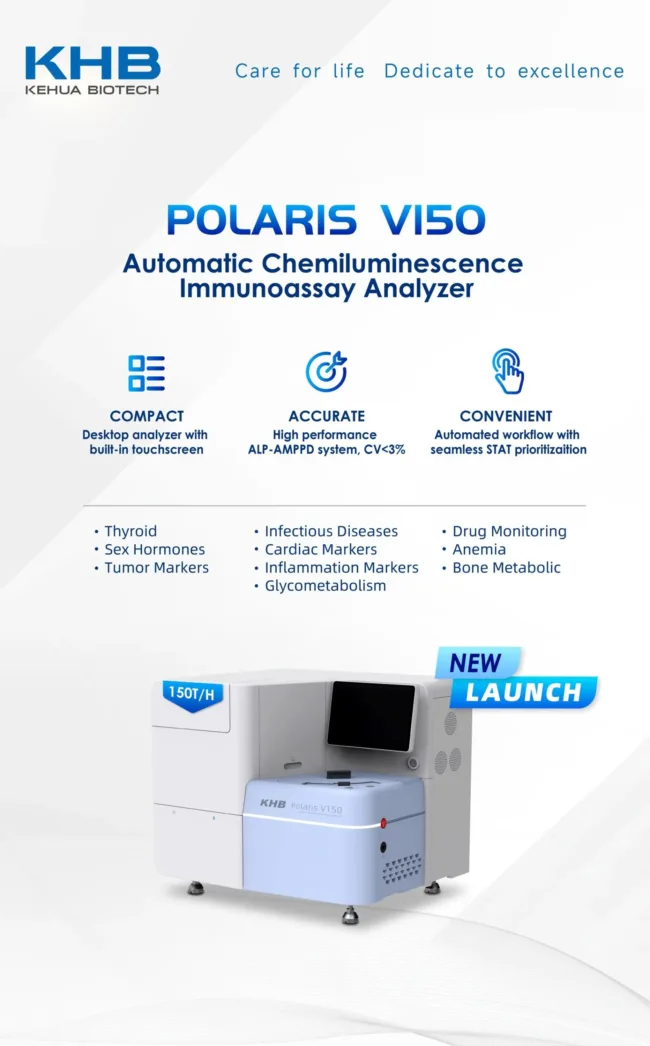
Shanghai Kehua Bio-engineering Co., Ltd. (KHB) (SZSE: 002022), an in-vitro diagnostics (IVD) manufacturer based in Xi’an, China, showcased its Polaris V150 Automatic Chemiluminescence Immunoassay Analyzer at MEDICA 2025, one of the world’s largest and most influential medical trade fairs. The Polaris V150 was a central highlight at the Shanghai Kehua Bio-engineering Co., Ltd. booth, underscoring the company’s continued focus on high-efficiency diagnostic solutions tailored for space-constrained laboratories and urgent care settings.
Unveiled to an international audience of laboratory professionals and healthcare stakeholders, the Polaris V150 represents a major step forward in miniaturizing high-precision chemiluminescence testing. Shanghai Kehua Bio-engineering Co., Ltd. has positioned the platform to serve the growing demand for intelligent diagnostic instruments that combine high throughput, minimal footprint, and robust operational autonomy.
By focusing on throughput, reagent intelligence, and compact engineering, Shanghai Kehua Bio-engineering Co., Ltd. is aiming to capture market share across small and medium-sized labs, emergency departments, and satellite diagnostic centers that require scalable and cost-effective immunoassay capabilities.
What features make the Polaris V150 a standout chemiluminescence analyzer for compact lab setups?
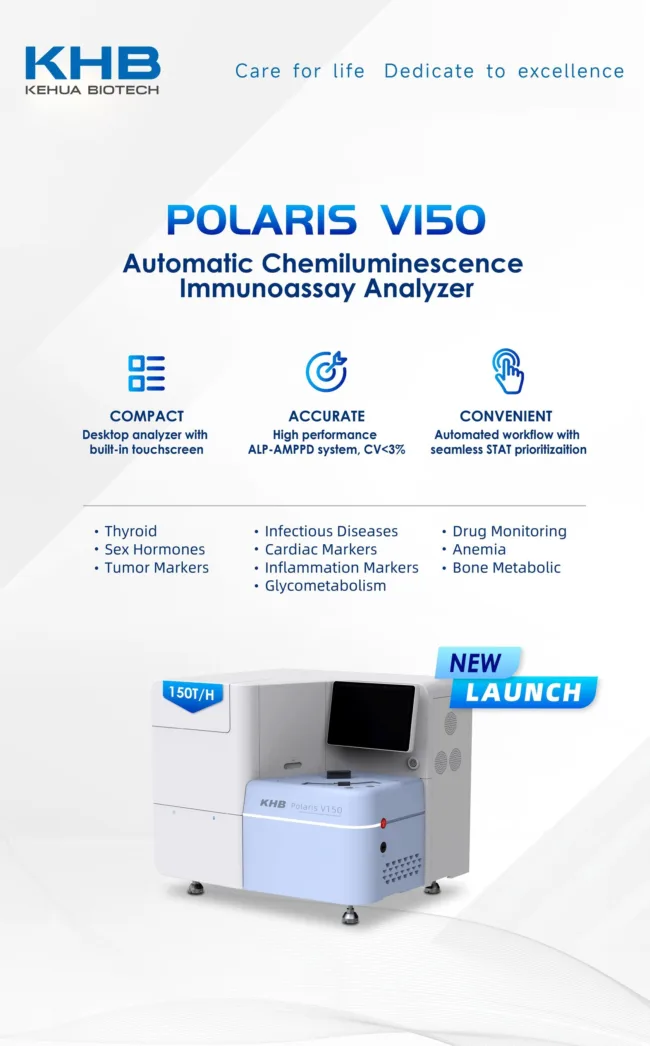
The Polaris V150 has been specifically designed to address the needs of decentralized laboratories where physical space is limited and operational efficiency is paramount. With a desktop footprint of only 0.36 square meters, the Polaris V150 incorporates a built-in touchscreen interface and fully self-contained system that does not require external computing hardware or controllers.
Shanghai Kehua Bio-engineering Co., Ltd. has emphasized that the system is ideally suited for smaller labs, third-party diagnostics providers, and STAT testing units within large hospitals. The form factor and user-centric design offer a versatile solution for environments where fast diagnostic turnaround and ease of operation are essential.
How does the V150’s throughput and automation help laboratories streamline diagnostic workflows?
Despite its compact size, the Polaris V150 delivers a testing throughput of 150 samples per hour. The platform features continuous loading capabilities for samples, reagents, and reaction cups, allowing laboratory staff to maintain uninterrupted workflows throughout the day. Its STAT function prioritizes urgent samples to ensure timely clinical decision-making, particularly in emergency or critical care situations.
The analyzer includes 40 sample positions and accommodates both serum and plasma. Features such as automatic dilution, real-time liquid-level detection, clot identification, and anti-collision safeguards help improve the reliability and safety of the testing process. These features reduce manual handling errors and streamline operations for labs operating under time and resource constraints.
What role does the ALP–AMPPD system play in ensuring high-precision assay results on the Polaris V150?
Shanghai Kehua Bio-engineering Co., Ltd. has equipped the Polaris V150 with a high-performance alkaline phosphatase–adamantyl 1,2-dioxetane (ALP–AMPPD) chemiluminescence system. This technology supports high sensitivity and precision across the analyzer’s testing menu, with a coefficient of variation of less than 3 percent across supported assays.
The system uses all-in-one reagent kits that include QR-coded calibrators and a pre-configured master curve. This design enables standardized assay performance across different installations while simplifying reagent handling. The reagent kits are ready-to-use and pre-labeled for traceability, further reducing setup time and user error.
Which diagnostic panels are supported by KHB’s reagent menu for the V150 platform?
The Polaris V150 is supported by an extensive in-house reagent portfolio developed by Shanghai Kehua Bio-engineering Co., Ltd., comprising over 60 assays spanning 10 major disease categories. The platform enables laboratories to run tests across a broad spectrum of diagnostic needs, including thyroid function, sex hormones, tumor markers, infectious disease serologies, cardiac biomarkers, glycometabolism, inflammation, anemia profiles, and bone metabolism.
By consolidating multiple high-value diagnostic panels into a single compact platform, the Polaris V150 enhances operational efficiency and reduces the need for multiple standalone systems. Shanghai Kehua Bio-engineering Co., Ltd. continues to expand the reagent menu with new markers aligned to evolving global diagnostic trends.
How is intelligent design improving lab usability and reagent visibility on the Polaris system?
In addition to analytical performance, Shanghai Kehua Bio-engineering Co., Ltd. has placed significant emphasis on usability and operational visibility. The Polaris V150 incorporates a real-time monitoring interface that tracks reagent and consumable status directly from the touchscreen. Laboratory personnel can assess operational readiness, reagent usage, and inventory levels without needing to access external software.
The intuitive interface design reduces the training burden for new users and helps standardize procedures across decentralized diagnostic networks. Shanghai Kehua Bio-engineering Co., Ltd. noted that usability was a key driver of partner engagement during live demonstrations at MEDICA 2025.
What maintenance and reagent stability features are built into the Polaris V150 for 24/7 uptime?
To support continuous laboratory operations, the Polaris V150 includes onboard refrigeration for up to 12 reagent positions. The built-in cooling system maintains a temperature range of 2 to 8 degrees Celsius to preserve reagent stability and performance integrity.
Other maintenance-related features include automated system cleaning protocols, remote performance monitoring, and smart service alerts. These tools allow laboratories to manage preventative maintenance schedules efficiently, while reducing downtime due to technical faults or operator oversight.
Shanghai Kehua Bio-engineering Co., Ltd. aims to reduce the total cost of ownership for laboratory clients by providing built-in maintenance automation that ensures consistent performance without manual intervention.
Why did the Polaris V150 generate strong partner interest at MEDICA 2025?
MEDICA 2025 served as a launch platform for the Polaris V150 and drew international interest from diagnostic service providers, hospital procurement teams, and distribution partners. Live demonstrations at the Shanghai Kehua Bio-engineering Co., Ltd. booth showcased the analyzer’s capabilities in real-time, with attendees exploring use cases for both routine and emergency testing environments.
According to the product manager at Shanghai Kehua Bio-engineering Co., Ltd., the high volume of inquiries and positive feedback at the exhibition reinforced the growing global demand for compact, fully automated chemiluminescence analyzers. The Polaris V150’s performance and flexibility attracted attention from stakeholders in both developed and emerging markets.
What strategic positioning does KHB aim for in the global IVD market with the Polaris platform?
Shanghai Kehua Bio-engineering Co., Ltd. has made diagnostic innovation a core pillar of its growth strategy. Since its founding in 1981 and listing on the Shenzhen Stock Exchange in 2004, the company has expanded its IVD product lines across immune, molecular, biochemical, and point-of-care testing categories. The Polaris V150 reflects its current push into scalable automation for decentralized diagnostics.
Analysts following the global IVD sector have noted increasing institutional interest in diagnostic platforms that offer high precision in compact, low-footprint formats. Shanghai Kehua Bio-engineering Co., Ltd. appears to be positioning the Polaris range to address this specific market need. With rising diagnostic volumes and a global shift toward near-patient testing models, compact systems like the Polaris V150 could become essential infrastructure in both public and private healthcare environments.
Shanghai Kehua Bio-engineering Co., Ltd. has also signaled continued investment in expanding the Polaris reagent menu, integrating connectivity features for LIS compatibility, and scaling international distribution through regional partnerships.
Key takeaways: Kehua Bio-engineering’s Polaris V150 launch at MEDICA 2025
- Kehua Bio-engineering introduced the Polaris V150 Automatic Chemiluminescence Immunoassay Analyzer at MEDICA 2025, targeting global labs seeking compact, high-precision platforms.
- The Polaris V150 has a desktop footprint of just 0.36 m² and delivers a throughput of 150 tests per hour, ideal for small to mid-sized labs and STAT testing environments.
- The platform features continuous loading, STAT prioritization, and built-in automation functions such as dilution, clot detection, and anti-collision safeguards.
- It uses ALP–AMPPD chemiluminescence technology with a CV < 3% and supports standardized QR-coded reagent kits with master curve calibration.
- Kehua Bio-engineering’s reagent menu includes over 60 assays across 10 diagnostic panels, covering thyroid, tumor, cardiac, infectious, and metabolic markers.
- The system integrates intelligent monitoring of reagents and consumables through a built-in touchscreen, reducing training and improving operational visibility.
- Onboard refrigeration and automated maintenance features enable 24/7 uptime with minimal service interruptions.
- MEDICA 2025 attendees showed strong interest in the Polaris V150, especially from hospital and diagnostic lab operators across multiple geographies.
- Kehua Bio-engineering is positioning the Polaris platform as part of its global strategy to support decentralized diagnostics and modular lab automation.
- Analysts view compact, high-efficiency platforms like Polaris V150 as critical infrastructure for the next phase of IVD expansion worldwide.
Discover more from Business-News-Today.com
Subscribe to get the latest posts sent to your email.