


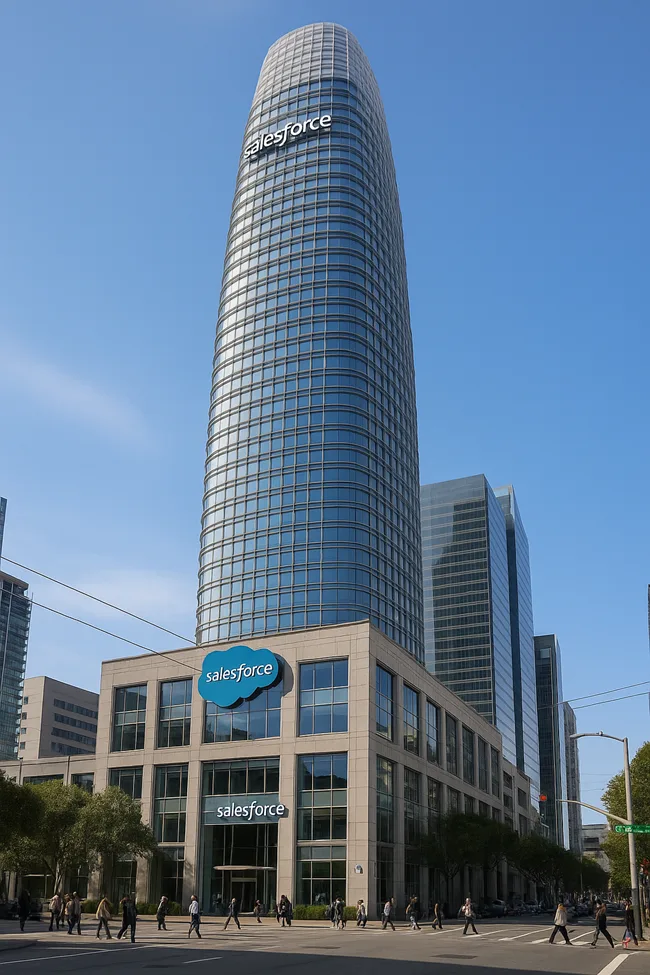
Salesforce, listed on the New York Stock Exchange under the ticker symbol CRM, has entered into a definitive agreement to acquire Spindle AI, a startup recognized for its work in agentic analytics and AI-native business modeling. The acquisition, announced on November 7, 2025, is expected to close in the fourth quarter of Salesforce’s fiscal year 2026, pending customary closing conditions. This strategic move is designed to expand the capabilities of Salesforce’s Agentforce platform by integrating real-time forecasting, agent observability, and decision scenario simulation.
Spindle AI was co-founded by Ryan Atallah, who previously founded ClearGraph, acquired by Tableau, and Carson Kahn, former founder and Chief Technology Officer of Volley ML, which participated in the JPMorgan In–Residence program. The startup has built a reputation around neuro-symbolic agents, AI-native infrastructure, and machine learning applications tailored for enterprise decision support. The acquisition will see Spindle AI’s core technology and engineering talent join Salesforce’s Agentforce division, with a focus on accelerating roadmap development in agent observability and self-improvement capabilities.
How will Spindle AI’s capabilities advance Salesforce’s Agentforce platform for enterprise AI?
According to Adam Evans, Executive Vice President and General Manager of the Salesforce AI Platform, the objective is no longer just to process vast amounts of data, but to make that data meaningful, interoperable, and actionable. Evans stated that Spindle AI’s deep bench of engineers and leaders would enable Salesforce to advance Agentforce’s ability to deliver dynamic, ROI-driven analytics and adaptive optimization at scale.
This acquisition aligns with Salesforce’s broader strategy to lead in agentic enterprise software, where AI agents operate semi-autonomously, continuously analyze outcomes, and self-correct based on observed performance. By bringing on Spindle AI, Salesforce aims to eliminate the persistent friction between business questions and data systems, empowering users to model and evaluate decisions with minimal technical overhead.
What makes Spindle AI’s scenario modeling platform different from legacy analytics stacks?
Spindle AI’s platform differentiates itself by leveraging AI-native data structures and neuro-symbolic agents capable of understanding natural language inputs and modeling their implications in seconds. Its core use cases include simulating pricing and packaging changes, optimizing go-to-market strategies, and recalibrating sales mix allocations. Rather than requiring data scientists to manually create models, the platform allows business teams to ask questions directly and receive scenario-based insights grounded in the company’s operational data.
Ryan Atallah, now set to join Salesforce’s Agentforce team, noted that Spindle AI was built to close the semantic gap between the questions enterprises want to ask and what their data systems can understand. He emphasized that the team spent years working through the most difficult technical challenges in analytics infrastructure, aiming to deliver systems that do not just compute outputs but also simulate strategic alternatives. Carson Kahn, who will become Chief AI and Product Officer within the Agentforce division, added that the next generation of AI platforms will be judged by their capacity to explain and improve their own reasoning, which is central to Spindle AI’s engineering philosophy.
Why does this acquisition signal a deeper shift toward autonomous analytics at scale?
Jayesh Govindarajan, Executive Vice President for Salesforce AI and the executive overseeing Agentforce, highlighted that this acquisition is not just about absorbing a tool, but onboarding proven technical leadership. He noted that Ryan Atallah and Carson Kahn have demonstrated expertise in multi-agent analytics, AI observability, and autonomous forecasting, which are key components in Salesforce’s vision for trustworthy AI-driven decision systems.
The Agentforce platform is being positioned as a foundational AI layer across Salesforce’s ecosystem, from Sales Cloud to Data Cloud and Slack. With Spindle AI integrated, Agentforce 360 will gain the ability to simulate business outcomes based on live enterprise data, enabling users to explore the impact of operational decisions in real-time. This includes forecasting revenue impact, reallocating sales targets, or even modeling cost structures based on macroeconomic changes.
The technology stack developed by Spindle AI is particularly aligned with enterprise demand for AI systems that are both autonomous and explainable. Businesses are increasingly seeking platforms that offer not just automation, but also transparency, auditability, and outcome validation. Spindle AI’s focus on neuro-symbolic reasoning and data-native architecture positions it to address these requirements at scale, which made it an attractive acquisition target for Salesforce.
What outcomes will Spindle AI be expected to deliver once the integration is complete?
Upon closing, the Spindle AI team will directly support the Agent Observability and Self-Improvement pillars of Agentforce 360. These features are designed to track the performance of AI agents in real-world deployments, simulate improvements, and adapt workflows to continuously optimize outcomes. Salesforce expects this will reduce reliance on manual model retraining or static rules, thereby delivering a more scalable and flexible AI platform to enterprise users.
The financial terms of the deal have not been disclosed, but industry observers interpret the transaction as a long-term bet on infrastructure-led innovation. While it may not produce immediate revenue uplift, the integration of Spindle AI is expected to sharpen Salesforce’s competitive edge in the enterprise AI space. Analysts tracking the software sector have pointed out that this move enhances Salesforce’s ability to compete with enterprise AI ecosystems being developed by Microsoft Copilot, ServiceNow Now Assist, and Google’s Vertex AI.
How are institutional investors responding to the acquisition and what are the key signals?
The investor response to the announcement has been measured. Salesforce’s stock has remained stable over the past five trading sessions, reflecting a cautious but supportive stance among institutional holders. Analysts believe that large-scale AI infrastructure integration often has delayed but compounding returns, especially when aimed at unlocking operational intelligence for Fortune 500 clients. Several market participants also indicated that the acquisition provides strategic depth rather than short-term earnings impact, which aligns with Salesforce’s ongoing shift toward platform consolidation.
The acquisition of Spindle AI follows Salesforce’s pattern of acquiring high-value, technical startups and embedding them into its broader platform roadmap. Previous moves like the acquisitions of Slack and MuleSoft have shown that Salesforce is comfortable making ecosystem bets that pay off over multiple product cycles. In the case of Spindle AI, the value lies in both the IP and the leadership that will now be driving core feature development for Agentforce.
What should the market watch for as Salesforce executes its Spindle AI integration roadmap?
Looking ahead, investors will be monitoring the rollout of new Agentforce capabilities linked to Spindle AI’s technology. Key performance indicators may include the uptake of dynamic forecasting tools, customer adoption of AI-modeled scenario planning features, and improvements in sales team efficiency tied to automated agentic insights. There is also speculation that Salesforce could use this integration to develop vertical-specific forecasting modules, targeting industries like healthcare, retail, and financial services.
As AI adoption continues to grow across industries, businesses are seeking more than just passive data dashboards. They need platforms that can autonomously suggest, simulate, and justify decisions in the face of growing complexity and compressed decision cycles. Spindle AI’s integration into Salesforce Agentforce marks a significant step in that direction, with implications that extend well beyond traditional analytics.
Key takeaways: Salesforce’s Spindle AI acquisition and its implications for agentic analytics
- Salesforce (NYSE: CRM) has signed a definitive agreement to acquire Spindle AI, with the transaction expected to close in Salesforce’s fourth fiscal quarter of 2026, subject to customary closing conditions.
- Spindle AI’s founders Ryan Atallah and Carson Kahn will join Salesforce’s Agentforce division to lead development of agent observability and self-improvement capabilities inside Agentforce 360.
- The acquisition brings neuro-symbolic agentic analytics and AI-native data modeling to Agentforce, enabling scenario modeling, ROI forecasting, and fast what-if simulation for pricing, go-to-market strategy, and sales mix optimization.
- No financial terms were disclosed, and the deal is viewed as an infrastructure and talent bet intended to strengthen long-term platform differentiation rather than deliver immediate revenue uplift.
- Institutional sentiment around Salesforce remains steady, with the stock trading in a narrow range as investors await evidence of feature integration and enterprise adoption.
- Key adoption and execution signals for investors to monitor include customer uptake of dynamic forecasting modules, usage metrics for AI-modeled scenario planning, measurable improvements in sales team efficiency tied to agentic insights, and any vertical-specific product launches.
- The move increases Salesforce’s ability to compete with other enterprise AI ecosystems such as Microsoft Copilot, ServiceNow Now Assist, and Google Vertex AI by adding explainability, observability, and autonomous optimization to its AI stack.
- The strategic value of the acquisition lies in combining Spindle AI’s IP and engineering leadership with Salesforce’s scale to deliver trustworthy, explainable agentic analytics across large enterprise customers.
Discover more from Business-News-Today.com
Subscribe to get the latest posts sent to your email.