

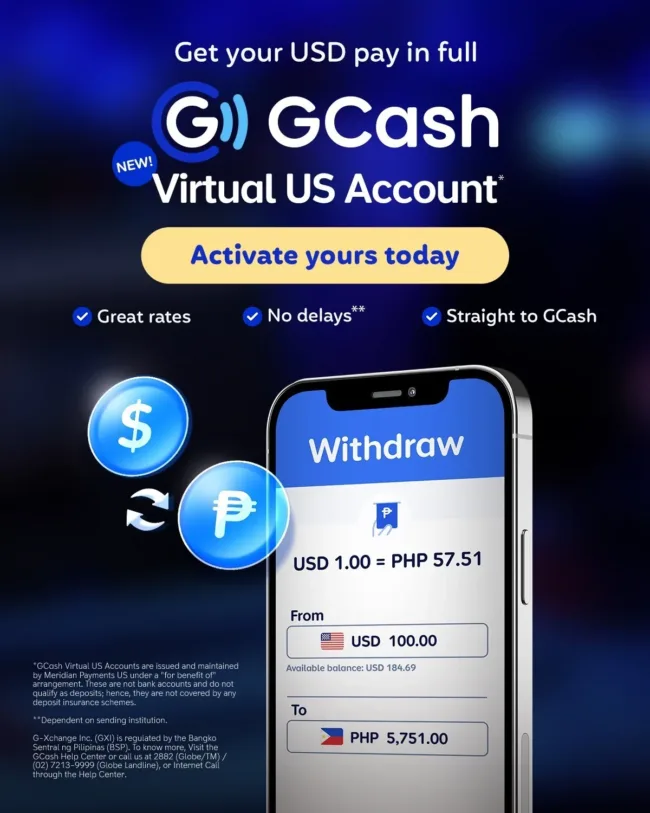
GCash, the leading fintech super app in the Philippines, has launched a new feature that could redefine how Filipinos receive US Dollar payments and remittances. The GCash Virtual US Account allows users to receive USD payments directly into their GCash wallets without requiring a U.S.-based bank account. The feature is powered by Meridian1, a global payments network, and is designed to eliminate costly transaction fees, reduce forex losses, and offer immediate access to funds for freelancers, gig workers, and families relying on remittances from the United States.
The launch is being positioned as a transformative step in expanding digital financial access and enabling a more efficient remittance model for the country’s remote workforce and overseas Filipino community. With remittances from the United States comprising nearly 40 percent of total remittance inflows into the Philippines from January to August 2025, according to data from the Bangko Sentral ng Pilipinas, the feature is expected to significantly impact how money is sent, received, and used across borders.

How does GCash’s new Virtual US Account make receiving USD remittances faster and cheaper?
The GCash Virtual US Account enables verified GCash users to receive USD funds instantly and hold the currency within their wallets. Unlike conventional remittance services that automatically convert foreign currency into pesos upon receipt, the new feature allows users to manage when and how they convert their USD to PHP. This gives them greater flexibility in timing their conversions to benefit from favorable exchange rates while avoiding unnecessary currency conversion losses.
According to GCash General Manager for International Paul Albano, the service is designed to help users maximize their income by letting them hold US Dollars and convert only when needed. This approach not only minimizes conversion costs but also provides users with a higher degree of financial autonomy. For Filipino freelancers, this change is particularly impactful. Historically, gig workers have faced significant deductions in their income due to platform charges, bank withdrawal fees, and uncompetitive forex rates. The GCash Virtual US Account effectively removes several of these barriers, allowing more of their hard-earned income to reach their pockets.
Why is the gig economy central to the rollout of USD receiving features like this one?
The feature is also likely to drive broader adoption across the Philippine digital economy. GCash has made the service available to fully verified users only, ensuring that identity verification and compliance mechanisms are in place. This also aligns with the platform’s ongoing efforts to integrate underbanked and unbanked Filipinos into the formal financial system using mobile-first solutions. Unlike traditional remittance services that often require trips to physical branches or cash-out locations, GCash allows users to manage everything within a single digital interface.
What is Meridian1’s role in powering the back-end of GCash’s Virtual US Account?
The technological backbone of the feature is provided by Meridian1. It is important to clarify that the Virtual US Accounts issued to GCash users are not U.S. bank accounts in the traditional sense. They are issued by Meridian Payments US under a “for benefit of” arrangement, which means they function as custodial accounts rather than personal checking or savings accounts. As such, these accounts are not insured under deposit protection schemes like the Federal Deposit Insurance Corporation. However, they are optimized for transactional efficiency, specifically designed to route USD transfers into users’ GCash wallets without engaging legacy SWIFT systems or involving multiple intermediary banks.
For most users, the absence of deposit insurance is unlikely to be a major deterrent, as the accounts are not intended for long-term savings but rather for near-instant payments and conversions. The partnership with Meridian1 reflects a broader fintech trend toward embedded financial infrastructure that enables faster, cheaper, and more transparent cross-border transactions. This model is already being used by international platforms such as Wise and Revolut, and its deployment by GCash signals growing maturity in the Southeast Asian digital finance ecosystem.
How are analysts and investors viewing this move within the Philippine fintech space?
The move is also expected to reinforce GCash’s leadership position in the local fintech sector. The platform is operated by Mynt, a joint venture backed by Ant Group, Globe Telecom, and Ayala Corporation. Although GCash itself is not publicly traded, Mynt is considered one of the most valuable fintech startups in Southeast Asia and is often tracked by institutional investors for its growth potential. Analysts believe that the Virtual US Account feature adds a new layer of monetizable functionality to GCash’s ecosystem. It is likely to increase user retention, raise average wallet balances, and generate new revenue streams via currency conversion margins, without alienating users through hidden fees.
Investor sentiment around Mynt’s expansion strategy has remained strong, particularly in the wake of its previous partnerships and product rollouts aimed at digital lending, insurance, and micro-investments. The addition of a cross-border USD receiving capability positions the company more competitively against global players like Payoneer and regional fintechs such as PayMaya and SeaMoney. For users, it offers a seamless alternative to traditional bank wires or remittance agents and may gradually reduce reliance on platforms that charge higher fees for similar services.
How could GCash’s Virtual US Account reshape personal remittance flows into the Philippines?
The impact of the GCash Virtual US Account extends beyond freelancers. Overseas Filipino Workers, many of whom send remittances monthly or even weekly, will also benefit from the streamlined process and reduced fees. These inflows are a cornerstone of the Philippine economy, contributing over USD 36 billion in personal remittances in 2024 alone. By enabling a more direct and cost-effective channel for USD transfers, GCash may help the country retain more of this inflow within its formal digital financial system. This, in turn, could support national goals around digital inclusion, economic resilience, and financial literacy.
Looking ahead, GCash is expected to explore additional corridor expansions beyond the United States. Other regions with significant Filipino populations such as Canada, the Middle East, and Europe may be next in line for similar service rollouts. If successful, the Virtual US Account model could serve as a blueprint for future innovations in remittance and cross-border gig economy payments.
Why GCash’s USD account model may signal a larger remittance infrastructure shift in Asia
In summary, the GCash Virtual US Account marks a pivotal evolution in how digital wallets can be leveraged for real-time, low-cost, international money transfers. It responds to urgent user needs, strengthens GCash’s competitive position, and could usher in a new era of remittance infrastructure for emerging markets. By removing traditional barriers such as banking access, fee transparency, and forex inefficiencies, the new feature positions GCash to set the benchmark for mobile-first financial inclusion across Southeast Asia.
What are the key takeaways from GCash’s launch of Virtual US Account for USD remittances?
- GCash has launched a new Virtual US Account feature, allowing Filipinos to receive USD payments directly into their GCash wallets without needing a U.S. bank account.
- The feature is powered by Meridian1 and uses a “for benefit of” custodial account model, bypassing traditional SWIFT-based systems and costly intermediaries.
- Users can hold US Dollars in their e-wallet and convert to Philippine pesos only when needed, helping them avoid unnecessary forex losses.
- The service eliminates withdrawal fees and hidden charges typically associated with freelance income or cross-border remittance platforms.
- This offering is targeted at freelancers, gig workers, and Overseas Filipino Workers who routinely receive income from U.S.-based sources.
- GCash requires users to be fully verified before accessing the service, reinforcing compliance and KYC standards.
- Analysts expect the feature to boost wallet balances, improve platform stickiness, and generate new revenue streams through optimized forex spreads.
- Institutional sentiment around Mynt, the parent company of GCash, remains positive as it expands embedded financial services for unbanked and underbanked users.
- The feature is expected to increase formal USD inflows into the Philippines, where U.S. remittances accounted for around 40 percent of total remittance volumes in early 2025.
- GCash may extend the model to other high-remittance regions such as the Middle East, Canada, and Europe, potentially setting a precedent for mobile-first remittance infrastructure across Southeast Asia.
Share this:
Discover more from Business-News-Today.com
Subscribe to get the latest posts sent to your email.