




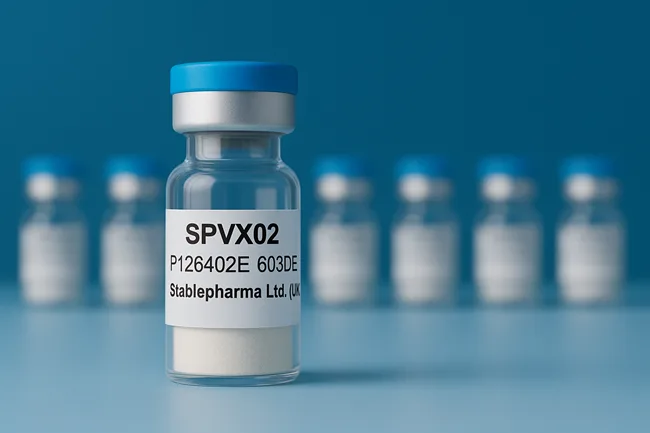
London-based biotech innovator Stablepharma Ltd has completed a key milestone in its push to transform global vaccine logistics, locking the clinical database for its Phase I trial of SPVX02, the world’s first thermostable tetanus-diphtheria (Td) vaccine candidate. With data analysis now underway, the trial marks the company’s most significant step yet in proving the viability of its flagship StablevaX technology in human use.
The milestone follows a six-month clinical effort involving 60 healthy adult volunteers across two United Kingdom sites, which include the NIHR Southampton Clinical Research Facility and the Medicines Evaluation Unit in Manchester. The trial was led by Professor Saul Faust, one of the UK’s most experienced vaccine researchers, and focused on evaluating SPVX02 for safety, tolerability, and immunogenicity compared to licensed comparator vaccines.
How does the Phase I database lock bring StablevaX closer to real-world impact?
Database lock in clinical trials signals that all patient data has been verified, collected, and finalized for statistical review. This marks the transition from active trial conduct to results interpretation. For SPVX02, this milestone represents validation of both the scientific platform and the operational execution that underpins Stablepharma’s strategy to deliver climate-resilient vaccine solutions.
SPVX02 is the first human trial candidate built using the company’s proprietary StablevaX platform, which reformulates existing vaccines to remain stable at high temperatures, including 40°C and above, without refrigeration or freezing. According to the World Health Organization, more than 50 percent of vaccines are wasted each year due to cold-chain failures. This creates urgency for thermostable alternatives.
“Achieving database lock is a critical step on our path to delivering a new generation of thermostable vaccines that can remove the need for cold-chain storage worldwide and reduce unnecessary cost and wastage,” said Ozgur Tuncer, Chief Executive Officer and Executive Director of Stablepharma. He credited the company’s scientific and operational teams, led by Chief Development Officer Dr Karen O’Hanlon and Development Project Manager Juana de la Torre Arrieta, for bringing the project to this stage.
Stablepharma now moves into the data analysis phase, with top-line results expected to inform the design of its pivotal Phase 2/3 confirmatory trial.
What sets the StablevaX platform apart from other thermostable vaccine approaches?
As previously covered by Business News Today in a July 2025 interview with Dr Karen O’Hanlon, Stablepharma’s platform takes a reformulation-first approach that allows the original antigen and adjuvant compositions to remain unchanged. This contrasts with vaccine development models that rely on new delivery vectors or complex encapsulation systems, which often face longer regulatory timelines.
StablevaX instead focuses on embedding existing vaccines into a proprietary stabilizing matrix within a pre-filled syringe. The result is a ready-to-reconstitute format that can be stored, shipped, and administered in environments where temperature excursions are unavoidable. This includes remote field clinics and post-disaster zones.
“Our technology enables significantly shorter development timelines,” Tuncer noted in the official statement. “Because the core components are unchanged and the CMC process is GMP validated, regulatory pathways are streamlined. This allows fridge-free vaccines to reach the market faster and at lower cost.”
In previous remarks to Business News Today, Dr O’Hanlon emphasized how StablevaX aligns with emerging global health priorities. These include the need to reduce cold-chain vulnerabilities, which became increasingly visible during the COVID-19 pandemic.
What is the structure of the Phase I SPVX02 trial and how were endpoints defined?
The Phase I trial for SPVX02 was a randomized, single-blind, comparative study involving 60 healthy adult participants. Each subject received either SPVX02 or one of two licensed tetanus-diphtheria vaccines already approved in the European market.
The primary endpoints focused on safety and tolerability. These measured local and systemic adverse reactions after administration. The secondary endpoints evaluated immunogenicity through antibody response profiling, which will be assessed after the ongoing statistical review concludes.
The trial design was shaped to reflect real-world use scenarios, ensuring that the data collected would be relevant for future scale-up and international regulatory engagement.
What are Stablepharma’s plans for the upcoming Phase 2/3 trial?
Looking ahead, Stablepharma has outlined a plan for a pivotal Phase 2/3 confirmatory trial, which will further evaluate SPVX02’s safety and immune response in a larger population. The trial will involve two cohorts. One group will receive SPVX02, while the other receives a licensed comparator vaccine. The study will be conducted across approximately 10 sites in the United Kingdom and Spain.
This next phase will be managed by PPD, a Thermo Fisher Scientific company. It is designed as a non-inferiority study, meaning SPVX02 must demonstrate comparable efficacy to existing vaccines while offering the added benefit of thermostability.
“This is not just about scientific novelty. It is about solving real distribution problems in global health,” said Dr O’Hanlon in the prior Business News Today interview. She noted that thermostable vaccine platforms like StablevaX are especially critical for regions with weak power infrastructure, humanitarian supply chains, and unpredictable ambient temperatures.
How is the SPVX02 thermostable vaccine program being funded and what is the UK government’s role?
The Phase I trial of SPVX02 was funded by a Smart Grant from Innovate UK, a competitive research funding program under the United Kingdom’s public innovation agency UK Research and Innovation. The grant supports projects with strong potential to deliver economic impact, scientific innovation, and societal value.
In the context of public health, funders are increasingly supporting platforms that reduce systemic risk and operational cost. Thermostable vaccines fit directly into this priority area, particularly as national health systems search for pandemic-proof supply chains and climate-adaptive healthcare technologies.
Stablepharma’s ongoing engagement with UK Research and Innovation also positions it well for future collaborations. These could involve global nonprofits, health ministries, or development finance institutions focused on healthcare delivery in resource-constrained environments.
Why does SPVX02 matter in the broader fight against vaccine wastage and cold-chain dependency?
Stablepharma’s breakthrough with SPVX02 is not occurring in isolation. It is part of a broader shift toward climate-resilient medical infrastructure where cold-chain fragility is no longer an acceptable constraint on access.
Thermostable vaccine technologies are gaining traction as essential tools for pandemic response, immunization campaigns, and emergency health deployments. As countries adopt more decentralized and flexible healthcare delivery models, the ability to administer vaccines without refrigeration becomes a critical advantage.
By demonstrating early-stage success with a widely used antigen pair like tetanus and diphtheria, Stablepharma has created a foundation for expanding the StablevaX platform to other targets. These may include hepatitis, rabies, and potentially mRNA-based constructs.
With its Phase 2/3 trial approaching, the biotech firm’s development efforts will continue to draw interest from healthcare stakeholders focused on cost efficiency, resilience, and equitable vaccine access.
Key takeaways from Stablepharma’s SPVX02 Phase I data lock milestone
- Stablepharma Ltd has completed database lock for its Phase I clinical trial of SPVX02, the world’s first thermostable tetanus-diphtheria (Td) vaccine.
- The milestone follows a six-month trial involving 60 healthy adult volunteers across two United Kingdom sites.
- SPVX02 was developed using the StablevaX platform, which reformulates existing vaccines to remain stable at 40°C and above, eliminating cold-chain storage requirements.
- Primary endpoints for the trial focused on safety and tolerability, while secondary endpoints assessed immunogenicity.
- Stablepharma is now preparing for a pivotal Phase 2/3 confirmatory trial to be conducted across ten sites in the United Kingdom and Spain.
- The trial is being supported by a Smart Grant from Innovate UK, reflecting growing institutional support for climate-resilient vaccine innovation.
- Fridge-free vaccine technologies like SPVX02 are positioned to reduce vaccine wastage and improve access in low-resource or high-temperature regions.
Discover more from Business-News-Today.com
Subscribe to get the latest posts sent to your email.