


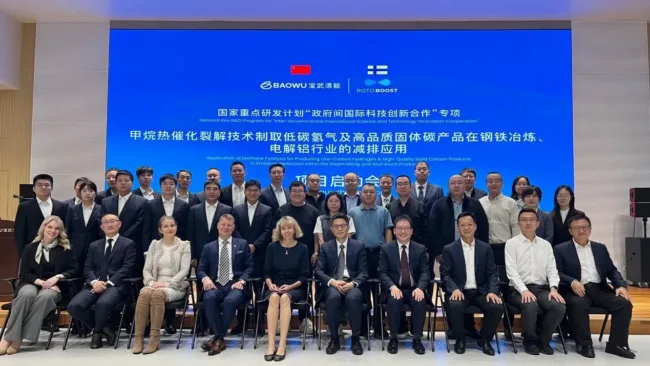
Finland-based hydrogen technology firm ROTOBOOST and China Baowu Group’s decarbonization platform, Baowu Clean Energy, have launched a strategic initiative to industrialize a methane pyrolysis-based pathway for hydrogen and carbon production at scale. Announced on October 21, 2025, in Shanghai, the collaboration is part of the China–Finland Joint Innovation Call initiated under Business Finland and the Ministry of Science and Technology of China.
The project centers around ROTOBOOST’s modular Thermo-Catalytic Decomposition (TCD) platform, which splits methane into hydrogen-rich gas and solid carbon without releasing process-level carbon dioxide. The partnership aims to enable low-emissions steel and aluminum production using on-site hydrogen while creating value from the resulting carbon in high-grade industrial applications.
China Baowu Group is the world’s largest steelmaker by volume. Its clean energy arm, Baowu Clean Energy, plays a central role in the group’s roadmap to peak emissions before 2030 and achieve carbon neutrality by 2050. ROTOBOOST brings proven technology with TÜV SÜD–certified carbon intensity metrics for both hydrogen and carbon outputs, making this project not just technically sound but also aligned with global climate standards.
How does ROTOBOOST’s TCD hydrogen platform work, and why is it suited for steel and aluminum industries?
ROTOBOOST’s Thermo-Catalytic Decomposition process is a methane pyrolysis technique that does not require water or generate carbon dioxide as a byproduct. Instead, it thermally splits natural gas using a proprietary catalyst at high temperatures, producing hydrogen-rich gas and solid carbon as separate streams. The modular units can be deployed at industrial sites, enabling distributed hydrogen production where it is consumed.
The low-carbon nature of this platform was certified by TÜV SÜD in May 2025, covering the emissions profile of both hydrogen and carbon products. This certification allows industrial buyers, investors, and regulators to treat ROTOBOOST’s outputs as compliant with emerging green procurement standards in Europe, China, and beyond.
The dual benefit of generating hydrogen and monetizable carbon positions the TCD platform as an attractive alternative to water electrolysis. Electrolysis remains capital-intensive, dependent on renewable power availability, and often cost-prohibitive at scale in heavy industry. In contrast, ROTOBOOST’s system is focused on cost-effective decarbonization with reduced infrastructure dependencies, making it more attractive for brownfield industrial sites.
The use of methane pyrolysis in steel not only addresses emissions at the hydrogen source but also creates circular value through carbon recovery, offering a differentiated model compared to electrolysis or carbon capture.
What is the deployment plan, and how are the outputs being integrated into Baowu’s operations?
Under the pilot, ROTOBOOST’s modular systems will be installed directly within Baowu Clean Energy’s operational footprint. Hydrogen generated on-site will feed into utilities supporting hydrogen-enabled steelmaking processes, including direct reduced iron (DRI) and electric arc furnaces (EAF). These methods significantly reduce reliance on coke-based blast furnace operations, traditionally the highest-emitting segment of steel production.
The project is also geared toward valorizing the solid carbon byproduct. This high-grade carbon is intended for use in electrodes, composites, and other materials relevant to both steel and aluminum production. This ability to generate marketable carbon from what is typically treated as a waste stream could dramatically improve the economics of methane pyrolysis.
Performance data will be collected continuously under commercial operating conditions. This includes tracking hydrogen output volumes, energy usage, system efficiency, and maintenance costs. The project also embeds a lifecycle assessment framework to build an auditable greenhouse gas inventory. This makes it possible for both partners to report emissions data aligned with international standards and pursue third-party verification for carbon accounting.
What industrial bottlenecks is the partnership aiming to solve and how does it align with national energy strategies?
Institutional investors and decarbonization analysts have flagged four critical barriers to low-carbon transitions in steel and aluminum: reliable hydrogen supply, favorable unit economics, ease of retrofitting, and materials performance. The ROTOBOOST–Baowu project directly addresses each of these. Hydrogen is generated on-site, eliminating dependence on pipeline or tanker logistics. The solid carbon is not a liability but a product with existing demand. The modular nature of the technology makes integration with legacy industrial assets less disruptive than full plant conversions. Finally, both outputs have documented performance in industrial settings.
From a national policy perspective, the collaboration supports China’s dual-carbon targets while advancing clean tech diplomacy with Finland. The project emerged from a formal innovation call by Business Finland and the Ministry of Science and Technology of China, reflecting both countries’ commitment to jointly develop climate solutions in hard-to-abate sectors. It also enables Finnish clean tech to gain traction in China’s vast industrial market, while allowing Baowu to access certified international hydrogen platforms.
How are institutional players reacting to methane pyrolysis compared to traditional green hydrogen?
While water electrolysis has received the bulk of attention in the hydrogen economy, its scalability in steelmaking remains contested due to high electricity demand and infrastructure costs. Methane pyrolysis in steel offers a bridge pathway by decarbonizing a fossil-based input while delivering competitive unit economics and lower capital intensity. For investors, the TÜV SÜD certification provides an assurance layer that can help these projects qualify for low-carbon funding or green procurement credits.
Institutional sentiment around ROTOBOOST’s technology has grown more favorable since its certification milestone. Analysts tracking hydrogen innovation have highlighted the ability to monetize carbon output without storage or disposal costs, which flips a liability into a revenue-generating asset.
If the Baowu pilot demonstrates strong techno-economics, it could unlock replication across other Asian, European, and Gulf Cooperation Council–based producers facing similar constraints around water availability, emissions compliance, and hydrogen import dependency.
What are the upcoming milestones in the project’s phased rollout, and what should the market watch for?
Both Baowu Clean Energy and ROTOBOOST have confirmed that engineering validation, safety assessments, and integration studies are underway. These activities will be followed by phased deployments, starting with smaller modular systems and expanding as performance validation progresses. Independent verification of emissions, operating efficiency, and carbon utilization metrics is expected in early 2026.
Stakeholders in hydrogen, energy transition finance, and climate-aligned industrial strategy will closely monitor key figures such as cost per kilogram of hydrogen, emissions abatement per ton of steel, operational uptime, and quality benchmarks for carbon byproducts. These metrics will play a critical role in enabling additional funding and fast-track regulatory approvals for future deployments.
The project is positioned to inform not just Baowu Group’s internal roadmap, but also broader industrial decarbonization frameworks across emerging markets and trade-linked supply chains. The validation of methane pyrolysis in steel through this pilot could change how global industries view hydrogen sourcing—moving away from one-size-fits-all green hydrogen rhetoric and toward modular, certified, and monetizable solutions.
Key takeaways from the Baowu Clean Energy and ROTOBOOST methane pyrolysis partnership for green steel
- ROTOBOOST and Baowu Clean Energy have partnered to deploy TÜV SÜD–certified Thermo-Catalytic Decomposition technology for low-carbon hydrogen production in China.
- The initiative is part of the China–Finland Joint Innovation Call under Business Finland and the Ministry of Science and Technology of China.
- The project will enable on-site hydrogen generation for direct reduced iron (DRI) and electric arc furnace (EAF) steelmaking routes, reducing dependency on blast furnace operations.
- Solid carbon byproducts from the methane pyrolysis process will be repurposed into electrodes and composites, creating dual monetization opportunities.
- The full system avoids direct process CO₂ emissions, requires no water input, and is designed for modular deployment across industrial sites.
- Lifecycle assessment (LCA) frameworks and third-party verification will ensure emissions accounting is auditable and compliant with international climate standards.
- Institutional investors are tracking the project for its replicability, favorable techno-economics, and potential to replace traditional green hydrogen in hard-to-abate sectors.
- The use of methane pyrolysis in steel is seen as a bridge strategy offering both emissions reductions and operational flexibility for brownfield industrial decarbonization.
- Engineering and safety validation have begun, with phased deployments and data-driven rollout expected through 2026.
Discover more from Business-News-Today.com
Subscribe to get the latest posts sent to your email.