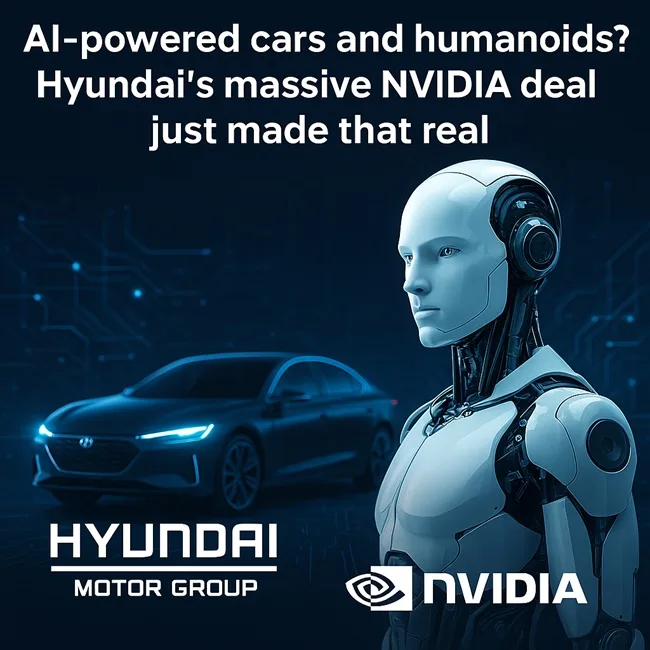
Hyundai Motor Group is going all in on AI—and it’s bringing NVIDIA Corporation along for the ride. In a bold move to reshape the future of mobility and manufacturing, the South Korean automotive giant has unveiled a $3 billion physical AI factory initiative powered by NVIDIA’s Blackwell GPU architecture, NeMo software stack, and DRIVE AGX Thor platform. Officially announced on October 31, 2025, in Gyeongju, South Korea, the partnership marks a strategic pivot away from traditional car-making toward a software-defined, AI-first ecosystem of smart vehicles, humanoid robots, and intelligent factories.
At the heart of the project is a massive deployment of more than 50,000 NVIDIA Blackwell GPUs—an AI supercomputing backbone that will fuel everything from digital twin simulations to autonomous driving pipelines and over-the-air vehicle intelligence. Hyundai Motor Group and NVIDIA Corporation are also teaming up with the South Korean government to establish national AI infrastructure, with a signed Memorandum of Understanding confirming their shared mission to turn Korea into a global leader in physical AI innovation.
For Hyundai Motor Group, this is more than just a tech upgrade. It’s a full-stack transformation. The company plans to train proprietary large language models, simulate real-world driving environments in Omniverse, and roll out precision-controlled manufacturing systems that use predictive AI and robotic integration—essentially turning its vehicles, robots, and factories into an interconnected, self-optimizing ecosystem.
Why is Hyundai Motor Group building a dedicated AI factory and what capabilities does it unlock?
The planned AI factory is designed to function as a central compute engine, enabling Hyundai Motor Group to build and manage a connected AI ecosystem spanning smart vehicles, humanoid robots, and intelligent manufacturing. NVIDIA’s Blackwell GPU cluster will allow Hyundai Motor Group to streamline AI model training, validation, and deployment within a single infrastructure, drastically accelerating its time-to-market for autonomous features and factory intelligence.
This ecosystem will be underpinned by three layers of NVIDIA’s AI compute platforms. The first is the NVIDIA DGX infrastructure, which supports scalable model training for large-scale AI applications including in-vehicle personalization, language models, and real-time sensor fusion. The second is NVIDIA Omniverse and NVIDIA Cosmos, which together allow Hyundai Motor Group to create photorealistic digital twins of factory floors, roads, and driving environments. These tools will simulate robot movements, test autonomous driving systems in edge cases, and optimize manufacturing operations through virtual commissioning. The third layer is NVIDIA DRIVE AGX Thor, the high-performance system-on-a-chip platform that powers next-generation advanced driver-assistance systems, intelligent infotainment, and over-the-air feature updates inside vehicles.
Hyundai Motor Group will also integrate these platforms to establish a dynamic development pipeline. This integration allows for seamless handoffs between model training in DGX, simulation in Omniverse, and real-world deployment via DRIVE AGX Thor. The result is a vertically integrated physical AI environment that spans design, testing, and deployment across multiple mobility and industrial domains.
How does this partnership align with South Korea’s national push for physical AI leadership?
The South Korean government is actively supporting the emergence of physical AI as a core pillar of national competitiveness, with Hyundai Motor Group and NVIDIA Corporation positioned as foundational partners in this strategy. The Ministry of Science and ICT emphasized that Korea’s strength in manufacturing data and industrial precision makes it an ideal environment for AI transformation across automotive and robotics sectors.
To support this transformation, Hyundai Motor Group and NVIDIA will collaborate on the development of several key physical AI facilities. These include Hyundai Motor Group’s Physical AI Application Center, a dedicated NVIDIA AI Technology Center, and multiple regional AI data centers. These hubs will support cross-sector AI innovation, skills development, and industry–government coordination.
Government officials also highlighted that the initiative represents a critical first step in public–private collaboration for physical AI. By combining Korea’s advanced industrial base with NVIDIA’s computing infrastructure and model training expertise, the project is expected to accelerate Korea’s role in shaping the future of manufacturing, transportation, and AI-based robotics.
Institutional analysts view this move as one of the clearest signs yet of South Korea’s intent to build a national AI cluster that goes beyond digital applications and into the physical world—connecting AI to sensors, devices, and environments in real time.
What AI-driven features are being developed for Hyundai Motor Group’s vehicles, robots, and factories?
Hyundai Motor Group is integrating a range of next-generation features into its vehicle portfolio using NVIDIA’s software and hardware platforms. These include intelligent cabin assistants powered by large language models, adaptive comfort systems based on driver preferences, over-the-air feature updates, and embedded AI for real-time decision-making in autonomous scenarios.
The advanced digital twins being developed using NVIDIA Omniverse will also support software-in-the-loop and hardware-in-the-loop testing of vehicle components. Engineers will be able to simulate manufacturing conditions, production bottlenecks, and robotic workflows before deploying physical assets on factory floors. This dramatically shortens development cycles and increases system reliability.
For its robotics division, Hyundai Motor Group is using NVIDIA Isaac Sim, a robotics simulation tool built on Omniverse, to test motion planning, task allocation, and ergonomic safety. Before physical robots are deployed into Hyundai Motor Group’s industrial plants or used in public-facing environments, their operations will be fully validated in photorealistic virtual environments.
Additionally, Hyundai Motor Group is currently piloting the use of NVIDIA RTX PRO Servers equipped with Blackwell GPUs to generate city-scale digital twins. These models include traffic flows, road conditions, weather scenarios, and regional driving behavior, which help improve autonomous driving stacks through better simulation fidelity. This marks a strategic evolution from static maps to dynamic, simulation-driven autonomy pipelines.
How are institutional investors interpreting the Hyundai–NVIDIA physical AI initiative?
Although the announcement did not directly reference equity movements, investor sentiment around both NVIDIA Corporation (NASDAQ: NVDA) and Hyundai Motor Company (KRX: 005380) has been influenced by their respective AI roadmaps. Institutional investors have expressed renewed confidence in NVIDIA’s strategy to expand its AI platforms beyond cloud and datacenter use cases into real-world verticals such as automotive, logistics, and industrial automation.
NVIDIA Corporation’s Blackwell platform is being widely adopted for foundational model training across multiple industries, but this initiative marks one of the largest known deployments tied to physical AI applications. The ability to operationalize Blackwell across cars, robots, and factory systems demonstrates significant compute utility beyond language models or cloud-native AI.
For Hyundai Motor Group, the move is being seen as a transformation from hardware-centric manufacturing toward platform-based innovation. Analysts believe the company is building a unique position in the global mobility value chain—one that fuses intelligent hardware, software ecosystems, and infrastructure-backed autonomy.
Institutional sentiment is especially bullish on Hyundai Motor Group’s ability to scale these capabilities across its global production network, given its existing footprint in electric vehicles, robotics (via Boston Dynamics), and urban mobility.
What does this mean for the future of physical AI in mobility and industrial operations?
The Hyundai–NVIDIA initiative serves as a blueprint for what physical AI at scale might look like. Unlike many mobility startups or cloud-native AI ventures, Hyundai Motor Group is embedding intelligence directly into physical processes—where AI is no longer a layer on top but is part of the machine’s core functionality.
By co-developing not just software features but also infrastructure and government-aligned frameworks, the two companies are creating a platform for scalable AI transformation across sectors. This includes potential expansions into areas such as smart city infrastructure, edge robotics, logistics automation, and intelligent energy systems.
Industry observers believe that if successfully executed, this model could be replicated across other advanced economies seeking to modernize legacy manufacturing or leapfrog into AI-first industrial ecosystems. The initiative not only boosts Hyundai Motor Group’s product portfolio but also enhances Korea’s positioning in the race for global AI and mobility leadership.
As the boundaries between software and physical systems continue to blur, Hyundai Motor Group’s bet on foundational AI compute and infrastructure may well define the next decade of automotive and industrial transformation.
Share this:
Discover more from Business-News-Today.com
Subscribe to get the latest posts sent to your email.