




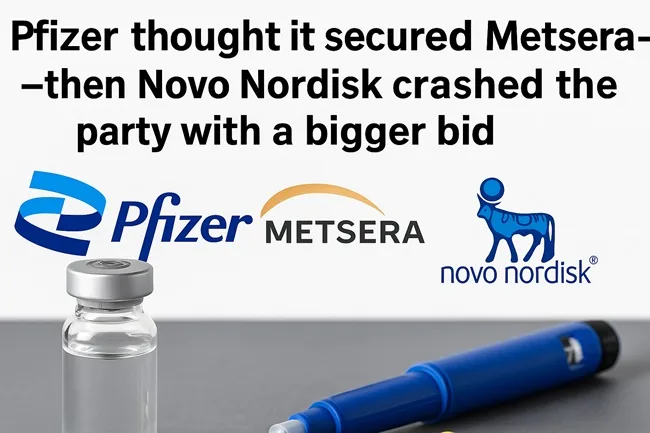
Novo Nordisk A/S has thrown a wrench into Pfizer Inc.’s $7.3 billion weight-loss playbook by launching an unsolicited and significantly higher offer for Metsera Inc., a U.S.-based obesity biotech company. The new proposal includes around $6 billion in upfront cash with milestone-linked payments that could drive the deal’s total value up to $9 billion. This aggressive counterbid not only disrupts Pfizer’s previously announced acquisition but also escalates what was already becoming the most hotly contested space in global biopharma—obesity therapeutics.
Metsera’s board has responded swiftly, calling the Novo Nordisk offer “superior” and triggering a narrow response window in which Pfizer must decide whether to sweeten its own deal or risk losing the asset entirely. With both companies desperate to dominate the next generation of weight-loss drugs, this surprise challenge from the Danish pharmaceutical giant could have far-reaching implications for metabolic disease strategy, M&A dynamics, and drug pricing politics.
Novo Nordisk’s move arrives just as the obesity drug market is tipping into explosive commercial territory. Blockbusters like Wegovy and Ozempic have already validated the GLP-1 mechanism, but the next wave of innovation—and profit—is expected to come from differentiated formats and novel hormone pathways. Metsera fits that bill with its once-monthly injectable GLP-1 analog, MET-097i, and a preclinical amylin-targeting compound, MET-233i. With both candidates showing potential to leapfrog weekly competitors, the biotech firm has quickly become a crown jewel in the obesity arms race. Pfizer thought it had locked it in. Novo Nordisk had other plans.
Why Novo Nordisk and Pfizer are locked in a contest for Metsera’s pipeline
The underlying reason Novo Nordisk and Pfizer are clashing over Metsera is clear: the company offers a strategically differentiated pipeline with potential for both commercial scalability and scientific innovation. Metsera’s lead candidate, MET-097i, is a once-monthly GLP-1 injectable therapy that demonstrated significant body weight reduction in early trials—around 14 percent on average, according to recent disclosures. This profile offers a competitive edge over weekly-dosed GLP-1 products like Wegovy and Zepbound. With patient adherence being a key factor in obesity drug efficacy, the monthly format could become a commercial differentiator if approved.
Further adding to Metsera’s appeal is its earlier-stage candidate MET-233i, which targets the hormone amylin. While GLP-1 receptor agonists remain dominant in the space, researchers and drug developers are increasingly exploring combinatory or adjacent pathways that may enhance weight-loss efficacy or improve safety and tolerability profiles. Novo Nordisk’s interest in this dual-pathway potential likely reflects an effort to stay ahead of not just Eli Lilly and Company’s Zepbound but also upcoming entrants from smaller players such as Viking Therapeutics Inc. and Structure Therapeutics Inc.
For Pfizer, the original Metsera agreement represented a chance to reassert its position in metabolic diseases following previous missteps. The pharmaceutical giant has struggled to establish a compelling obesity pipeline in recent years, especially after the discontinuation of its own early-stage candidates. Acquiring Metsera was meant to mark a strategic reset, providing access to a promising platform with both GLP-1 and non-GLP-1 assets. Novo Nordisk’s intervention has upended those plans, forcing Pfizer into a decision that could escalate bidding or trigger litigation over contractual rights.
What this bidding war reveals about changing obesity drug valuations
This rivalry between two of the largest pharmaceutical companies is not just a one-off conflict—it reflects a broader shift in how obesity drug assets are valued. With Novo Nordisk offering up to $9 billion and Pfizer’s original offer sitting just below $7.5 billion, market watchers have noted the extraordinary premiums now being placed on mid-stage obesity drug platforms. Metsera has no approved product yet, but the competing offers assume peak annual sales could exceed $5 billion, based on physician surveys, payer feedback, and early efficacy data. That is a notable valuation multiplier even in the context of high-growth therapeutic categories.
Strategically, this premium underscores that the obesity drug sector is no longer being treated as a niche opportunity. The rise of GLP-1 drugs into blockbuster territory has catalyzed new thinking on metabolic disease pipelines, with some analysts projecting the market could reach over $100 billion by 2030. As a result, early-stage and mid-stage biotechs in this space are increasingly seen as cornerstone acquisition targets, not speculative R&D plays. This deal frenzy resembles oncology’s buyout cycle in the early 2010s, where platform differentiation—rather than commercial readiness—drove M&A premiums.
Novo Nordisk’s structure, which includes performance-based milestone payments, indicates a cautious but aggressive approach. It seeks to front-load the acquisition with enough capital to lock in the deal while managing execution risk. Pfizer’s response, still forthcoming, may hinge on whether it can match or exceed the financial and strategic terms of Novo Nordisk’s unsolicited proposal. With antitrust scrutiny a looming concern, any counteroffer may also face regulatory headwinds if structured too aggressively.
Will Metsera trigger a new wave of M&A across obesity and metabolic disease sectors?
From a strategic viewpoint, this bid situation may trigger a domino effect across the sector. Already, investor sentiment has begun spilling over to peer companies. Shares of Viking Therapeutics and Structure Therapeutics have gained sharply following news of the bidding war, with investors interpreting the Novo Nordisk–Pfizer scramble as validation of smaller companies’ pipelines. The implication is that any biotech with differentiated obesity or metabolic disease assets will now be viewed as a potential target.
Novo Nordisk and Eli Lilly and Company have limited opportunities to build beyond their own GLP-1 platforms unless they acquire innovation from outside. While both have strong internal pipelines, the industry has acknowledged that the real battle lies in once-monthly formats, oral GLP-1s, and non-GLP-1 pathways like amylin, GIP, and GLP-1/glucagon dual agonists. Companies with these mechanisms—especially in Phase 2 or early Phase 3 development—will likely see intensified interest from larger players.
Moreover, the structure of this deal hints at a broader shift in M&A psychology. Rather than waiting for Phase 3 data or post-approval validation, pharmaceutical companies are increasingly willing to take earlier-stage bets, particularly in competitive therapeutic classes with high reimbursement potential. In this context, Metsera serves not just as a target but as a benchmark for how similar assets might be priced and pursued in the quarters ahead.
How regulatory scrutiny and legal uncertainty could shape the outcome of Novo Nordisk’s takeover bid for Metsera
While Novo Nordisk’s bid has the potential to reshape the obesity market, it also carries material legal and regulatory risks. Pfizer’s statement calling the bid “reckless” suggests it may challenge the legality of Novo Nordisk’s approach under existing merger agreements and potential antitrust concerns. With both companies having deep regulatory footprints across the United States, Europe, and Asia, the competition authorities will likely scrutinize this acquisition more thoroughly than smaller transactions.
The legal uncertainty centers around whether Pfizer’s earlier agreement with Metsera contained exclusivity or right-to-match clauses that Novo Nordisk may have violated by submitting a rival offer directly to Metsera’s board. While Metsera has described Novo Nordisk’s proposal as “superior,” it has also initiated a four-business-day period to allow Pfizer to respond, as per deal terms. This could be a signal that legal counsel sees potential exposure depending on how quickly Pfizer reacts and whether it can structure a new proposal that satisfies both the board and regulators.
From a policy perspective, regulators may also assess the implications of further consolidation in a sector where only a handful of companies control both pricing power and manufacturing capacity. Obesity drugs are emerging as public health imperatives with implications beyond shareholder value. With the U.S. government, insurance providers, and employers all beginning to incorporate obesity drug coverage, the market could face public interest-based scrutiny akin to what is seen in the insulin pricing debate. Novo Nordisk, as one of the major suppliers of insulin and GLP-1 therapies, will be acutely aware of this regulatory context.
How the Novo Nordisk–Pfizer bidding war could redefine the global obesity drug landscape and future M&A strategies
This high-profile bidding war marks a turning point in how the global pharmaceutical industry is approaching the obesity therapeutics category. Whether Novo Nordisk secures Metsera or Pfizer counters with a revised offer, the fundamental reality is that competition for differentiated, scalable obesity therapies has entered an aggressive new phase. With projected revenues, payer alignment, and real-world demand all pointing north, the pressure to build defensible product portfolios is creating a gold rush atmosphere among biopharma giants.
For institutional investors, the short-term implication is clear: biotech firms with credible GLP-1 or amylin-based programs are suddenly much more valuable. For analysts and strategists, the long-term outcome will depend on how Novo Nordisk or Pfizer execute on integration, clinical development, and market expansion. But for the industry as a whole, this may just be the first major battle in what will likely become an extended campaign to dominate one of the most transformative therapeutic markets of the 2020s.
What are the takeaways investors and industry watchers should remember about the Novo Nordisk–Pfizer Metsera bidding war?
- Novo Nordisk has submitted an unsolicited rival offer for Metsera that includes roughly US $6 billion upfront and could reach about US $9 billion with milestone payments, overtaking Pfizer’s earlier agreement valued at about US $7.3 billion.
- Metsera’s lead candidate, MET‑097i, is a once‑monthly GLP‑1 injectable that showed roughly 14 percent average body‑weight reduction in mid‑stage data, and the company also has an earlier‑stage amylin‑targeting asset that increases strategic value.
- Metsera’s board has labelled Novo Nordisk’s proposal superior and has opened the contractual window for Pfizer to respond, creating a short, high‑pressure timeline that could prompt a counteroffer or legal action.
- Pfizer has publicly criticised the unsolicited approach and may pursue contractual or litigation remedies if it believes exclusivity or right‑to‑match provisions were breached, adding legal uncertainty to the process.
- Antitrust and merger‑control scrutiny is a material risk given the concentration of obesity therapeutics among a few large suppliers and the public policy sensitivities around access and pricing for weight‑loss medicines.
- The bidding war signals a valuation reset for obesity assets, with acquirers now willing to pay multibillion‑dollar premiums for differentiated dosing formats and novel mechanisms, which could accelerate M&A activity across the sector.
- Short‑term market implications include re‑rating of smaller obesity and metabolic disease biotechs, while long‑term implications hinge on execution risk, regulatory approvals, and how Novo Nordisk or Pfizer integrate and advance Metsera’s pipeline.
Discover more from Business-News-Today.com
Subscribe to get the latest posts sent to your email.

