




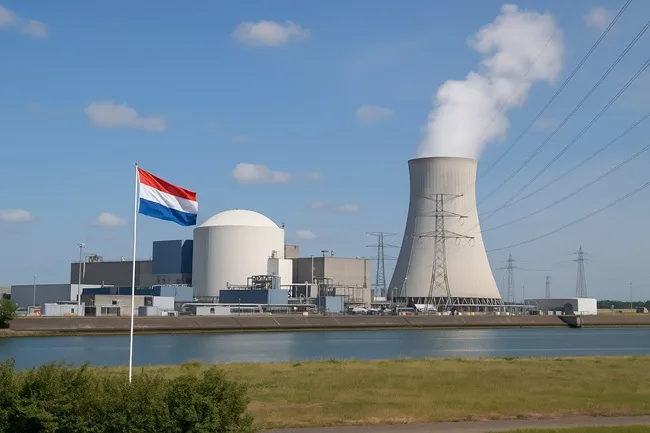
The Dutch government is moving forward with a major legislative shift that would extend the operating life of the Borssele Nuclear Power Station, the only commercial nuclear reactor in the Netherlands, well beyond its previously mandated closure in 2033. A proposed amendment to the Dutch Nuclear Energy Act, submitted to parliament in October 2025, would enable operator Elektriciteits Produktiemaatschappij Zuid-Nederland B.V. (EPZ) to formally apply for an extension of the plant’s operating license. If approved by the national regulator, this move could keep the Borssele plant running until at least 2054, solidifying its role as a cornerstone of the country’s low-carbon energy mix.
This policy development comes at a time when the Netherlands is also advancing plans to construct two new large-scale nuclear power reactors and invest in small modular reactor (SMR) technology. Together, these moves represent a significant recalibration of Dutch energy strategy, with nuclear power now being positioned as a long-term asset essential to meeting both climate and energy security goals.
Why is the Netherlands prioritizing a lifetime extension for the Borssele nuclear plant in 2025?
The decision to pursue a license extension for the Borssele Nuclear Power Station is rooted in strategic, environmental, and grid stability considerations. Operating since 1973, the Borssele plant currently delivers around 485 megawatts of net electricity capacity and contributes approximately three percent of the Netherlands’ total power generation. Despite its age, the reactor is widely regarded as one of the safest and most efficiently run nuclear facilities in Europe.
Dutch authorities have stated that extending Borssele’s operation would support the country’s transition to a CO₂-free energy system by providing reliable baseload electricity to complement variable renewables like wind and solar. According to the Ministry for Economic Affairs and Climate Policy, nuclear energy is “indispensable” to ensure that the Netherlands can maintain grid reliability even when renewable output fluctuates due to weather conditions. The current law mandates the closure of the Borssele plant by 2033. However, under the proposed amendment, EPZ would be allowed to apply to the national nuclear safety authority—Autoriteit Nucleaire Veiligheid en Stralingsbescherming (ANVS)—to operate the reactor for an additional 20 years, provided it meets stringent safety, operational, and environmental criteria.
What does the new legislation mean for the Dutch nuclear landscape going forward?
The proposed changes to the Nuclear Energy Act do more than just authorize a possible extension. They signal the government’s long-term commitment to nuclear power by establishing legal clarity for future reactor projects. Notably, the Dutch government is also preparing to invest in two new gigawatt-scale reactors, each between 1,000 and 1,650 megawatts, near the existing Borssele site in the Zeeland province. These new units are expected to enter operation around 2035, with preliminary planning, environmental assessments, and grid integration already underway.
To support this expansion, a new public company called the Nuclear Energy Organisation of the Netherlands (NEO NL) will be formed to oversee project development and coordinate with international reactor vendors and construction partners. The Ministry has also earmarked €20 million to support early-stage development of small modular reactors, as part of a dual-track approach that combines proven large-scale infrastructure with next-generation nuclear technology.
Another critical provision under discussion is the government’s potential acquisition of a direct ownership stake in the Borssele plant. Such a move would align the public sector more closely with the future management and financing of the facility, potentially altering the capital structure and risk-sharing model for any future upgrades or license extensions. EPZ is currently co-owned by energy firms Essent and PZEM.
What are the operational, technical, and regulatory risks tied to extending the Borssele reactor’s life?
Although the strategic case for Borssele’s life extension is clear, the operational and regulatory implications are significant. Extending the operational life of a 50-year-old nuclear reactor requires a comprehensive safety assessment, including evaluation of aging reactor pressure vessels, cooling systems, control software, and seismic compliance standards. EPZ will need to submit an extensive license amendment application to ANVS, demonstrating continued compliance with all European Union and International Atomic Energy Agency safety protocols.
Additionally, the company will likely need to implement plant modifications and life-extension upgrades, including digitalization of analog controls and enhanced post-Fukushima safety mechanisms. These investments, while costly, are seen as necessary to ensure public trust and regulatory approval. The Netherlands has a well-established waste management regime in place, with the Central Organisation for Radioactive Waste (COVRA) providing secure interim storage facilities for high- and low-level nuclear waste. However, a longer plant life will also require updated waste projections and extended storage planning.
How does this decision fit into the Netherlands’ broader energy strategy in 2025?
The extension of the Borssele plant and the push for new nuclear build-outs reflect a broader recognition within the Dutch government that energy security and climate goals must be pursued in parallel. Like many European countries, the Netherlands has faced increasing volatility in natural gas supply following geopolitical disruptions, while attempting to decarbonize its power grid at pace. The inclusion of nuclear energy as a formally recognized contributor to the national climate strategy—alongside renewables and green hydrogen—is a significant departure from earlier political consensus that had deprioritized nuclear post-Fukushima.
From a policy standpoint, this move brings the Netherlands more in line with other European Union member states such as France, Finland, and Sweden, all of which are expanding their nuclear portfolios. The country is also expected to support a favorable taxonomy classification for nuclear projects under EU sustainable finance guidelines, unlocking potential private and public investment into both Borssele and future SMR deployments.
What are the implications for investors and the European nuclear value chain?
For institutional investors and energy infrastructure funds, the Dutch government’s endorsement of a long-term nuclear strategy is a bullish signal. The potential for state co-investment, paired with long-term power purchase agreements and sovereign-backed policy guarantees, could attract private capital to projects that had previously faced regulatory or political uncertainty. It also opens new commercial opportunities for reactor suppliers, SMR technology firms, engineering procurement and construction (EPC) contractors, fuel cycle vendors, and digital modernization solution providers.
Vendors such as Westinghouse Electric Company, Korea Hydro & Nuclear Power (KHNP), and EDF are expected to bid for the new Dutch reactor contracts. Meanwhile, SMR contenders like Rolls-Royce SMR, GE Hitachi Nuclear Energy, and NuScale Power could see the Netherlands as a critical European testbed if pilot deployment funds materialize. Moreover, Dutch grid operator TenneT will likely need to update regional transmission infrastructure to accommodate new generation capacity and ensure integration with offshore wind and hydrogen production hubs.
Why extending Borssele is seen as a pragmatic step toward balancing nuclear and renewable energy
Extending the Borssele plant is a pragmatic and timely move. It reflects the reality that next-generation nuclear technologies like small modular reactors, while promising, are not yet commercially deployed at scale. Retaining a functioning, regulated, and relatively modernized reactor like Borssele provides the Netherlands with a hedge against both decarbonization delays and fossil fuel price shocks. It also sends a clear policy signal: nuclear is back on the table as a mainstream solution, not a legacy problem.
Critically, the legislative clarity introduced by the proposed amendment to the Nuclear Energy Act also sets a precedent for how the Netherlands intends to govern future nuclear investments. This includes financing models, ownership structures, licensing pathways, and integration with broader decarbonization targets. If the new reactors come online by 2035 as planned, nuclear could supply up to 13–15 percent of Dutch electricity needs, radically reshaping the country’s power mix alongside wind, solar, and energy storage.
What are the key takeaways from the Netherlands’ move to extend the Borssele nuclear plant?
- The Dutch government has submitted an amendment to the Nuclear Energy Act to allow the Borssele Nuclear Power Station to operate beyond its current 2033 closure deadline.
- Elektriciteits Produktiemaatschappij Zuid-Nederland B.V. (EPZ), the operator of Borssele, would be eligible to apply for a 20-year license extension, potentially running the reactor until 2054, pending regulatory approval.
- The Borssele plant, which began operations in 1973, generates approximately 485 megawatts of net electricity capacity and supplies about 3% of the Netherlands’ total power output.
- A new state-owned body, the Nuclear Energy Organisation of the Netherlands (NEO NL), will be created to oversee two new large-scale nuclear reactors targeted for operation around 2035.
- The government has earmarked an initial €20 million to explore small modular reactor (SMR) deployment, signaling a dual-track approach to nuclear innovation.
- Authorities cited energy security and climate targets as key drivers, emphasizing the need for reliable, CO₂-free baseload power alongside intermittent renewables.
- The legislative changes also open the door for potential state ownership in Borssele, reshaping the investment structure and signaling deeper public sector involvement.
- Regulatory oversight will remain with Autoriteit Nucleaire Veiligheid en Stralingsbescherming (ANVS), which must assess safety and technical upgrades before any extension is granted.
- The Dutch decision aligns with a broader European shift toward nuclear energy as part of energy transition planning and grid reliability strategy.
- Companies across the global nuclear value chain—including reactor vendors, SMR developers, and infrastructure investors—are watching closely for commercial opportunities linked to Borssele’s extension and the new build program.
Discover more from Business-News-Today.com
Subscribe to get the latest posts sent to your email.