





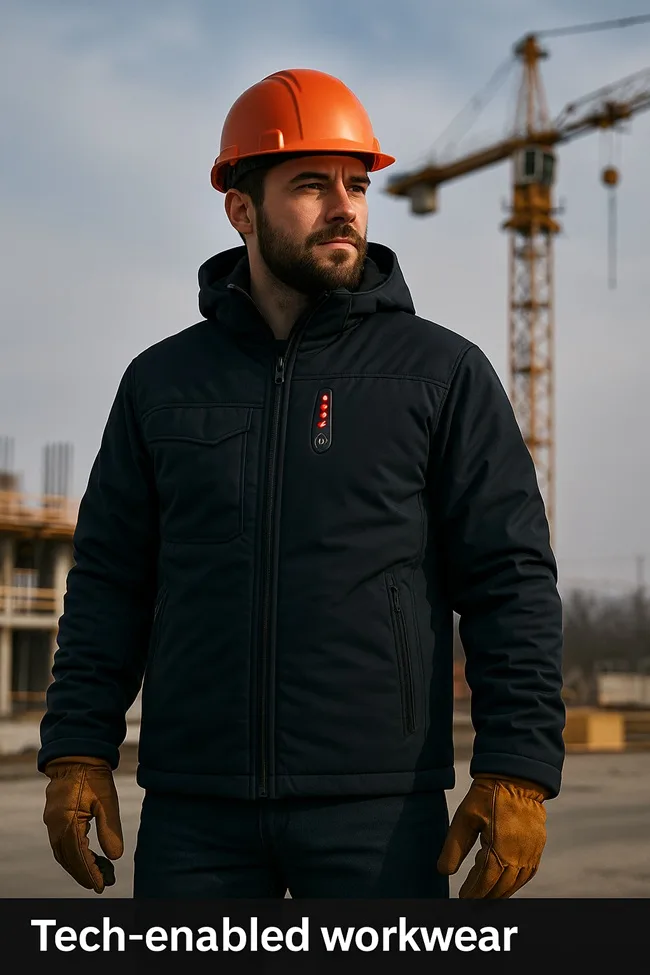
Across construction zones, infrastructure projects, logistics yards, and utility corridors, the work uniform is undergoing a transformation. Traditional cotton overalls, hi-vis vests, and rugged jackets are being replaced or enhanced by a new generation of performance workwear. These garments feature embedded sensors, active heating and cooling systems, and advanced textiles capable of withstanding extreme conditions—all designed to improve safety, mobility, and productivity.
The shift is rooted in multiple converging factors. As outdoor workforces contend with increasing climate variability, prolonged exposure to harsh conditions, and intensifying productivity demands, employers are re-evaluating how gear contributes to worker well-being and operational efficiency. Simultaneously, material science and wearable technology have matured to a point where smart clothing is no longer just a novelty but a practical, scalable solution.
Apparel makers focused on professional wear are integrating thermal regulation systems, ergonomic tailoring, antimicrobial fabrics, and even IoT-connected modules into their designs. The result is a wearable toolkit: clothing that does more than protect—it augments. In industries where time outdoors is critical and conditions are punishing, the benefits of adopting such gear are increasingly hard to ignore.
How are new fabrics, heating systems, and sensors changing the experience of the modern outdoor worker?
Workwear innovation today goes far beyond thicker linings or high-visibility panels. Heating elements powered by lithium-ion batteries, often controlled through multi-zone toggles, allow workers to adjust warmth in key areas like the chest, back, and arms. Cooling technologies, including phase-change materials and active venting systems, help those in high-temperature environments avoid heat exhaustion. Breathable, moisture-wicking layers maintain comfort throughout long shifts.
These improvements are complemented by embedded sensors that track environmental exposure, posture, or fatigue. Such data can be shared in real time with supervisors or safety platforms, offering insights into workforce conditions that were previously invisible. Some systems are even being designed to detect signs of heat stress or dangerous body positions before injuries occur.
Durability remains central to the mission of workwear, but the definition has expanded. Now, garments must be electronically rugged as well—capable of functioning despite rain, dust, and the daily wear-and-tear of physical labor. Battery packs must hold up over extended shifts without compromising safety. Heating elements must survive machine wash cycles and still operate reliably in sub-zero temperatures.
In this new landscape, the humble work jacket has become a platform—one that heats, cools, senses, and adapts to the worker’s environment and tasks.
What challenges still stand in the way of mass adoption of smart workwear across sectors?
Despite a compelling use case, the adoption of tech-enabled workwear remains uneven. The first major hurdle is cost. Smart gear, especially those integrating heating and sensor systems, often carries a price tag significantly higher than conventional apparel. For companies outfitting hundreds or thousands of workers, these costs scale quickly. Until tangible productivity or safety returns are clearly demonstrated, many employers remain hesitant to invest widely.
Durability, while improving, is still a concern. Outdoor professionals work in unpredictable environments that include mud, abrasive materials, high winds, and heavy machinery. A jacket with advanced electronics that malfunctions after a few cycles or loses heating in cold conditions is more than inconvenient—it can be a liability.
User behavior also matters. Many jobsite workers prefer gear that is simple, predictable, and durable. Introducing wearable tech that requires charging, syncing, or special handling may meet resistance unless the benefits are clearly felt day-to-day. If it adds friction, adoption will slow.
Integration with corporate procurement systems and compliance frameworks can also act as a bottleneck. Uniform contracts are often locked into long-term vendor relationships with conservative product expectations. PPE certifications, especially in regulated sectors like utilities or transportation, take time to update for novel features like embedded electronics.
Standardization remains a broader issue. As more vendors enter the smart workwear space, industry-wide benchmarks for battery safety, fabric performance, environmental resistance, and interoperability are still maturing. Without such standards, employers risk vendor lock-in or system incompatibility.
Where are smart workwear innovations already in use—and what results are emerging?
In sectors like utilities, mining, telecommunications, and logistics, smart workwear is beginning to gain traction. Workers in these environments routinely face thermal extremes, long shifts, and operational risk, making them ideal candidates for gear that enhances comfort and safety.
Heated jackets and gloves, particularly those with dual-control systems, are already being used by cold-climate utility crews. These professionals report reduced layering needs and greater mobility, especially when working on elevated platforms or in confined spaces. In hot environments, cooling shirts with evaporative layers or air circulation modules are helping outdoor personnel reduce fatigue.
Some firms have begun equipping workers with garments containing biometric sensors that monitor temperature, hydration, or stress levels. These can be integrated into broader workforce monitoring platforms, alerting supervisors if a team member exhibits signs of heat exhaustion, low blood pressure, or poor ergonomics. While the use of such data is still evolving—and raises privacy questions—it represents a frontier in proactive safety.
Other promising applications include LED-embedded safety gear for low-light worksites, garments with embedded communication devices, and uniforms that can signal emergency alerts based on biometric triggers. In these scenarios, smart workwear is not just reactive; it becomes part of an early-warning system.
What does the future hold for apparel brands, employers, and outdoor professionals?
For apparel brands, the message is clear: the age of functional fashion is moving deeper into performance-driven, data-aware territory. Design now demands a balance between comfort, compliance, technology, and style. Brands that can embed advanced functionality into clothing without compromising simplicity, affordability, or safety will lead this transformation.
Employers who embrace these innovations may gain a competitive edge—not only in worker safety but also in recruitment and retention. In an era of labor shortages and rising attrition, outfitting field teams with advanced, climate-responsive gear signals investment in workforce well-being. It also opens up new data streams that can inform everything from scheduling and training to asset allocation and risk mitigation.
For outdoor professionals, this shift promises more than comfort. It may mean fewer days lost to illness or fatigue, more mobility in harsh conditions, and a greater sense of protection on the job. If adoption continues to rise, smart workwear could become as essential as hard hats and safety boots—an everyday part of the modern worker’s toolkit.
The next evolution is likely to bring even more integration: garments that connect to fleet dashboards, alert systems, or machine interfaces. Think smart gloves that control cranes, jackets that monitor air quality, or pants that correct posture in real-time.
What are the key takeaways from the rise of tech-enabled workwear for outdoor professionals?
- Tech-enabled workwear is evolving from niche pilots to large-scale adoption across industries facing extreme climate, safety, and performance challenges.
- Embedded heating and cooling technologies, biometric sensors, and advanced fabrics are redefining industrial clothing as active performance gear rather than passive protection.
- These innovations are improving worker comfort, safety, and productivity while helping employers address operational efficiency and workforce well-being.
- Cost, durability, user adoption, and system integration remain the main barriers to full-scale deployment, but the long-term value proposition continues to strengthen.
- Early adopters in utilities, infrastructure, logistics, and construction are reporting measurable gains in worker satisfaction, retention, and incident reduction.
- As procurement systems evolve and safety standards mature, smart workwear is expected to become an indispensable part of outdoor operations for both employers and frontline professionals.
Share this:
Discover more from Business-News-Today.com
Subscribe to get the latest posts sent to your email.