




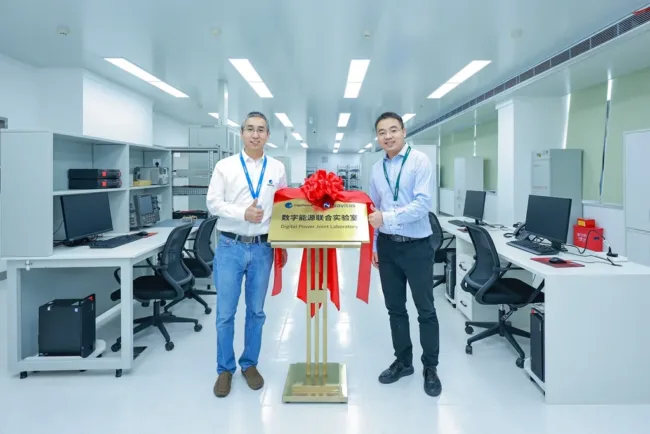
Navitas Semiconductor Corporation (NASDAQ: NVTS) saw a noticeable stock rally during early trading on October 16, 2025, rising over 4% to USD 15.84 by 11:10 AM ET. The sharp upward movement follows two catalysts that have amplified institutional attention: the formal launch of a Digital Power Joint Lab with GigaDevice and new technical disclosures showing Navitas’ deeper alignment with NVIDIA’s 800 VDC AI factory architecture. Both developments position Navitas not just as a gallium nitride (GaN) power chip company, but as a systemic player in the future of AI data center power infrastructure.
The combination of GigaDevice’s microcontroller (MCU) and Flash memory expertise with Navitas’ wide-bandgap GaNFast, GaNSafe, and GeneSiC power semiconductors is creating high-efficiency, AI-ready power delivery systems. The announcement comes amid growing demand for power-dense, thermally optimized, megawatt-scale platforms to support accelerated AI workloads, smart energy infrastructure, and electric vehicle (EV) charging.
What is the strategic intent behind Navitas and GigaDevice launching a digital power joint lab?
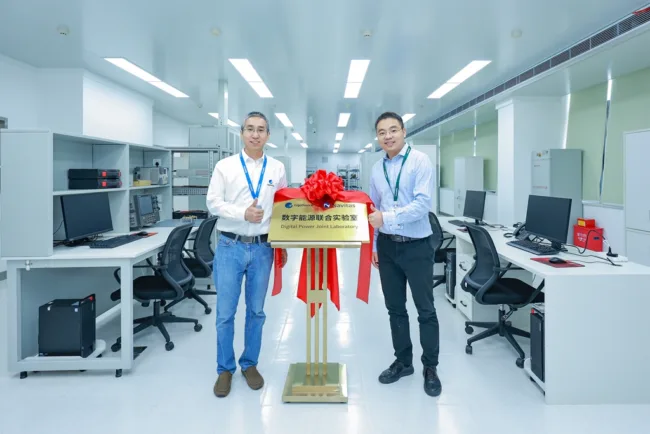
The newly formed Digital Power Joint Lab represents a full-stack initiative to engineer high-performance digital power conversion systems tailored to emerging sectors. These include AI servers, photovoltaic (PV) microinverters, grid-tied energy storage, EV charging systems, and other high-density power environments. The lab will integrate GigaDevice’s GD32G553 microcontrollers with Navitas’ advanced GaN and SiC platforms to enable system-level innovation.
Prior to its public unveiling, the lab had already produced notable breakthroughs such as a 500W single-stage PV micro-inverter and 12kW power supply modules targeting hyperscale server racks. The 500W micro-inverter solution integrates Navitas GaNFast Bi-Directional power ICs with GigaDevice MCUs using a novel single-stage DC-to-AC architecture. This eliminates the need for intermediate DC-DC conversion, achieving more than 97.5% peak efficiency, over 97% California Energy Commission (CEC) efficiency, and a maximum power point tracking (MPPT) rate above 99.9%. These metrics are rarely seen in commercial-grade inverter deployments at this power level.
Meanwhile, the 12kW AI server PSU solution achieves 97.8% peak efficiency—exceeding even the 80 PLUS® “Ruby” level. It supports Open Compute Project (OCP), ORv3, and CRPS standards and is designed for multi-megawatt rack environments seen in next-generation AI infrastructure.
This isn’t just a technical exercise. It’s a long-term signal that GigaDevice and Navitas are looking to co-develop application-specific, turnkey platforms for customers building tomorrow’s digital infrastructure.
How is Navitas Semiconductor positioning itself within NVIDIA’s 800 VDC AI factory power transition?
Navitas Semiconductor’s current narrative is inseparable from NVIDIA’s introduction of the 800 VDC AI factory power architecture. With legacy 54 V in-rack power systems no longer able to meet the scale of large language model (LLM) training or high-performance computing (HPC) workloads, NVIDIA has redefined the baseline. Navitas is responding with a full GaN and SiC component suite that targets every power conversion stage in this new topology.
Traditional data centers follow a multi-stage AC-DC and DC-DC flow, introducing inefficiencies at every step. In contrast, the 800 VDC model eliminates those stages by delivering utility-scale 13.8 kVAC power directly into the data center’s power room, where it is converted to 800 VDC using solid-state transformers (SSTs). From there, the voltage is stepped down through two efficient DC-DC stages to GPU-level voltages.
Navitas offers solutions at every level of this hierarchy. Its GeneSiC trench-assisted planar SiC devices are purpose-built for high-voltage AC-DC front-end conversion. Its 650 V and 100 V GaN FETs handle the critical DC-DC stages on GPU power boards. The company’s advanced dual-sided cooled GaN FET packages offer high-density thermal performance—a necessity for rack designs hosting multiple kilowatts per server.
This alignment with NVIDIA’s next-gen reference architecture elevates Navitas from a component supplier to a critical infrastructure partner.
How are markets and institutional investors reacting to Navitas Semiconductor’s infrastructure pivot?
The sharp 4.11% gain in Navitas Semiconductor stock by late morning on October 16 reflects renewed confidence in the firm’s strategic pivot. From an early low of USD 15.21, NVTS rebounded strongly to USD 15.84, aided by intraday institutional flows and positive retail sentiment. The stock’s surge comes after a multi-session consolidation period, suggesting this breakout was catalyst-driven rather than speculative.
Analysts tracking the semiconductor sector have pointed to Navitas’ new relevance in megawatt-scale power delivery. Institutions are increasingly viewing NVTS not just as a GaN pure-play, but as a potential category leader in the AI infrastructure race. The firm’s new strategic partnership with Power Chip, which enables 100 V GaN production on 200 mm wafers, also supports scalability and volume pricing advantages—an area where many GaN startups struggle.
If this manufacturing partnership proves cost-effective, it could unlock design wins across both AI servers and automotive platforms. Institutional investors appear to be pricing in this upside, especially given the broader industry push toward wide-bandgap adoption across power-sensitive workloads.
What differentiates Navitas’ GaNFast, GaNSafe, and GeneSiC platforms from competing technologies?
Navitas’ technology stack is built around performance, safety, and manufacturability—attributes that directly address enterprise and hyperscale buyers.
GaNFast power ICs integrate control, drive, and sensing functions into compact devices capable of ultra-fast switching and minimal power loss. These are already in mass production across fast-charging and industrial verticals.
GaNSafe represents a leap forward in safety and robustness, featuring 350 ns short-circuit protection response times, built-in electrostatic discharge (ESD) protection up to 2 kV, and programmable slew rate control. This makes them suitable for mission-critical environments like AI GPU boards, where thermal failure margins are thin and reliability is non-negotiable.
GeneSiC, Navitas’ silicon carbide product line, offers voltage ranges from 650 V to 6,500 V and is already being used in multi-megawatt deployments for grid-tied systems and renewable energy storage. The trench-assisted planar design architecture provides consistent performance across thermal ranges and enables high-speed switching—key to compacting rack infrastructure and maintaining thermal balance.
Together, these three technologies form a vertically integrated, wide-bandgap toolkit that can scale from laptop chargers to 100 MW data centers—something few competitors can credibly claim.
What future developments could reinforce Navitas’ transformation in the eyes of investors?
From a capital markets perspective, Navitas Semiconductor is now under watch for a series of inflection points. These include upcoming customer design wins, expansion of production capacity through Power Chip, and new use cases for its GaN and SiC platforms in electric vehicles and smart energy grids.
There’s also growing anticipation around potential customer disclosures linked to NVIDIA’s Rubin Ultra platform or hyperscale data center deployments in Asia and North America. Even indirect confirmation of Navitas technologies inside AI training clusters could send a clear signal to institutional allocators and technology-focused ETFs.
Meanwhile, its expanding partnership with GigaDevice opens the door to embedded AI and IoT devices requiring high-efficiency onboard power conversion. The Digital Power Joint Lab is expected to release further reference designs over the next two quarters.
At a macro level, Navitas benefits from secular tailwinds—rising demand for AI compute, declining tolerance for energy waste in data centers, and a global shift to electric mobility and distributed power infrastructure.
Why does Navitas Semiconductor matter in the context of AI, energy, and electrification?
Navitas Semiconductor has quietly become one of the most consequential players in the global power electronics reshuffle. As data center power requirements evolve from kilowatts to megawatts and as energy systems move from centralized generation to edge-powered flexibility, firms like Navitas are no longer optional—they are infrastructure.
Its transformation from a fast-charging niche supplier to a wide-bandgap powerhouse is already underway. The latest moves with GigaDevice and the 800 VDC standard give Navitas a first-mover edge in architecting the future of power delivery across AI factories, EVs, and next-generation renewables.
The broader semiconductor market is taking note. Investors, regulators, and infrastructure developers alike are watching closely to see if Navitas can continue delivering innovation, integration, and profitability at the scale AI-driven electrification demands.
Discover more from Business-News-Today.com
Subscribe to get the latest posts sent to your email.