




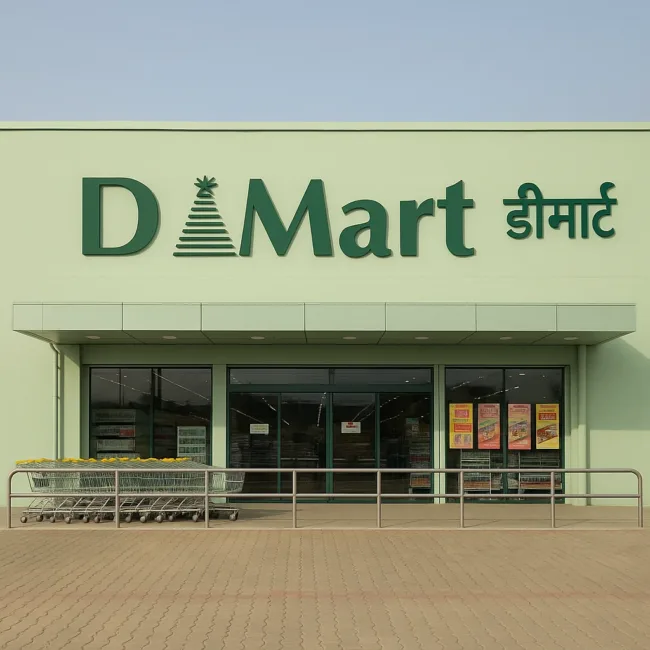
Avenue Supermarts Limited (NSE: DMART, BSE: 540376), one of India’s most influential grocery and FMCG retail chains, announced its financial results for the quarter and half year ended September 30, 2025. The company, which operates under the DMart brand, reported a standalone revenue of ₹16,219 crore in Q2 FY26, reflecting a year-on-year growth of 15.4 percent compared to ₹14,050 crore in Q2 FY25. For the half-year period (H1 FY26), the total standalone revenue reached ₹32,151 crore, a robust 15.8 percent rise from ₹27,762 crore recorded in H1 FY25.
EBITDA for the quarter came in at ₹1,230 crore, an 11.3 percent increase over the ₹1,105 crore posted in Q2 FY25. However, this topline growth was accompanied by margin compression, with EBITDA margin dipping to 7.6 percent from 7.9 percent in the previous year. PAT for Q2 FY26 was reported at ₹747 crore, up 5.1 percent from ₹710 crore a year earlier. PAT margin narrowed to 4.6 percent from 5.0 percent. Earnings per share (EPS) for the quarter improved marginally to ₹11.47, compared to ₹10.92 in the same period last year.
For the six-month period ending September 30, 2025, Avenue Supermarts posted EBITDA of ₹2,543 crore, up from ₹2,326 crore in H1 FY25. Net profit for H1 FY26 came in at ₹1,576 crore, a 3.5 percent increase year-over-year, while EPS for the half year rose to ₹24.22 from ₹23.41.
On a consolidated basis, Q2 FY26 revenue reached ₹16,676 crore versus ₹14,445 crore in the same quarter of FY25. Consolidated EBITDA rose to ₹1,214 crore, compared to ₹1,094 crore last year. PAT grew to ₹685 crore from ₹659 crore, but margins again witnessed a drop with EBITDA margin at 7.3 percent (down from 7.6 percent) and PAT margin at 4.1 percent (down from 4.6 percent).
These figures reflect a trend where DMart continues to deliver consistent top-line growth while facing rising operational costs and tighter margin controls—factors that analysts believe could influence both the company’s valuation and its long-term investor narrative.
How has DMart’s store expansion strategy evolved across India in the first half of FY26?
Store expansion remains a central pillar of Avenue Supermarts’ retail strategy. As of September 30, 2025, the company operated 432 retail stores across India, including one store in Navi Mumbai that is temporarily shut for reconstruction but still included in the official count. This represents a net addition of 17 new stores during the first half of FY26, eight of which were opened during the second quarter alone.
Geographically, Maharashtra continues to dominate DMart’s footprint with 120 stores, followed by Gujarat (68), Telangana (45), Karnataka (41), and Andhra Pradesh (42). Other states with meaningful store presence include Tamil Nadu, Madhya Pradesh, Rajasthan, Punjab, and the National Capital Region. The retailer’s long-standing cluster-based expansion approach continues to guide store placement, with greater emphasis on network density in high-performing zones rather than scattered presence across all states.
Retail business area at the end of Q2 FY26 stood at 17.9 million square feet, up from 17.6 million square feet in the previous quarter. Notably, store additions have picked up pace again after a relatively muted FY24 expansion phase, signaling confidence in demand fundamentals and operational scalability in India’s urban consumption hubs.
What does the Q2 FY26 performance suggest about DMart’s profitability and margin trends?
While Avenue Supermarts is delivering solid revenue growth, profitability metrics have faced consistent pressure over the last several quarters. In Q2 FY26, EBITDA margin dropped to 7.6 percent from 7.9 percent, and PAT margin fell to 4.6 percent from 5.0 percent in Q2 FY25. The margin erosion extended into the half-year as well, with EBITDA margin at 7.9 percent (down from 8.4 percent) and PAT margin at 4.9 percent (down from 5.5 percent).
Inventory turnover ratio for H1 FY26 declined to 6.3 from 6.6 in the same period last year. Fixed asset turnover also fell slightly to 1.7x, compared to 1.8x in H1 FY25. These metrics indicate that while store efficiency remains strong in absolute terms, incremental productivity per asset is starting to decelerate.
Return on Net Worth (RoNW) stood at 14.1 percent for H1 FY26, down from 15.6 percent in H1 FY25, while Return on Capital Employed (RoCE) dropped to 6.8 percent from 8.8 percent. These declines suggest higher capital intensity, likely tied to ongoing store rollouts, supply chain investments, and DMart Ready expansion.
Debt levels have remained well-controlled, with a debt-to-equity ratio of 0.06 as of H1 FY26, offering the retailer significant balance sheet strength to weather margin pressure. However, from an investor perspective, sustaining growth with shrinking returns on invested capital may necessitate either margin uplift or tighter cost optimization in coming quarters.
How is the DMart Ready e-commerce business faring amid metro-city consolidation?
Avenue E-Commerce Limited, the digital arm of Avenue Supermarts that operates the DMart Ready platform, continues its cautious yet deliberate metro-focused expansion. According to Whole-Time Director and CEO Vikram Dasu, the company added 10 new fulfilment centers during the quarter, deepening its presence in existing large urban markets such as Mumbai, Pune, Bengaluru, Hyderabad, and Ahmedabad.
However, operations were discontinued in five cities—Amritsar, Belagavi, Bhilai, Chandigarh, and Ghaziabad—indicating a sharpened focus on unit economics and regional profitability. As of September 30, 2025, DMart Ready services were available in 19 cities across India. The e-commerce strategy appears to be focused on deep operational efficiency in top-tier metros rather than rapid national rollout—a move that aligns with DMart’s historically conservative expansion philosophy.
While the company does not yet break out separate revenue or profitability figures for DMart Ready, institutional investors are closely watching the platform’s operating metrics. The strategy of exiting unprofitable cities while bolstering urban centers suggests the retailer is in a calibration phase, testing the scalability of its online model without diluting return ratios.
What are analysts indicating about Avenue Supermarts’ valuation, PE ratio, and investor sentiment?
As of the last trading session before earnings were announced, Avenue Supermarts’ shares were hovering around ₹4,328, representing a modest 0.53 percent day-on-day increase. The stock has delivered relatively stable returns over the past 12 months, supported by strong institutional ownership, consistent earnings visibility, and a premium retail brand positioning.
However, analysts remain divided on the valuation front. At over 50 times trailing earnings, Avenue Supermarts continues to command one of the highest PE multiples in the Indian consumer retail sector. While long-term investors cite its disciplined EDLC-EDLP strategy, negative working capital cycle, and high asset turns as justification for the valuation, some caution that decelerating profit growth and compressed margins may test investor patience.
In recent quarters, foreign institutional investor activity has been neutral to marginally positive, with DMart continuing to feature in the top holdings of several retail-focused mutual funds. Domestic institutional investors have also maintained their positions, signaling confidence in the business model despite narrower profit margins.
Looking ahead, most analysts expect Avenue Supermarts to maintain its cautious expansion strategy, while investing selectively in backend infrastructure, omnichannel capabilities, and supply chain automation. However, unless EBITDA margins begin to improve or e-commerce scales profitably, the stock may continue to face valuation resistance near current levels.
Discover more from Business-News-Today.com
Subscribe to get the latest posts sent to your email.