



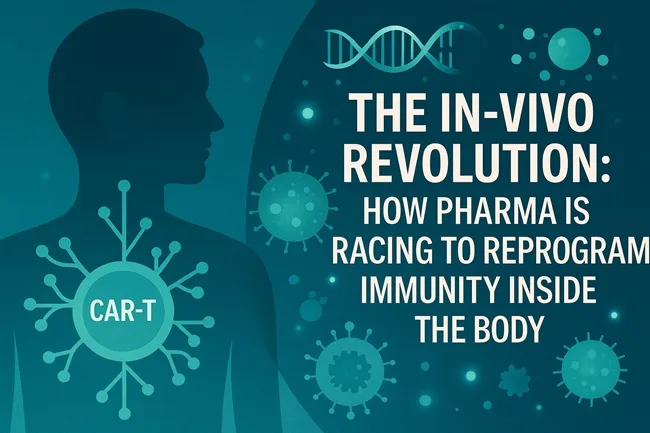
Bristol Myers Squibb’s $1.5 billion acquisition of Orbital Therapeutics has brought a once-theoretical dream closer to reality — reprogramming a patient’s immune cells inside their own body. This bold move marks the beginning of what experts now call the in-vivo revolution, a transformative shift in biotechnology that aims to overcome the limits of traditional cell therapy. Instead of extracting, editing, and reinfusing patient cells, in-vivo therapies use advanced RNA delivery systems and lipid nanoparticles to reprogram immunity directly in situ.
Across the global biotech industry, companies from Bristol Myers Squibb and BioNTech to emerging innovators like Capstan Therapeutics and Orna Therapeutics are converging on this new frontier. The stakes could not be higher. If successful, in-vivo immune reprogramming could reshape the economics, accessibility, and scalability of treatments for both cancer and autoimmune diseases — turning what are now one-time, hospital-limited procedures into mass-deployable medicines.
What is in-vivo CAR-T and how does it differ from conventional cell therapy?
To understand the momentum behind this shift, one must first revisit how traditional CAR-T therapy works. The ex-vivo model, which underpins current treatments such as Abecma and Breyanzi from Bristol Myers Squibb, involves harvesting a patient’s T cells, engineering them outside the body to express a chimeric antigen receptor (CAR), expanding those cells in a bioreactor, and then reinfusing them to attack cancer cells. The process is highly personalized and clinically effective but remains expensive, complex, and geographically constrained.
In-vivo CAR-T, by contrast, reimagines the process as a direct intervention. Scientists deliver genetic or RNA-based instructions into the patient’s immune cells using lipid nanoparticles or viral vectors, triggering the body itself to produce CAR-T cells internally. This “biological programming” happens inside the bloodstream, cutting out weeks of manufacturing and reducing dependency on sophisticated cell-processing facilities.
The shift from laboratory manipulation to in-body reprogramming represents not just a technical evolution but a conceptual leap. It aligns with the broader biopharma goal of transforming therapies from procedures into products — off-the-shelf, scalable interventions that behave more like drugs than surgeries. For patients, it means shorter wait times, fewer hospital visits, and potentially more affordable access to life-saving treatments.
Why now? The science that made in-vivo immune reprogramming possible
The idea of directly programming cells inside the human body has existed for over a decade, but three recent breakthroughs have accelerated its feasibility. First, the rise of circular RNA (circRNA) technology has addressed one of RNA medicine’s biggest limitations — stability. Circular RNA resists enzymatic degradation and allows for sustained protein expression, making it ideal for controlled CAR production.
Second, lipid nanoparticle (LNP) delivery systems, proven at scale during the mRNA vaccine rollout, now allow targeted, safe transport of RNA payloads to specific immune cells. These nanoparticles can be modified to reach T cells, B cells, or macrophages with remarkable precision. Third, AI-driven sequence design and predictive modeling have dramatically improved how researchers optimize RNA constructs for durability, safety, and tissue selectivity.
Together, these advances have turned in-vivo cell programming from speculative science into a tangible, investable technology platform. Companies are leveraging this convergence to design new therapies that can encode entire immune pathways rather than single proteins — an idea that could redefine treatment for both cancer and chronic inflammation.
Which companies are leading the in-vivo race — and why are mergers defining this new frontier?
The in-vivo revolution has triggered a wave of dealmaking across the pharmaceutical landscape. Bristol Myers Squibb’s purchase of Orbital Therapeutics for $1.5 billion was the clearest signal yet that Big Pharma sees in-vivo CAR-T as the next platform race. The deal followed Gilead’s $350 million acquisition of Interius BioTherapeutics, which develops similar in-vivo delivery systems for T-cell targeting. Pfizer, AstraZeneca, and Roche are also quietly building RNA-delivery research divisions, while BioNTech and Moderna are extending their mRNA expertise beyond vaccines into programmable immunotherapy.
Among startups, Capstan Therapeutics, Orna Therapeutics, and Cartesian Therapeutics are seen as leaders. Capstan is developing LNPs that home in on T cells, while Orna’s circular RNA pipeline aims to create transient but durable immune reprogramming. Cartesian, recently backed by AstraZeneca, is exploring in-vivo mRNA cell therapies for lupus and other autoimmune diseases.
The recent flurry of acquisitions and partnerships underscores one pattern: large pharmaceutical companies would rather buy than build these complex platforms. With safety validation, regulatory pathways, and AI integration all moving fast, consolidation has become the quickest way to secure intellectual property and technical know-how.
What challenges and risks still stand in the way of in-vivo CAR-T therapies?
For all the excitement, in-vivo immune programming faces formidable scientific and regulatory hurdles. Delivering genetic material safely to the right immune cells remains a delicate task. Even with advanced LNPs, off-target effects, cytokine overactivation, or prolonged expression can pose serious risks. Regulators are still developing frameworks to evaluate transient genetic modifications, and dosing remains a major unknown.
Unlike ex-vivo therapies, where CAR-T cells can be closely monitored and controlled, in-vivo systems rely on the body’s own biology. Controlling dosage, persistence, and reversibility is essential to avoid immune overdrive or chronic toxicity. Furthermore, manufacturing RNA-LNP constructs at scale requires precision and stability that only a handful of facilities currently possess.
The U.S. Food and Drug Administration and the European Medicines Agency are reportedly collaborating on new guidance to handle in-vivo reprogramming trials. Until the first human results demonstrate consistent safety, investors and clinicians alike will approach this new modality with cautious optimism rather than unbridled enthusiasm.
Can in-vivo reprogramming shift treatment paradigms in autoimmune disease and cancer?
If safety and efficacy can be proven, the implications are enormous. Autoimmune diseases such as lupus, myasthenia gravis, and multiple sclerosis — all driven by rogue immune cells — could be addressed through selective depletion and retraining of immune pathways. Instead of lifelong immunosuppressants, patients could receive one or two in-vivo CAR-T doses that “reset” their immune balance.
In oncology, the technology could reduce the bottleneck in access to CAR-T treatments, which are currently limited to specialized centers. Imagine an oncology clinic administering a standardized RNA therapy that instructs the patient’s immune system to target their own tumor antigens — effectively converting a hospital procedure into a drug. The same framework could extend to vaccines, regenerative medicine, and even metabolic disorders where transient gene expression could correct imbalances.
The broader vision, echoed by industry leaders, is a future where medicine becomes code — sequences written, optimized, and delivered directly into human biology.
How are investors pricing the in-vivo revolution—and what early signals show where the smart money is moving?
The financial community is treating in-vivo immunotherapy as the next major platform cycle after mRNA vaccines. Institutional investors have shown willingness to back preclinical-stage companies at billion-dollar valuations, valuing platform potential over near-term revenue. Analysts from major brokerages describe the sector as a “binary but asymmetric opportunity,” where one validated human proof-of-concept could unlock massive upside.
Bristol Myers Squibb’s acquisition of Orbital Therapeutics reflects that sentiment. The $1.5 billion outlay for a pre-IND asset might seem aggressive, but the company views it as an investment in optionality — the ability to generate multiple therapies from a single RNA-delivery foundation. For investors, the immediate market reaction to such deals tends to be muted or even negative, as seen in BMY’s slight share dip after announcement, but longer-term sentiment hinges on early safety and efficacy data.
Funds specializing in biotech innovation are already rotating capital toward in-vivo platforms, betting that by 2027 at least one therapy will enter clinical Phase 1. The consensus is that the first demonstration of controllable, safe, and reversible CAR expression in humans would set off a wave of secondary financing and M&A across the industry.
What key milestones could decide whether in-vivo cell therapy becomes biotech’s next major breakthrough by 2027?
Between now and 2027, three milestones will determine whether in-vivo immune reprogramming remains a dream or becomes the next biotech paradigm. The first is regulatory validation, including the acceptance of investigational new drug (IND) applications for in-vivo CAR-T trials. The second is human proof-of-concept data showing controllable gene expression and measurable immune correction without toxicity. The third, and perhaps most decisive, is manufacturing scalability — the ability to produce LNP and RNA constructs reliably and affordably for thousands of patients.
Analysts expect multiple pharmas, including BMS, BioNTech, and Gilead, to file INDs within the next 18 months. Any positive safety signal could ignite a wave of investor enthusiasm comparable to the early mRNA vaccine breakthrough in 2020. On the other hand, any adverse immune events could delay the field by years and invite heavier regulatory scrutiny.
The road ahead: What the in-vivo revolution could mean for patients and pharma
The race to reprogram immunity inside the human body represents one of the boldest transformations in modern medicine. It is not merely about speed or cost; it’s about changing the architecture of therapy itself. In-vivo reprogramming blurs the line between biology and technology, promising a world where treatments are digitally designed, RNA-encoded, and biologically executed.
For pharmaceutical giants like Bristol Myers Squibb, this is a strategic necessity — a way to remain competitive as traditional blockbusters face patent cliffs. For startups, it is the opportunity of a generation to define an entirely new therapeutic category. And for patients, it is the hope that a complex, costly treatment can one day be delivered as a simple infusion, with the body doing the rest.
The next two years will determine whether the in-vivo revolution is biotech’s next golden age or its next great lesson in scientific humility. Either way, the direction of travel is clear: the future of medicine is no longer outside the body — it’s happening within.
Discover more from Business-News-Today.com
Subscribe to get the latest posts sent to your email.