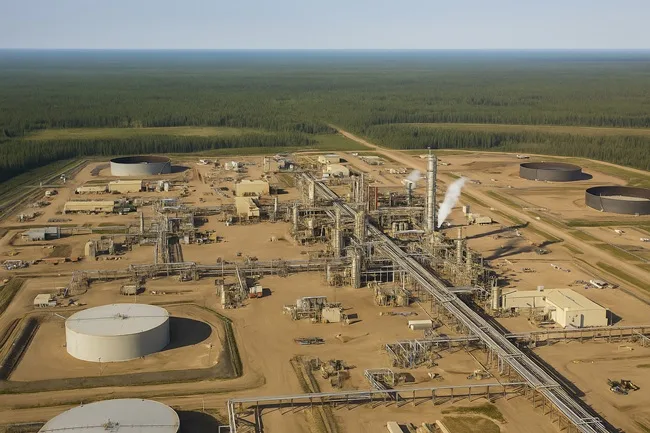
Strathcona Resources Ltd. (TSE: SCR) has ended its hostile bid for MEG Energy Corp. (TSE: MEG), conceding the field to Cenovus Energy Inc. (TSE: CVE) and closing one of Canada’s most closely watched corporate battles of the year. The move is more than the conclusion of a takeover drama—it is a referendum on whether scale, once the surest path to profit in Alberta’s oil sands, still translates to value in a world that prices carbon as aggressively as crude.
Strathcona’s termination followed governance maneuvers by MEG’s board that left Cenovus with a clear structural advantage. Unable to satisfy its own bid conditions, Strathcona announced a C$10-per-share special distribution and a strategic reorganization that would leave it a pure-play heavy-oil company. In the same breath, the firm signaled a new era of discipline: capital return over empire building.
The episode has become a litmus test for Canada’s energy industry. If Cenovus and MEG succeed in integrating, they could validate the mega-merger as a defensible model even amid tightening emissions policy. If not, 2025 may be remembered as the year size stopped being synonymous with success.
Why did the Strathcona–MEG–Cenovus triangle become the proving ground for merger logic in the oil sands?
The bidding war unfolded as global capital retreated from large upstream projects. In May 2025, Strathcona launched a hostile C$5.9 billion approach for MEG. Within weeks, MEG’s board declared the offer inadequate and endorsed a friendly merger with Cenovus. By August, that deal carried a headline value near C$7.9 billion, later sweetened to C$8.6 billion including debt—about C$29.80 a share.
Strathcona countered at C$30.86, but MEG’s directors granted Cenovus permission to purchase and vote additional shares, then postponed the shareholder meeting. Those procedural steps effectively neutralized the higher offer. When Strathcona finally withdrew, it was clear that governance—not valuation—had decided the outcome. The message to investors was unmistakable: in modern M&A, control of the process can outweigh the size of the cheque.
If valuation no longer decides outcomes, how are governance levers redefining value creation in mega-mergers?
Hostile bids have become rare precisely because of tools like standstill waivers, shareholder-record rules, and poison-pill defences. In this contest, MEG’s board used those instruments to prioritize “deal certainty” and fend off disruption. For activists and merger arbitrageurs, the case will be cited for years as a turning point in Canadian takeover law.
It also illustrates a larger truth. In an industry that is consolidating under ESG pressure, boards are asserting strategic judgment over pure market pricing. The calculus is no longer “who pays more” but “who can execute within carbon and capital constraints.” That shift favours well-financed incumbents such as Cenovus, Suncor, and Canadian Natural—firms with deep integration and political capital to navigate Ottawa’s evolving climate framework.
Do oil sands mega-mergers still deliver classic synergies when carbon costs threaten to erode them?
Cenovus’s pitch rests on operational overlap. Its Foster Creek and Christina Lake sites already share infrastructure with MEG’s leases. Combining them promises unified steam networks, lower diluent costs, and simplified logistics across nearly 720,000 barrels a day of production. Analysts estimate potential annual savings in the C$300-C$400 million range once integration stabilizes.
Yet synergy math now faces a new counter-variable: the cost of decarbonization. Steam-assisted gravity drainage, the technology underpinning most oil-sands extraction, is energy-intensive. As Canada’s carbon-pricing system phases upward, each ton of CO₂ carries a real cash penalty. The only way for mega-projects to defend margins is to spread abatement technology—carbon-capture units, solvent co-injection, electrified boilers—across the widest possible base. Paradoxically, scale both magnifies exposure and enables mitigation.
Can sheer scale protect margins under Canada’s tightening emissions-cap and carbon-pricing policies?
Ottawa’s proposed oil-and-gas emissions cap aims to cut sector-wide output by as much as 40 percent from 2019 levels by 2030, while keeping the national carbon price trajectory toward C$170 per ton. For producers, the compliance math is stark: the larger the footprint, the bigger the bill.
However, bigger firms can finance carbon-capture and storage at lower cost. Cenovus, Suncor, and CNRL jointly lead the Pathways Alliance—a multi-billion-dollar CCUS corridor designed to collect and store up to 10 million tons of CO₂ annually by 2030. Smaller operators struggle to afford participation. Thus, consolidation doubles as a decarbonization strategy.
The risk is policy volatility. Should a future government tighten caps faster than credit schemes evolve, even the largest balance sheets could feel strain. For now, industry sentiment sees collaboration with regulators as the safer path than fragmentation.
Are Canada’s domestic champions replacing exploration with optimization as their growth model?
The oil sands once thrived on new-mine ambition; today they survive on operational finesse. Following a decade of foreign divestments—Shell, TotalEnergies, and ConocoPhillips all scaled back—Canadian firms turned inward. Instead of greenfield development, they chase bolt-ons, debottlenecking, and efficiency upgrades.
Cenovus’s integration of Husky Energy in 2021 proved the template: capture synergies, deleverage, then recycle cash into dividends and share buybacks. Canadian Natural Resources and Suncor have echoed the playbook. Strathcona’s retreat and cash distribution signal that the discipline narrative now dominates. Investors reward predictable returns, not production spikes.
Are investors still rewarding mega-mergers—or are they skeptical until integration and carbon goals are proven?
Market reaction to the MEG saga suggests conditional optimism. MEG shares trade close to the Cenovus offer price, implying confidence in completion. Cenovus stock remains range-bound as traders balance synergy potential with integration and debt concerns.
Institutional funds now scrutinize merger discipline more than deal size. Portfolios demand free-cash-flow yield, capital-return visibility, and credible emissions pathways. Ratings agencies, meanwhile, view scale as credit-neutral unless accompanied by measurable cost or carbon savings. Strathcona’s C$10 special payout was interpreted as a shareholder-first pivot—a signal that restraint can be as value-accretive as acquisition.
The post-pandemic investor psyche prizes patience: better a C$10 cash distribution today than a C$10 billion acquisition that could underperform tomorrow.
How can Canada’s oil sands mergers still create shareholder value over the next five years?
The economics of value have moved downstream into execution. Integration that enhances throughput and reliability, logistics that cut transport costs, and carbon-capture networks that monetize credits all produce real cash flow. Large, contiguous SAGD complexes can share heat, water, and blending infrastructure, trimming per-barrel operating costs.
Marketing scale improves netbacks by optimizing heavy-crude blending and export scheduling. Access to global capital improves refinancing terms and lowers the weighted average cost of capital. Most importantly, larger entities can sustain higher decarbonization spending without threatening dividend stability.
That is why investors still back disciplined consolidation: not for empire, but for efficiency. The alpha now lies in post-merger integration quality, not the takeover premium.
Could Canada’s policy pendulum erase the benefits of scale if regulations tighten faster than technology adapts?
Policy remains the biggest variable in every valuation model. A harsher emissions-cap trajectory or an abrupt shift in carbon-credit availability could compress free cash flow. Conversely, a balanced framework that rewards intensity reductions while protecting competitiveness could amplify merger value by accelerating returns on CCUS and electrification investments.
Industry insiders expect compromise. Ottawa cannot meet climate targets without corporate participation, and corporations cannot attract capital without regulatory clarity. The likely outcome is a pragmatic equilibrium: gradual tightening, matched by tax credits and provincial flexibility. In that environment, consolidation becomes a compliance hedge as much as a growth strategy.
So, can mega-mergers still create alpha in a carbon-constrained decade—or has the center of gravity shifted for good?
Mega-mergers remain economically defensible when they deliver tangible cost reductions and credible decarbonization leverage. The key is execution within a tight policy corridor. The 2025 Strathcona–MEG–Cenovus contest proved that investors now judge deals by governance quality, integration speed, and carbon strategy rather than offer size.
If Cenovus achieves its synergy targets and demonstrates emissions improvements through the Pathways Alliance, it will validate the new-era merger thesis: scale not as expansion, but as efficiency. If it falters, the narrative will swing decisively toward smaller, more agile operators emphasizing shareholder payouts over strategic mass.
Either way, the era of growth for growth’s sake is over. The oil sands’ future depends less on discovering new reserves and more on discovering new discipline.
What should investors watch as the next catalyst in Canada’s oil sands consolidation cycle?
The MEG shareholder vote on October 22 is the near-term inflection point. Beyond that, markets will track synergy delivery, debt reduction, and carbon-capture milestones through 2026. Analysts also see potential secondary waves of consolidation among mid-tiers such as Baytex Energy, Tamarack Valley, and Athabasca Oil, where bolt-on economics could extend the scale narrative without re-igniting hostile drama.
In this evolving ecosystem, governance preparedness—transparent boards, shareholder alignment, and credible climate disclosure—will decide who becomes the next consolidator and who becomes the next target. The lesson from Strathcona’s retreat is clear: value creation in 2025 is not about winning bids; it is about winning trust.
Discover more from Business-News-Today.com
Subscribe to get the latest posts sent to your email.