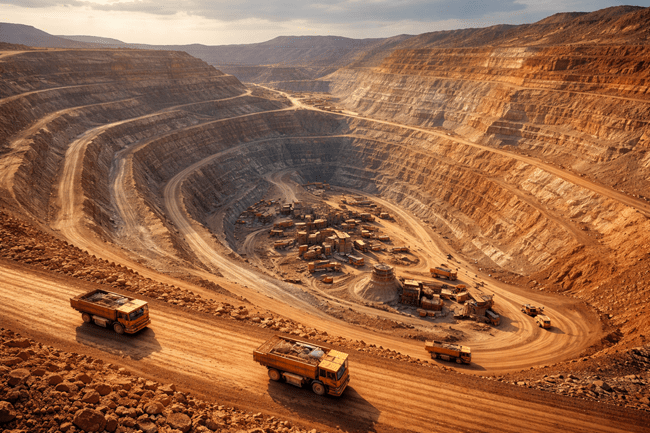




Global mining powerhouse Rio Tinto plc (NYSE: RIO | LSE: RIO), together with Mitsui Iron Ore Company and Nippon Steel Corporation, has announced a US $733 million investment to extend the life of the West Angelas iron ore hub in Western Australia’s Pilbara region. Rio Tinto’s share of the funding stands at US $389 million, with the remainder covered by its Japanese joint-venture partners under the Robe River JV structure.
The project aims to sustain output at around 35 million tonnes per year, integrate autonomous haulage systems by 2027, and protect about 950 full-time roles, while an additional 600 jobs will be created during the construction phase. The new investment signals Rio Tinto’s commitment to maintaining its dominance in the global iron ore market despite cost pressures, ESG scrutiny, and decelerating steel demand in China.
Why is Rio Tinto doubling down on its sustaining iron ore strategy now?
Rio Tinto’s decision comes at a time when iron ore markets remain volatile and sentiment toward heavy industry capital spending is mixed. The company is opting for a sustaining project, not a greenfield expansion, focusing on life-extension and refurbishment of existing assets rather than riskier exploration ventures.
The West Angelas mine, operational since 2002, has long been a cornerstone of Rio’s Pilbara operations. The new investment will fund the development of adjacent deposits, construction of new haul roads and non-process infrastructure, and continued modernization of its processing facilities. By extending the hub’s life, Rio Tinto ensures reliable supply for Asian steelmakers and reduces the risk of production disruption as new projects such as Rhodes Ridge advance through the planning stages.
This “maintenance before expansion” approach aligns with Rio Tinto’s broader strategy in the Pilbara — sustaining output around 130 million tonnes per annum through incremental capital rather than large greenfield spends. Earlier in 2025, the company approved a US $1.8 billion boost for its Brockman hub, signaling a portfolio philosophy that balances reliability with future growth.
How does this investment fit into Rio Tinto’s long-term Pilbara roadmap?
Pilbara remains Rio Tinto’s most lucrative region, anchoring its cash flows and dividends. Sustaining West Angelas ensures continuity in a tight logistical network that feeds ore to Port Dampier and Cape Lambert. The company has also initiated a pre-feasibility study for the Rhodes Ridge deposit, targeting an initial capacity of 40 million tonnes per year by 2030.
The investment has already cleared state and federal regulatory approvals and includes agreements with the Yinhawangka and Ngarlawangga Peoples to safeguard cultural heritage sites — a key lesson from the 2020 Juukan Gorge incident that damaged Rio Tinto’s reputation. By embedding co-design and heritage management into its mine-life extensions, the company is attempting to restore its social license to operate while meeting environmental obligations.
This is crucial because Australia’s Environmental Protection Authority is tightening oversight on rehabilitation and biodiversity compliance. For Rio, linking capital projects to ESG frameworks is no longer optional — it is core to securing permits and long-term credibility.
What are the financial and operational implications for Rio Tinto and partners?
Rio Tinto’s US $389 million stake will be spread across haul road construction, ore-zone development, electrical upgrades, and autonomous truck deployment. The project is expected to deliver first ore by 2027 and extend the hub’s mine life for another decade.
Operationally, this investment bolsters efficiency by reducing downtime and equipment wear. Rio’s adoption of autonomous haulage is expected to cut unit costs over time, while retaining its focus on safety and local employment. For Japan’s Mitsui and Nippon Steel, it secures a stable stream of high-grade iron ore to fuel steel production and energy-transition infrastructure back home.
In 2024, Rio Tinto reported its lowest profit in five years as iron ore prices softened and unit cash costs in the Pilbara rose from US $23.20 to US $24.30 per wet metric ton. That weakness carried into the first half of 2025, with underlying profit down 16 percent year-on-year. Given that iron ore still accounts for more than half of Rio’s EBITDA, this US $733 million infusion is essential to protect core earnings. If executed efficiently, the sustaining project should help stabilize cash flows and preserve dividend capacity amid price volatility.
How did the market react to Rio Tinto’s announcement?
Investors initially welcomed the news. Rio Tinto’s shares rose around 0.9 percent on the Australian Securities Exchange and 1.2 percent in London, outperforming broader market indices. Traders interpreted the move as a sign of long-term confidence in iron ore fundamentals and production continuity.
Over the past 12 months, Rio’s stock has been range-bound between US $51.60 and US $70.00, with a modest total return of –6.6 percent including dividends. So far in 2025, shares are up roughly 3.7 percent year to date, showing measured institutional optimism.
Analysts view this capex move as defensive but strategically sound. It signals Rio is not chasing volume growth for its own sake but focusing on asset quality and efficiency. That message resonates with investors favoring dividend resilience over speculative expansion. Institutional flows from long-only funds appear steady, with marginal rotation from short-term commodity trades back into longer-term positions.
What are the key risks that could impact project returns and shareholder value?
Environmental oversight remains a significant variable. The Western Australia Environmental Protection Authority has been pressing miners like Rio Tinto, BHP Group, and Fortescue Metals to improve land rehabilitation and closure plans. Failure to meet these requirements could increase capitalized costs and delay permits.
Geological and operational uncertainties also loom. Lower-grade ore zones can reduce yield over time, forcing more processing per ton of saleable output. Any slippage in autonomous technology deployment or infrastructure completion could push first ore beyond 2027, affecting cash flow timing.
Externally, iron ore prices remain highly sensitive to China’s steel production policies and global demand cycles. If Beijing’s construction activity remains subdued, average benchmark prices could stay below US $95 per ton for longer, compressing returns from sustaining projects. Conversely, if India’s infrastructure boom accelerates, Rio’s decision may prove prescient.
How does this investment influence Rio Tinto’s transition-metal portfolio and future positioning?
The West Angelas funding is a reminder that iron ore remains Rio Tinto’s breadwinner, even as the company pivots toward energy-transition metals. Recent moves such as the Arcadium Lithium acquisition and expanded copper production from Oyu Tolgoi in Mongolia show a portfolio hedge against cyclicality. Yet, the Pilbara still accounts for the bulk of Rio’s earnings power and credit strength.
In that context, West Angelas is not just maintenance—it is insurance against global market volatility. Analysts expect Rio Tinto to maintain its dividend yield above 6 percent for FY26, supported by steady iron ore volumes and moderate capital discipline. Sustaining projects like this one offer visibility into future cash generation that appeals to long-term institutional investors seeking defensive commodity exposure.
Does this move justify a buy or hold stance on Rio Tinto stock?
From an expert standpoint, the US $733 million allocation appears strategically balanced—large enough to matter, small enough to stay within capital discipline. Market reaction suggests analysts lean toward a “hold to moderate buy” view, contingent on iron ore price stability and project delivery timelines.
Investors seeking yield can view Rio Tinto as a steady cash flow producer, while growth investors may wait for clearer signals from the Rhodes Ridge project and transition-metal diversification. Institutional sentiment remains measured but constructive, with major funds still allocating to the miner for its balance-sheet strength and strong ESG disclosure progress since 2022.
How could Rio Tinto’s execution, iron ore prices, and regulatory landscape shape outcomes beyond 2026?
Execution discipline will determine whether Rio’s sustaining strategy pays off. Analysts will track the progress of road and haulage infrastructure, on-time autonomous fleet rollout, and any updates to the Rhodes Ridge timeline. Iron ore price movements, particularly from China and India, will also shape the stock’s trajectory.
A sustained price recovery above US $110 per ton could improve Rio Tinto’s free cash flow by billions annually and enable further buybacks or debt reduction. On the flip side, tighter regulations or environmental disputes could delay projects and suppress returns. Still, the company’s pivot to “steady-state excellence” shows that Rio Tinto is relying on operational depth as much as scale to stay ahead of rivals like BHP and Fortescue.
For now, Rio Tinto’s $733 million Pilbara investment signals quiet confidence that iron ore still has a long future in the energy transition era — and that well-timed sustaining capital can be just as strategic as new discovery.
Discover more from Business-News-Today.com
Subscribe to get the latest posts sent to your email.