What makes the AK-630 procurement a defining step in India’s short-range air defence modernization?
The Indian Army’s decision to acquire six AK-630 30 mm multi-barrel air defence guns under Mission Sudarshan Chakra signals a strategic evolution in how India defends its western frontier. These rapid-fire, naval-grade cannons—long trusted aboard warships—are being re-engineered for land deployment along the Pakistan border, forming the innermost layer of a new multi-tiered air defence shield.
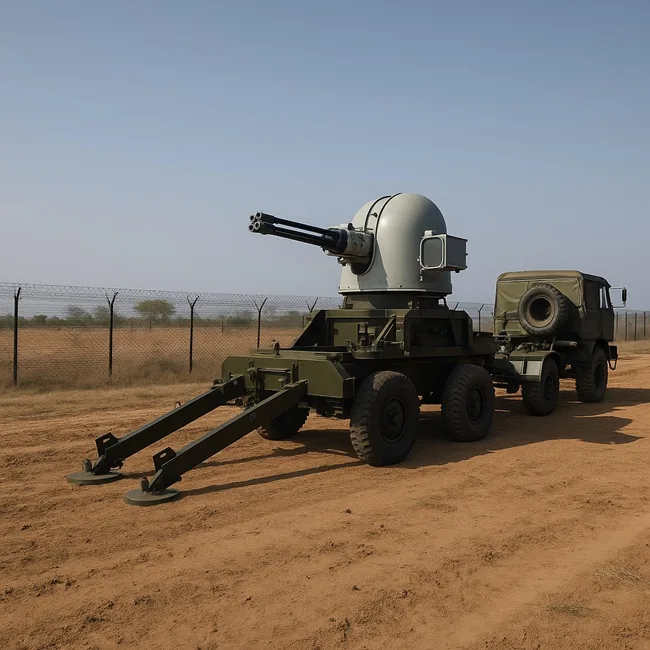
Designed to counter drones, rockets, artillery, and mortar threats, the land-mounted AK-630 will serve as India’s first dedicated close-in weapon system for border zones. Each gun can fire up to 3,000 rounds per minute, covering an effective range of approximately four kilometres. The goal is to intercept low-altitude targets before they reach populated areas or sensitive installations.
Under the Army’s Request for Proposal, the system will be mounted on high-mobility trailers and paired with electro-optical tracking modules for automatic target acquisition. This configuration allows swift redeployment across diverse terrain—from desert plains in Rajasthan to riverine belts near Punjab—while maintaining full 360-degree coverage.
How Mission Sudarshan Chakra evolved after Operation Sindoor and why its scope now extends beyond missiles
Mission Sudarshan Chakra, launched in 2025, represents India’s vision for a unified, multi-layered defence grid integrating radar, sensors, cyber command, and kinetic interceptors. Its timing was no coincidence. The program was accelerated in the aftermath of Operation Sindoor, when Pakistan allegedly targeted civilian and religious zones across Jammu and Punjab with low-flying projectiles and modified drones.
Those incidents exposed a vulnerability in India’s lower airspace defences—missile systems like Akash or S-400 could handle medium- to high-altitude threats, but slower, smaller aerial intrusions often went undetected until too late. The Army’s leadership concluded that a fast-response “gun layer” was missing, prompting the decision to repurpose a proven naval system like the AK-630.
While the Sudarshan Chakra framework already includes indigenous missile initiatives like Project Kusha, the AK-630’s integration reflects a new understanding of layered deterrence: that no single class of weapon can handle every vector. Drones and loitering munitions require speed and volume of fire, not just range or precision.
By deploying these systems near vulnerable border towns and places of worship, the Army is extending the reach of Sudarshan Chakra from strategic missile interception to tactical civilian protection—a move that merges defence with domestic security.
How the naval AK-630 system is being re-engineered for mobility, terrain, and networked warfare
Adapting the AK-630 for land is an engineering challenge that blends naval precision with ground-force agility. Unlike ships, land vehicles must stabilize firing under uneven terrain and maintain rapid rotation speed without a fixed hull. Engineers are therefore integrating stabilized power systems, reinforced recoil mounts, and modular cooling units to sustain firing bursts in desert heat or Himalayan cold.
The success of this adaptation hinges on its integration with the Akashteer air defence control network—India’s emerging digital backbone for radar-gun-missile coordination. If executed properly, radar feeds from Akashteer and other surveillance assets will guide the AK-630’s fire control systems in real time, allowing synchronized target engagement across multiple layers of defence.
However, logistics remain a major constraint. The AK-630 consumes large volumes of 30 mm ammunition, requiring steady supply lines and rapid reload capabilities. Each system will also demand trained operators capable of interpreting radar inputs and coordinating with higher command in seconds. A single hesitation could mean the difference between interception and impact.
How this procurement changes the balance of deterrence along the Pakistan border
Strategically, deploying AK-630s along the Pakistan frontier is both tactical and symbolic. It signals India’s intent to harden its border infrastructure and deter asymmetric aerial warfare that exploits civilian corridors. Unlike high-altitude missile batteries that guard wide regions, these guns can operate in urban and semi-urban perimeters, protecting key sites like gurdwaras, oil depots, and logistics hubs.
The psychological effect matters too. The sight of rotating, high-velocity gun platforms near sensitive zones sends a visible message of readiness, echoing global trends in close-in protection. Nations such as Israel, South Korea, and Turkey have all moved toward multi-layered systems that combine kinetic guns with missile interceptors and electronic warfare jammers. India’s decision to localize that concept—through the Sudarshan Chakra umbrella—places it in line with contemporary defence doctrines that prioritize speed over scale.
But such deployment also raises operational questions. The proximity of civilian zones to active gun units demands strict fire-discipline protocols and automated “safe zone” calibration. Commanders must ensure that human oversight and electronic targeting maintain balance between rapid response and collateral-damage prevention.
How the AK-630 fits within India’s broader air defence modernization strategy
Within the Indian Army’s air defence ecosystem, the AK-630 is envisioned as the final kinetic layer, sitting below the Akash missile batteries and Project Kusha interceptors. This tiered structure mirrors the Iron Dome concept, but tailored for India’s unique geography.
Above the gun layer, medium-range surface-to-air systems will intercept incoming munitions between 10–100 km out, while long-range assets like the S-400 Triumf will guard critical command nodes and cities. At the top sits ballistic missile defence, being developed by the Defence Research and Development Organisation.
Together, these layers aim to create a 360-degree, continuously monitored envelope. The AK-630’s role, though narrow, is crucial: to handle “leakers”—those threats that evade radar locks or missile engagement envelopes. In effect, it’s the difference between interception and impact.
Institutionally, the move also fits within the Aatmanirbhar Bharat defence mandate, as state-owned Advanced Weapons and Equipment India Ltd (AWEIL) will oversee procurement and eventual localization. That could pave the way for a future Make-II version built in India, reducing dependence on legacy imports.
Why defence experts see the AK-630 deployment as both a tactical breakthrough and a technological experiment
Defence analysts interpret the AK-630 procurement as an innovative yet high-risk experiment. Converting naval systems for ground deployment could deliver immediate firepower gains but may also expose integration bottlenecks. Success will depend on sensor fusion, terrain adaptability, and sustainment logistics rather than sheer gun performance.
Strategic observers also highlight that this decision reflects a doctrinal pivot. Instead of investing solely in high-end missile defences, India is adopting a “many-small-solutions” strategy—deploying multiple layers of affordable, quick-response assets that collectively raise the deterrence threshold.
However, there’s cautious optimism. If the AK-630 land variant achieves full operational capability, it could become a template for future land-based CIWS platforms across the Army, Air Force, and even homeland security agencies guarding airports or critical infrastructure.
The risk lies in execution. Without proper radar linkage, training cycles, and ammunition logistics, the system could become an expensive standalone asset. Its real test will come not in procurement but in integration—how fast it can talk, track, and fire within the joint command grid.
What lies ahead for India’s tactical air defence roadmap under Mission Sudarshan Chakra
In the months ahead, the Indian Army will begin vendor evaluations and field trials across select western command sectors. Initial deployment is expected in high-vulnerability corridors where cross-border drone or rocket activity remains frequent. Parallel development under Project Kusha will aim to integrate these gun units into India’s emerging digital air defence ecosystem by 2026.
The long-term plan under Mission Sudarshan Chakra envisions a phased readiness model—with radar, missile, and gun layers harmonized through artificial-intelligence-enabled control centres. If achieved, India could possess one of the world’s most adaptive hybrid defence networks, blending indigenous innovation with repurposed global technology.
For now, the AK-630 announcement is more than a procurement—it’s a signal of strategic impatience. The Army is no longer waiting for perfect solutions; it’s adapting what works, fast. In an era when drone warfare blurs civilian and military boundaries, speed of adaptation may matter more than technological purity.
From a broader defence-industry lens, this pivot redefines India’s procurement philosophy—from reactive import to proactive innovation. The outcome will determine whether Sudarshan Chakra becomes a national deterrent model or just another ambitious military acronym.
Discover more from Business-News-Today.com
Subscribe to get the latest posts sent to your email.