Why is WeRide’s Ras Al Khaimah deployment seen as a pivotal milestone in the UAE’s smart mobility strategy?
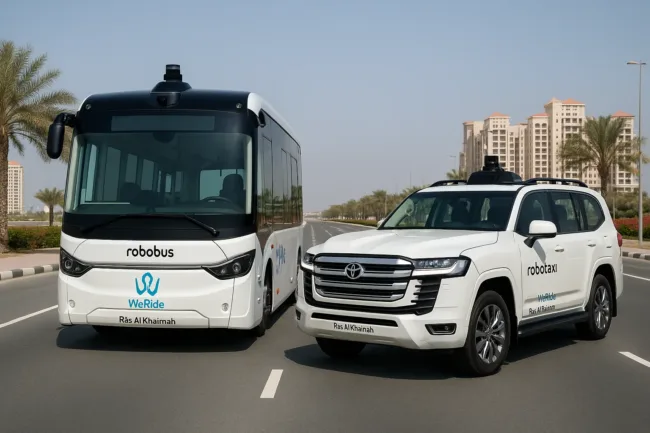
WeRide Inc. (NASDAQ: WRD), the Chinese autonomous driving pioneer, has launched pilot operations of its Robotaxi GXR and Robobus services in Ras Al Khaimah, marking its entry into the third emirate of the United Arab Emirates. The deployment, carried out in collaboration with the Ras Al Khaimah Transport Authority (RAKTA), is a strategic addition to the UAE’s push for smart mobility and a critical step in WeRide’s Middle East expansion strategy.
The symbolic weight of the launch was underscored by the presence of His Highness Sheikh Saud bin Saqr Al Qasimi, Ruler of Ras Al Khaimah, who personally boarded the inaugural Robobus ride on Al Marjan Island. He was accompanied by the Chinese ambassador to the UAE and senior transport officials, highlighting both political support and the strengthening of technological ties between the UAE and China.
By embedding autonomous technology into the emirate’s transport ecosystem, Ras Al Khaimah is positioning itself as a frontrunner in next-generation mobility. The project aligns closely with RAKTA’s Comprehensive Mobility Plan 2030, which focuses on integrating multiple transport modes, advancing regulatory frameworks, and expanding sustainable, tech-enabled services.
How do the robotaxi and robobus services operate in Ras Al Khaimah today?
The Ras Al Khaimah pilot introduces two services with distinct purposes. The Robobus operates a nine-stop route along Al Marjan Island, connecting luxury hotels, resorts, and entertainment destinations, with planned extensions to Mina Island. This positioning is not coincidental, as Al Marjan has become the centerpiece of the emirate’s tourism strategy, with major hospitality investments and the planned introduction of the region’s first integrated casino.

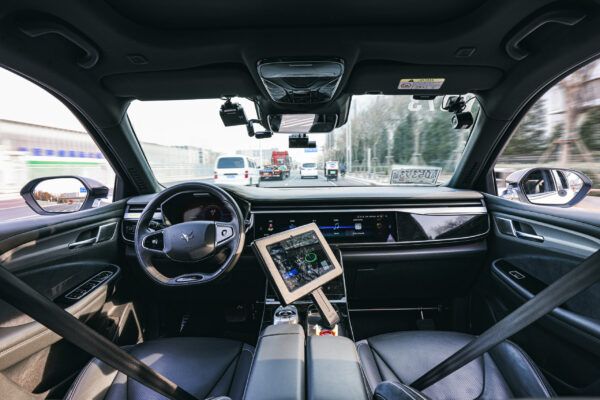
The Robotaxi GXR focuses on the city center, enabling autonomous mobility to be tested in mixed-use urban corridors. Both services are currently operated with a safety officer onboard, a transitional measure that balances public trust with regulatory oversight. The ultimate aim is to achieve fully driverless operation once approvals are secured, a milestone expected in the coming years.
For now, exclusivity is key. WeRide has been designated as the sole autonomous mobility partner in Ras Al Khaimah, giving the company a significant competitive edge and establishing high barriers to entry for rivals seeking access to the emirate.
What does the Memorandum of Understanding between WeRide and RAKTA include?
The partnership between WeRide and RAKTA was formalized through a Memorandum of Understanding. The agreement extends beyond mere vehicle deployment to include operational training, technical support, and regulatory development. By embedding WeRide within RAKTA’s strategic planning, the emirate ensures that autonomous technology is integrated into its transport ecosystem in a structured and scalable manner.
This alignment is particularly important because one of the most persistent obstacles to autonomous mobility worldwide has been fragmented regulation. Ras Al Khaimah’s approach reduces those friction points and positions the emirate to move swiftly from pilot to commercialization.
Why is Ras Al Khaimah becoming an attractive testing ground for autonomous vehicles?
Although smaller than Dubai or Abu Dhabi, Ras Al Khaimah has emerged as a dynamic hub for tourism and logistics. The emirate’s emphasis on developing Al Marjan Island as a hospitality and leisure destination makes it a natural setting for futuristic, tourist-centric mobility solutions. Unlike the more complex traffic environments of Dubai or Abu Dhabi, Ras Al Khaimah offers a balance of controlled routes and mixed-use areas, making it an ideal testing ground for real-world autonomous transport.
The UAE has consistently been a first mover in mobility innovation. Dubai began experimenting with autonomous taxis in 2019, while Abu Dhabi introduced driverless shuttles on Yas Island. Ras Al Khaimah now joins that ecosystem, ensuring that multiple emirates contribute to shaping the regulatory and operational framework of autonomous mobility.
This approach aligns with the UAE’s wider economic diversification strategy, which emphasizes technology adoption, tourism growth, and infrastructure investment. By positioning itself at the cutting edge of mobility, Ras Al Khaimah enhances its global profile as both a tourist destination and an innovation testbed.
What is the investor sentiment toward WeRide and its Nasdaq-listed stock?
As a publicly traded company, WeRide Inc. (NASDAQ: WRD) has been drawing close attention from investors. The company operates in a sector defined by high capital expenditure and long development cycles. Despite these challenges, investor sentiment has been cautiously optimistic. Analysts have projected potential upside of 50 to 100 percent for the stock, contingent on WeRide’s ability to scale commercial operations across both Gulf and Asian markets.
The company currently operates with negative forward and trailing P/E ratios, reflecting its ongoing investments and lack of profitability at this stage. Yet, institutional investors such as Robert Bosch GmbH and Mirae Asset Global have taken significant positions in the company, signaling confidence in its long-term trajectory.
Analyst sentiment remains mixed, with some advising a hold position due to execution risks, uncertain regulatory timelines, and unclear monetization strategies. Others point to WeRide’s exclusive partnerships, such as the Ras Al Khaimah deal, as clear signals of first-mover advantage that justify a buy recommendation. For retail investors, the stock has gained traction as a speculative growth play, reminiscent of Tesla’s early positioning in the electric vehicle sector.
What risks could affect the Ras Al Khaimah project and WeRide’s global trajectory?
The risks are significant and cannot be overlooked. Safety is paramount. Although no incidents have been reported, the fact that operations still require onboard safety officers highlights the distance that remains before full autonomy can be realized. Any mishap, even at low speed, could have reputational consequences that ripple through both regulatory and public trust environments.
Tourism dependence is another risk. The Robobus service is heavily tied to the Al Marjan corridor, and ridership could fluctuate with changes in tourist flows. Similarly, global economic slowdowns or regional disruptions could impact demand for autonomous shuttle services.
On the competitive front, WeRide faces formidable global rivals. U.S.-based Waymo and Cruise, along with Chinese competitor Baidu Apollo, are aggressively scaling their footprints. WeRide’s edge in Ras Al Khaimah is meaningful but will need to be replicated across markets with more stringent regulations.
How does this move fit into the global autonomous transport race?
The deployment reflects a larger global shift in which Middle Eastern governments are positioning themselves as living laboratories for disruptive technologies. With sovereign wealth backing and aggressive diversification strategies, Gulf states are offering regulatory flexibility, infrastructure, and capital to attract mobility innovators.
For WeRide, the Ras Al Khaimah launch is not just about serving a local market. It represents a model that can be exported to other cities in Asia, Africa, and emerging markets where tourism and urbanization are creating similar opportunities. By proving operational viability in mixed-use tourism and city corridors, the company gains a showcase that strengthens its global pitch.
What is the outlook for WeRide and the UAE’s autonomous ecosystem?
The near-term milestones will include securing regulatory approval for fully driverless operation, expanding the Robobus service into Mina Island, and scaling the Robotaxi GXR’s coverage across Ras Al Khaimah. Success in these areas will further cement WeRide’s position as a leading operator in the region.
For the UAE, the project reinforces its ambition to lead in artificial intelligence and smart infrastructure. Ras Al Khaimah’s strategy complements the broader national vision to establish the country as a global testbed for emerging technologies. If executed effectively, the WeRide deployment could serve as a template for other emirates and even neighboring Gulf countries such as Saudi Arabia and Qatar.
For investors, the Ras Al Khaimah deal is a reminder that while profitability is still distant, WeRide’s progress is tangible. Market watchers will be closely monitoring regulatory decisions, operational performance, and route expansion over the coming months. These developments will determine whether WeRide can convert pilot projects into fully commercial ecosystems that justify its long-term valuation story.
Discover more from Business-News-Today.com
Subscribe to get the latest posts sent to your email.