



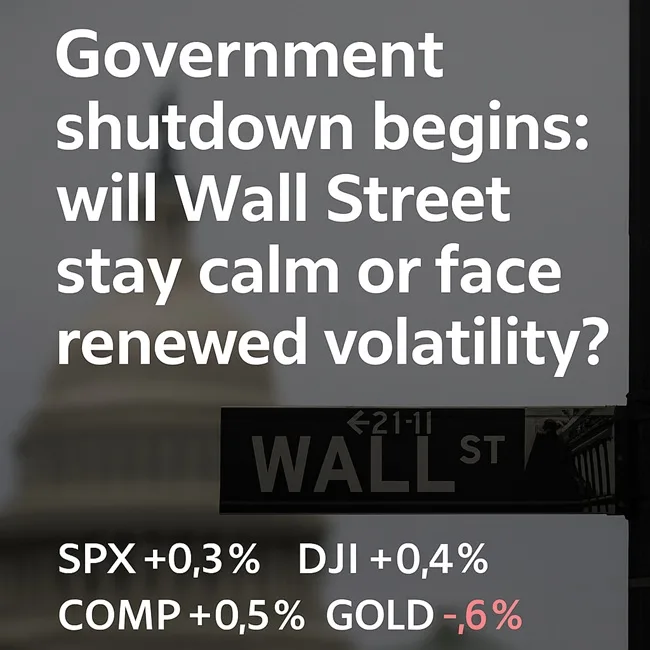
The U.S. federal government officially entered a shutdown on October 1, 2025, after Congress failed to reach a funding agreement before the deadline. As federal offices shutter and hundreds of thousands of employees brace for furloughs, investors are watching closely to see whether the standoff in Washington will rattle Wall Street. History suggests that shutdowns rarely produce market meltdowns, but the 2025 context—with inflation worries, an uncertain Federal Reserve policy path, and a slowing economy—raises the stakes in ways that could test investor patience.
Why does history show that government shutdowns rarely trigger sharp stock market declines even when political battles intensify?
Despite the dramatic headlines, past shutdowns have typically had little effect on equity markets. Since 1976, there have been 22 shutdowns, most lasting just a few days. The S&P 500 has risen during more than half of those episodes, with average market reactions muted. Even the record 35-day shutdown in 2018–2019 coincided with a strong equity rebound, as the S&P 500 climbed about 10 percent over the period. For many investors, that episode underscored a long-standing pattern: government shutdowns tend to be disruptive politically but manageable financially.
Analysts often emphasize that shutdowns are viewed as temporary disruptions. Markets assume Congress will eventually resolve the impasse, and corporate fundamentals rarely change overnight simply because government operations pause. This distinction between headline drama and economic fundamentals helps explain why investors often keep calm during these periods.
How could the 2025 shutdown scenario differ from past experiences and why might Wall Street react more sharply this time?
This year’s shutdown is already raising fresh concerns. One immediate effect is the suspension of critical government data releases. Agencies such as the Bureau of Labor Statistics and the Commerce Department cannot publish timely reports on jobs, inflation, and GDP, leaving the Federal Reserve without its usual guidance. Without updated data, markets may be forced to speculate about the direction of monetary policy, raising the risk of volatility.
Compounding the problem is the macro backdrop. The U.S. economy is facing slowing growth, persistent inflationary pressures, and questions over whether the Fed has the flexibility to cut rates in 2026. Unlike earlier shutdowns that unfolded against relatively stable economic conditions, the current environment is fragile. Prolonged fiscal dysfunction could deepen those concerns and increase the risk of investor unease.
Economists note that duration matters as much as the fact of the shutdown itself. A lapse of a few days may prove inconsequential, but if the standoff drags on for weeks, the cumulative effect on government contractors, consumer sentiment, and market psychology could become material.
What early signals should investors watch in financial markets if the shutdown drags on beyond initial expectations?
With the shutdown now underway, the next stage is to monitor how markets respond in real time. Safe-haven flows are already emerging, with gold prices hitting record highs. Bond markets may also offer early warnings. A drop in Treasury yields could signal expectations of slower growth, while widening corporate credit spreads would suggest rising concern about economic fallout.
Currency markets are another barometer. A weakening dollar would indicate eroding confidence in U.S. fiscal stability, especially if investors begin to see repeated episodes of political dysfunction as a structural risk. Meanwhile, the equity market’s IPO pipeline is at risk of freezing since the Securities and Exchange Commission cannot process new listings during the shutdown. A sustained backlog in IPO approvals could hurt sentiment in growth and tech sectors, where momentum depends heavily on fresh capital flows.
How are institutional investors and analysts framing sentiment around this shutdown compared with past ones?
Institutional analysts are largely counseling patience, pointing to decades of evidence that markets tend to move past shutdowns quickly. Many asset managers are advising clients to hold quality equities and avoid knee-jerk reactions. However, some economists have issued sharper cautions. They argue that the 2025 shutdown poses greater risks precisely because it collides with heightened uncertainty over Fed policy. If the central bank cannot act with clarity due to missing data, markets could experience bouts of volatility not seen in previous shutdowns.
Others have warned that a prolonged shutdown could trim GDP growth in the fourth quarter, with knock-on effects for corporate earnings. Sectors most exposed to federal spending, from defense contractors to health and infrastructure firms, could see pressure earlier than large-cap tech or consumer stocks.
For retail investors, the lesson is to remain disciplined. Panic selling is rarely justified, but paying attention to institutional flows, Treasury movements, and volatility indexes can help gauge whether this shutdown is unfolding differently from prior episodes.
What is the bottom line for Wall Street and why might the duration of the shutdown matter more than the event itself?
The U.S. government is already in shutdown, and while the first hours have been marked by relatively calm trading on Wall Street, seasoned investors know that the initial stillness does not always foreshadow the full market story. Equities often react with restraint in the opening sessions of a shutdown, as institutional traders adopt a wait-and-see approach and avoid making major portfolio adjustments before policy clarity emerges. Yet history underscores that the length of the standoff, not the mere existence of it, ultimately dictates how deeply markets feel the strain.
In the short term, a lapse of a few days is unlikely to derail Wall Street. Large-cap companies with global footprints are insulated from the immediate effects of furloughs and delayed government services, while liquidity in the U.S. Treasury market ensures that borrowing costs do not spike overnight. Investors also recognize that shutdowns are political battles with finite lifespans, and that historically, funding agreements are reached before serious economic damage occurs. This explains why indexes such as the S&P 500 and Dow Jones Industrial Average often remain steady in the opening phase of a shutdown.
But if the impasse stretches beyond a week, the picture begins to change. Prolonged gridlock can amplify existing economic fragilities, particularly in a climate already burdened by sticky inflation, rising credit card delinquencies, and slower business investment. Without fresh data from agencies like the Bureau of Labor Statistics or the Commerce Department, the Federal Reserve risks being forced to navigate policy decisions in the dark. This lack of visibility could spook markets, as traders speculate over whether the central bank might miss opportunities to adjust interest rates at a critical juncture.
Investor sentiment also tends to deteriorate if shutdowns drag on, as credit markets become jittery and safe-haven demand rises. Signs of this shift are already visible, with gold prices climbing to historic highs and Treasury yields starting to soften as buyers seek security. Should the standoff persist, sectors reliant on government spending—such as defense, healthcare, and infrastructure—may see investor outflows, while defensive plays like utilities and consumer staples gain momentum.
The broader risk is reputational. Repeated shutdowns erode global confidence in U.S. fiscal governance, raising questions about the stability of American policymaking at a time when the dollar’s role as the world’s reserve currency is already under scrutiny. If international investors begin to view U.S. assets as vulnerable to recurring political dysfunction, capital flight into non-dollar assets could intensify, weakening the dollar and heightening volatility in equity and bond markets alike.
For now, the message is clear: financial markets have entered the shutdown era with guarded optimism. Wall Street appears willing to give policymakers time to negotiate, but every passing day without resolution increases the risk that calm will turn into concern. The longer the shutdown endures, the more likely it is that investor patience wears thin, volatility spikes, and a routine episode of political brinkmanship transforms into a genuine market event with global repercussions.
Discover more from Business-News-Today.com
Subscribe to get the latest posts sent to your email.