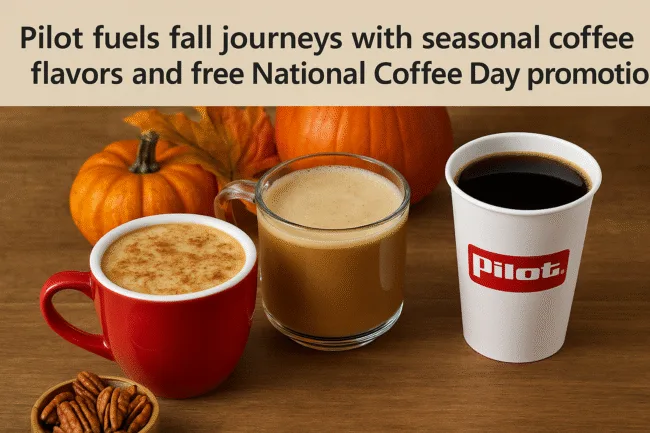
Pilot Travel Centers LLC, the Berkshire Hathaway–owned operator of the largest network of travel centers in North America, is marking National Coffee Day 2025 with a major consumer-focused campaign. The Knoxville, Tennessee–based company has unveiled its seasonal coffee flavors while offering free hot coffee at all participating Pilot, Flying J, and One9 branded travel centers across the United States. The offer, valid on September 29, 2025, provides guests with a complimentary any-size cup of hot coffee through the Pilot app, underscoring the company’s ongoing push to position itself as more than a fuel stop and as a hospitality brand with strong food and beverage appeal.
The initiative highlights how Pilot Travel Centers is deepening customer engagement at a time when the U.S. convenience and travel retail sector is being reshaped by lifestyle-driven purchasing trends. Coffee has become one of the most competitive categories in retail, with seasonal flavors such as pumpkin spice driving significant consumer traffic in autumn months. By coupling this promotion with its digital app-based loyalty platform, Pilot aims to capture both immediate sales uplift and long-term loyalty among drivers and travelers.
Why is Pilot’s National Coffee Day campaign seen as a strategic step to build customer loyalty?
National Coffee Day has grown into a high-visibility marketing opportunity for retailers and restaurant chains alike. From Starbucks to Dunkin’ and McDonald’s, brands increasingly use the day to showcase limited-time flavors, reward customers with freebies, and strengthen their loyalty ecosystems. Pilot Travel Centers, which serves more than 1.2 million guests daily, is now leveraging this cultural moment to assert its identity as a coffee destination for highway travelers.
Institutional observers interpret the move as a calculated attempt to use coffee—a high-margin, frequently purchased item—to balance fuel-driven revenues that can fluctuate with oil price volatility. For Berkshire Hathaway, which finalized majority control of Pilot in 2024, the campaign demonstrates how ancillary businesses such as coffee and food service can underpin revenue resilience. Analysts note that Pilot’s coffee program also provides an accessible entry point for younger demographics, a key audience for future brand growth.
What fall coffee flavors has Pilot introduced and why are they important for seasonal demand?
For the 2025 season, Pilot is offering Bourbon Pecan, Pumpkin Spice Cappuccino, and Campo Sur Brazilian bean-to-cup roast as part of its limited-time lineup. Each flavor is designed to capture a different segment of consumer demand. Bourbon Pecan, back by popular demand, combines rich nutty tones with Southern-inspired bourbon notes, appealing to customers seeking indulgent flavors. Pumpkin Spice Cappuccino, with its blend of cinnamon, nutmeg, and pumpkin, aligns with one of the most iconic fall beverages in the United States. Meanwhile, Campo Sur Brazilian introduces an international roast that highlights Pilot’s willingness to broaden its flavor portfolio.
These seasonal introductions are not just about taste. They allow Pilot to align its brand with broader consumer rituals and cultural trends. Research from the U.S. National Coffee Association has consistently shown that flavored and seasonal coffees see peak sales in September and October. By participating in this trend, Pilot not only competes with urban coffee chains but also strengthens its claim as the “Best Coffee on the Interstate®,” a long-standing slogan it has promoted.
How does coffee fit into Pilot Travel Centers’ transformation beyond fuel retailing?
Pilot Travel Centers has traditionally been known as a refueling destination for professional drivers and long-distance travelers. However, over the past decade, it has steadily repositioned itself as a holistic travel center offering food, beverage, and digital services. With more than 900 locations across 44 states and five Canadian provinces, Pilot has used its scale to roll out app-based loyalty programs, expanded menus, and premium coffee options.
This transformation accelerated after Berkshire Hathaway acquired an 80 percent stake in Pilot. Since then, the travel center operator has invested heavily in modernizing its locations, expanding EV charging infrastructure, and deepening its renewable fuels portfolio. Within this strategy, coffee has emerged as a critical growth lever because of its ability to attract repeat customers daily, unlike fuel which is a lower-frequency purchase for most drivers. For truckers who stop frequently, high-quality coffee and food offerings can make the difference in where they choose to refuel, creating additional revenue capture for Pilot.
What are the specifics of Pilot’s free coffee promotion and how does it drive digital engagement?
The National Coffee Day free coffee offer is available only on September 29, 2025, at participating U.S. locations. Customers must download the Pilot app, save the digital offer, and present their myRewards account details at checkout to redeem a free hot coffee of any size. By tying the offer to its digital app, Pilot ensures that every redemption translates into increased engagement with its loyalty ecosystem.
For institutional investors, this is a crucial element of the promotion. Free coffee offers may appear to erode short-term margins, but the long-term benefit lies in customer data capture, repeat marketing opportunities, and conversion of occasional visitors into loyal guests. The app-based strategy mirrors broader retail trends, where loyalty platforms are central to capturing customer lifetime value. For Pilot, which serves both long-haul truck drivers and road-trip families, the opportunity to personalize offers through data-driven marketing is seen as a competitive advantage.
How are institutional stakeholders and consumer analysts interpreting Pilot’s seasonal campaign?
Analysts view Pilot’s seasonal campaign as a strong indicator of its intention to expand non-fuel revenue categories. With fuel margins increasingly squeezed by both commodity volatility and the energy transition, retail diversification is essential. Pilot’s coffee program, along with its freshly prepared food offerings, aligns with these investor expectations. Institutional sentiment has been broadly positive, with observers pointing to the scale of Pilot’s network as an asset in rolling out seasonal promotions nationally.
Consumer-focused analysts emphasize that Pilot is effectively competing with quick-service restaurants by creating a comparable seasonal experience within a travel center environment. By adding international offerings such as Campo Sur Brazilian, Pilot is also appealing to more adventurous coffee drinkers who are looking for variety on the road. This strategy is interpreted as both defensive—keeping customers within the Pilot ecosystem rather than losing them to urban coffee chains—and offensive, by expanding Pilot’s relevance beyond professional drivers to a wider traveling audience.
What does Pilot’s history and operational scale reveal about its ability to execute coffee campaigns?
Founded in 1958, Pilot has grown into the third-largest fuel tanker fleet operator in North America while serving millions of customers annually. Its sheer scale—supplying around 12 billion gallons of fuel per year and employing about 30,000 people—allows it to roll out promotions with nationwide consistency. This operational capacity is a competitive advantage in the travel center industry, where smaller operators often lack the distribution and marketing strength to execute campaigns across states.
The company’s reputation as a reliable stop for drivers gives credibility to its coffee campaigns. For a brand with over six decades of history, seasonal beverages are not just limited-time offerings but part of a broader effort to refresh the customer experience while leveraging logistical strength. Pilot’s ability to integrate new flavors, manage supply, and promote consistently at hundreds of locations reinforces its positioning as both a fuel and hospitality operator.
What future outlook do analysts see for Pilot’s beverage strategy and brand evolution?
Looking ahead, institutional sentiment suggests that Pilot is likely to expand its beverage strategy beyond fall flavors. Industry observers expect the company to replicate the seasonal approach during winter holidays, spring promotions, and summer campaigns, using coffee as a year-round anchor product. With Berkshire Hathaway’s support, Pilot is also expected to continue integrating its food and beverage strategy with its renewable fuel and EV charging programs, creating comprehensive highway hubs for the energy transition era.
Future loyalty strategies will likely involve deeper personalization through the Pilot app, offering tailored promotions based on customer purchase history and travel patterns. Analysts believe this integration of digital engagement with seasonal promotions will be essential for maintaining margins as the energy landscape evolves. In this context, coffee is more than just a beverage—it is a symbol of Pilot’s transformation into a diversified travel center operator equipped for both current consumer habits and the future of mobility.
Discover more from Business-News-Today.com
Subscribe to get the latest posts sent to your email.