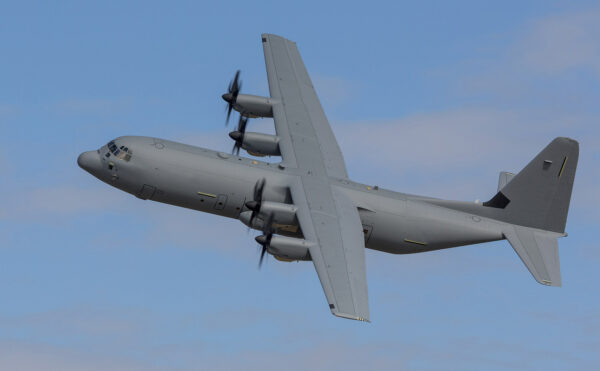




The Boeing Company (NYSE: BA) and the International Association of Machinists and Aerospace Workers (IAM) are set to resume stalled contract negotiations on Monday under the guidance of a federal mediator. The talks represent a turning point in a nearly two-month-long strike that has affected Boeing’s defense operations in St. Louis and surrounding regions. For investors, policymakers, and defense clients, the outcome will shape not only Boeing’s near-term margins but also its ability to maintain credibility as a supplier of critical military assets.
Why did the Boeing defense strike escalate into a test case for aerospace labor relations?
The strike began on August 4, when around 3,200 machinists from IAM District 837 walked off the job after rejecting Boeing’s contract proposal. Workers argued that the company’s offer fell short on wage increases, bonus payments, and retirement benefits. With their labor tied directly to the assembly of F/A-18 and F-15 fighter jets, MQ-25 tanker drones, missile systems, and T-7 trainer aircraft, the walkout has immediately disrupted production across several key U.S. defense programs.
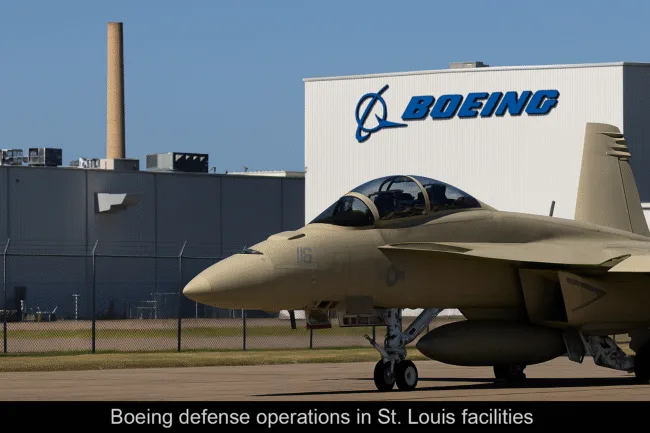
This is not the first time Boeing has faced labor unrest on a scale that shook its operations. In 2008, a machinists’ strike cost the company an estimated $100 million per day and delayed aircraft deliveries for months. More recently, in 2024, a Seattle-based strike within its commercial aircraft division disrupted production and revenue cycles at a time when Boeing was already under scrutiny for safety issues and backlog challenges. The current dispute adds another chapter to Boeing’s long history of tense labor relations, underscoring the strategic importance of how it manages its workforce in both commercial and defense divisions.
Why has Boeing absorbed the impact so far without significant financial pain?
Despite headlines of lost work hours and missed schedules, analysts suggest Boeing has not felt the same immediate financial impact that a commercial strike would deliver. Unlike the commercial division, which directly depends on delivering aircraft to airlines to secure cash flows, Boeing’s defense segment often works on contracts that have already been funded by the U.S. government. This structure has insulated Boeing from sharp revenue shocks, at least in the short term.
Reports indicate that Boeing has continued to deliver some defense products even during the strike, including one F/A-18, one F-15, and thousands of JDAM kits. The company has also relied on replacement workers to keep parts of its operations moving, signaling to the union that it is prepared for a prolonged standoff. However, these replacements are not a perfect substitute for experienced machinists, especially in high-precision defense manufacturing. Over time, quality concerns, training lags, and contractual penalties could erode Boeing’s relative advantage.
For now, the muted pain has given Boeing a stronger bargaining position than it had in past strikes. Yet the situation remains fluid. If programs like the MQ-25 or T-7 trainer continue to miss milestones, Pentagon officials could push back, creating reputational costs that reverberate across Boeing’s entire defense backlog.
What are the major sticking points in the new mediated negotiations?
The IAM union has tabled a revised four-year proposal that includes a $10,000 ratification bonus, stronger wage escalators, and improved 401(k) matching. Boeing, in contrast, has labeled parts of the offer as unrealistic, saying it cannot afford to set precedents that ripple across its global workforce. Its earlier offer involved a $5,000 bonus and a four-year, 20 percent wage increase.
At the heart of the dispute is how each side defines fairness. Workers argue that Boeing’s recovery from its commercial struggles and steady defense funding should translate into higher compensation for skilled machinists. Boeing counters that its cost structure cannot be compromised at a time when margins are under pressure, competition in defense contracting is intensifying, and global labor costs are rising.
The mediator’s challenge will be to create space for incremental compromise, likely involving phased bonuses or performance-linked escalators. Both sides must find a way to exit without appearing to have conceded too much. The longer the talks drag on, the more they risk inflaming frustrations among workers and raising doubts among defense clients.
How is Boeing’s stock performing and what is investor sentiment signaling?
Shares of Boeing (NYSE: BA) have shown resilience through 2025, supported by optimism around commercial aviation recovery and expectations of stabilizing safety performance. Year-to-date, the stock has managed to climb despite bouts of volatility tied to the strike and macroeconomic uncertainties. Investors seem to be discounting the likelihood of a full-scale breakdown, anticipating instead a negotiated settlement that keeps Boeing on track to deliver against its defense backlog.
Still, institutional flows suggest caution. Some funds have rotated from Boeing into peers such as Lockheed Martin and Northrop Grumman, which face fewer labor headlines. This indicates that investors see Boeing as a “hold” until greater clarity emerges. Bullish analysts frame the current dip as a potential accumulation opportunity, expecting a relief rally once an agreement is reached. More conservative voices caution that if Boeing concedes too much on bonuses and wage growth, margins could compress further, undermining its long-term financial story.
Foreign institutional investors (FIIs) appear mixed, with inflows balanced by hedging activity. Domestic institutional investors (DIIs) remain steady, betting on the long-term durability of Boeing’s defense and commercial order books. For retail investors, the strike represents a short-term risk event but does not fundamentally alter the company’s positioning as a global aerospace leader.
What does this strike reveal about the future of U.S. defense contracting and labor stability?
The Boeing–IAM dispute carries implications that go beyond one company. U.S. defense contractors are under mounting pressure to deliver sophisticated systems on time while navigating tighter margins and global competition. Labor unrest exposes a vulnerability that could ripple across the sector, particularly if unions in other companies see an opportunity to extract concessions.
This is a moment where history seems to repeat itself. Boeing’s past strikes have taught the company hard lessons about underestimating labor’s power. Whether those lessons have been fully absorbed remains to be seen. For policymakers, the strike underscores the importance of workforce stability in defense readiness — especially at a time of heightened geopolitical tensions.
For Boeing, the outcome of these mediated talks will shape investor trust, labor relations, and competitive standing in defense markets. A credible resolution that balances worker demands with Boeing’s need for discipline could strengthen its position. A prolonged stalemate or poorly structured deal, however, risks eroding confidence at a critical juncture.
Discover more from Business-News-Today.com
Subscribe to get the latest posts sent to your email.