


Why is Trump pushing a restructuring of TikTok and what does the deal involve?
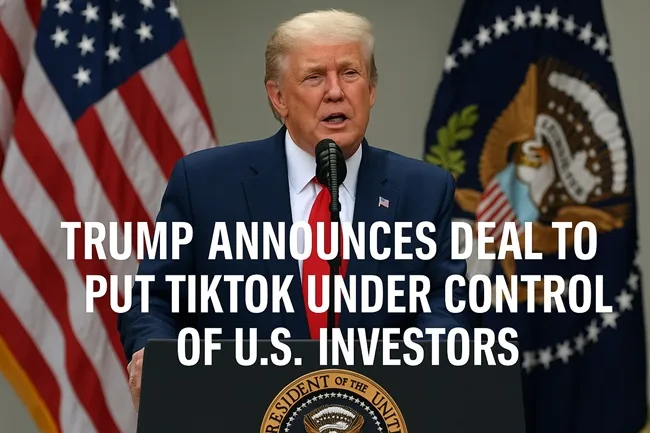
President Donald Trump has unveiled a restructuring plan that would place TikTok’s United States operations under majority control of American investors, marking one of the most consequential interventions into the ownership structure of a social media platform in history. The deal values TikTok U.S. at roughly 14 billion dollars and is structured to ensure that the Chinese parent company, ByteDance, remains a minority player while relinquishing authority over user data and security.
The agreement was presented as a national security safeguard, with Trump describing it as a pragmatic resolution to months of legal and political battles. The deal follows the enforcement of the Protecting Americans from Foreign Adversary Controlled Applications Act, or PAFACA, which mandated foreign divestiture of apps deemed security threats. After the U.S. Supreme Court upheld the law in early 2025, ByteDance had little choice but to negotiate a qualified divestiture to maintain TikTok’s access to the U.S. market.
How does the investor group structure change the control of TikTok in the US?
Under the plan, a consortium of U.S. and allied investors will hold significant authority. Oracle Corporation, Silver Lake Partners, and Abu Dhabi–based MGX have agreed to take about 45 percent of TikTok U.S., while ByteDance is expected to hold less than 20 percent. The new board will include six members appointed by U.S. investors and just one from ByteDance, reinforcing Washington’s control over governance.
This structure echoes the political consensus in Washington that algorithmic and content governance must be separated from Chinese influence. Oracle, already serving as TikTok’s U.S. data storage partner, is expected to play a pivotal role in overseeing the handling of user information. Silver Lake’s technology investment background and MGX’s financial heft round out the consortium. Together, they provide the White House with a deal it can point to as ensuring security without banning a platform used daily by more than 100 million Americans.
Why was the Protecting Americans from Foreign Adversary Controlled Applications Act critical?
The legal foundation for this restructuring lies in PAFACA, signed into law in April 2024. The act gave foreign-owned apps classified as adversary-controlled a limited window to divest or face bans. TikTok fought the law in court, claiming it violated free speech protections, but the Supreme Court ruled against the company in January 2025. The decision provided legal clarity and reinforced that national security imperatives could justify regulation of digital platforms.
The timing was crucial. Facing a divestment deadline, TikTok briefly suspended its U.S. operations in early 2025, disrupting users and businesses that relied on the app. The Trump administration, newly in office, signaled that it would not tolerate a permanent shutdown but required ByteDance to concede on ownership and governance. The compromise now presented reflects both political pragmatism and legal enforcement.
What challenges remain around algorithm control and Beijing’s approval?
While Trump declared victory in protecting American users from foreign control, significant questions linger. One unresolved issue is algorithm governance. TikTok’s recommendation engine, the secret sauce that fuels its virality, remains under ByteDance’s intellectual property. The deal envisions a licensing arrangement that would allow U.S. investors to deploy the algorithm independently, but critics warn this may not eliminate Chinese influence.
China’s government, which has previously placed export restrictions on certain artificial intelligence technologies, has not yet formally approved the licensing arrangement. If Beijing resists, the U.S. consortium may be forced to operate TikTok without the full recommendation engine, a prospect that could diminish user engagement and commercial value. This geopolitical wrinkle underscores how the deal, though domestically celebrated, still depends on delicate international negotiations.
How will users, creators, and advertisers be affected by this restructuring?
For everyday users, the most immediate effect of the deal is continuity. The specter of a ban or shutdown has been lifted, allowing TikTok to continue as a leading social platform in the United States. For content creators, who generate income through sponsorships and partnerships, the assurance that TikTok remains operational offers stability. Advertisers, too, are expected to welcome the clarity, particularly as TikTok remains a central platform for reaching younger demographics.
Yet the platform could evolve under its new governance. Content moderation policies may shift, especially as U.S. investors and regulators place new emphasis on misinformation control, political advertising, and harmful content. Advertisers will be watching closely to ensure that TikTok maintains brand safety standards while also protecting creative freedom.
How are US investors, global institutions, and Washington policymakers interpreting Trump’s TikTok restructuring deal?
Investor sentiment is mixed but cautiously optimistic. On one hand, the 14 billion dollar valuation is viewed as modest relative to TikTok’s global influence, suggesting that the U.S. consortium has secured favorable terms. On the other hand, institutional investors caution that without Beijing’s approval of algorithm licensing, the U.S. version of TikTok could become a diluted product.
Policy experts highlight the broader significance of the deal. By creating a precedent where a foreign-controlled social platform is forced into U.S. ownership, Washington is asserting digital sovereignty. Analysts suggest that this may embolden lawmakers to target other apps or platforms with similar scrutiny, particularly as concerns grow about data flows, disinformation, and cross-border influence operations.
What are the global implications for tech regulation and national sovereignty?
This agreement is not just about TikTok. It represents a blueprint for how major powers may govern foreign digital platforms in the future. If the model proves effective, it could inspire Europe and other jurisdictions to demand similar divestitures or localization of control. The precedent signals that digital sovereignty is now a frontline issue in geopolitics, merging technology, regulation, and national security.
For China, the deal is a setback, as it weakens a flagship platform that had become a global cultural phenomenon. Yet Beijing retains leverage through its control over intellectual property licensing. For the United States, the agreement is both a victory and a gamble: it demonstrates assertiveness but also creates a new regulatory experiment that must balance free speech, security, and market efficiency.
How does Trump’s TikTok restructuring deal highlight the evolving role of digital sovereignty in technology governance?
The Trump administration’s move to put TikTok under U.S. investor control is a watershed moment in the ongoing tug-of-war between open markets and national security. It prevents a politically costly ban, appeases lawmakers calling for stronger controls, and gives investors a stake in one of the world’s most influential platforms. At the same time, it raises new questions about algorithmic independence, foreign approval, and the risk of political influence over content moderation.
From my perspective, the deal is a pragmatic gamble. Trump has carved out a middle path that avoids an outright shutdown while signaling strength against Beijing. Whether this restructuring strengthens TikTok or hollows it out depends on execution in the next 120 days. If U.S. investors can assert real independence and maintain platform vitality, the deal may be remembered as a landmark in digital governance. If not, it risks becoming a cautionary tale about political compromises in the age of algorithmic power.
Discover more from Business-News-Today.com
Subscribe to get the latest posts sent to your email.