


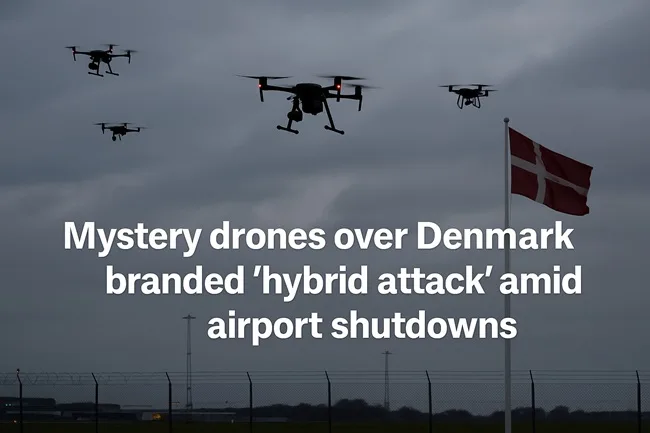
Denmark has been shaken by a string of unexplained drone incursions over its airports, with government officials escalating the rhetoric by branding the disruptions as a potential “hybrid attack.” The incidents, which unfolded over consecutive nights and forced multiple airport closures, are being viewed as more than a nuisance. According to Denmark’s defense minister, the pattern suggests coordination and intent, rather than random civilian interference.
The first disruption struck Copenhagen Airport earlier in the week, leading to flight cancellations and emergency responses across the aviation system. What followed was a wave of drone sightings over Aalborg, Esbjerg, Sønderborg, and Skrydstrup, the latter being home to Denmark’s fleet of F-16 fighter jets and the future base for the F-35 program. For two nights in a row, Denmark’s airspace became a testing ground for aerial trespass that was deliberate enough to provoke fears of hostile reconnaissance or sabotage.
Officials underscored that civilian safety was the priority. No drones were shot down despite the temptation to neutralize them, because the risk of fragments damaging passenger aircraft outweighed the desire for immediate retaliation. Yet the frequency and choice of targets raised questions Denmark can no longer afford to ignore.
How did the incidents unfold and which airports were most heavily affected in Denmark?
The first signs of trouble came when air traffic controllers at Copenhagen Airport detected drones flying dangerously close to approach paths. With safety compromised, operations were suspended and flights were grounded, evoking memories of the 2018 Gatwick Airport chaos in the United Kingdom. The difference this time was scale. By the following evening, reports multiplied as drones appeared above Aalborg, a site that doubles as a civilian and military hub, and Esbjerg, a western port city increasingly critical for North Sea energy operations.
At Sønderborg, a smaller but strategically located facility, operations were interrupted once again, while Skrydstrup Air Base became the most sensitive breach, given its role in NATO operations and Denmark’s military posture. Danish intelligence agencies concluded that the sequence of flights was not coincidental. Instead, they pointed to a systematic pattern that hinted at professional operators, possibly with state backing.
Airport closures were temporary, but the disruption was significant enough to ripple through airlines, logistics chains, and emergency services. Danish authorities reopened airports only after extensive sweeps confirmed no drones remained in the area.
What are Danish officials saying about hybrid warfare and the intent behind these incursions?
Danish defense leaders described the drone intrusions as part of a broader category of hybrid warfare—hostile actions designed to destabilize societies and institutions without crossing the threshold into open conflict. The defense minister framed the repeated incursions as calculated attempts to instill fear, undermine trust in authorities, and stress test Denmark’s ability to respond to unconventional threats.
The justice minister added that while attribution remains elusive, the effect is undeniable: disruptions to civilian life, heightened security costs, and an atmosphere of uncertainty. Both officials suggested that the ultimate aim is to weaken democratic institutions and erode the sense of security among ordinary citizens.
Russia was not explicitly named, but speculation hung heavy over the possibility of Russian involvement, given the wider pattern of drone activity across Europe since the start of the Ukraine war. The Russian embassy in Denmark rejected the accusations outright, dismissing the claims as a staged provocation. For now, Copenhagen is careful to avoid direct accusations, but the geopolitical undertones are impossible to ignore.
How do these Danish airport incidents fit into the wider European security context?
The mystery drones over Denmark are not isolated. In recent months, Poland, Romania, and the Baltic states have reported Russian drones breaching their airspace. The overlap between military and civilian targets has blurred the line between surveillance, intimidation, and potential sabotage.
For Europe, the Danish incidents highlight how low-cost drones can become strategic assets in the hands of adversaries. Unlike conventional aircraft, drones are harder to track, can be launched from ships or hidden bases, and offer plausible deniability to their operators. The threat profile is no longer limited to battlefields in Ukraine; it now extends into the heart of NATO member states.
Policy discussions around a “drone wall”—a coordinated cross-border defense system spanning Nordic and Baltic countries—have accelerated. Officials are also calling for shared databases, joint procurement of counter-drone technology, and synchronized air defense exercises. The urgency is underscored by the fact that airports, power plants, and energy terminals are increasingly seen as potential soft targets.
What technological and regulatory gaps are being exposed by Denmark’s response?
Denmark’s handling of the crisis revealed both progress and gaps. On one hand, authorities acted swiftly to close airports, protecting passengers and averting worst-case scenarios. On the other, the inability to neutralize or capture the drones highlighted weaknesses in counter-UAV infrastructure.
Unlike battlefields where military jamming or kinetic systems can be deployed freely, civilian airspace imposes stricter rules. Denmark is now considering new legislation that would grant critical infrastructure owners the authority to disable drones. Such laws would represent a sharp departure from current norms, raising debates about liability, civil rights, and the potential for accidental escalation.
Technology is another bottleneck. Radar systems often struggle to distinguish small drones from birds, while electronic jammers risk interfering with communications equipment. Directed energy solutions like laser interceptors are in development but remain costly. For smaller countries like Denmark, the financial burden of nationwide deployment is formidable, meaning NATO burden-sharing may be the only practical path forward.
How are institutions, markets, and allies interpreting the drone incursions?
Institutional sentiment in Copenhagen and Brussels leans toward caution but also solidarity. NATO members have been briefed, and Denmark is weighing whether to invoke Article 4 consultations, which would formally place the incidents on the alliance’s agenda. Such a step would not trigger collective defense but would underscore the seriousness with which Denmark views the incursions.
Market reaction has been muted, given that the incidents have not yet escalated into a confirmed attack on critical infrastructure. However, aviation insurers and airport operators are watching closely, as any repeat pattern could drive up premiums and operational costs. Airlines, already burdened by fuel volatility and labor unrest, are wary of adding drone disruptions to the list of existential risks.
For allies, the Danish case is a cautionary tale. It is a reminder that hybrid threats are not theoretical and that adversaries may exploit vulnerabilities far from the frontline. The incidents are likely to bolster European Union debates on defense integration, cybersecurity harmonization, and joint procurement of anti-drone systems.
What are the key risks Denmark and Europe face if drone incursions continue without clear attribution?
The most immediate risk is safety. Drones near airports pose collision hazards during takeoff and landing phases, when aircraft are at their most vulnerable. A single mid-air encounter could have catastrophic consequences.
Beyond safety, the strategic risk lies in normalization. If drone incursions become routine without consequences, adversaries will have succeeded in creating a climate of unpredictability that weakens public confidence and forces states to expend resources on endless monitoring.
Attribution is another challenge. Without clear evidence of origin, Denmark risks overreaction or underreaction. Too strong a response risks escalating tensions, while too weak a response may embolden perpetrators. This balance between vigilance and restraint is at the heart of hybrid warfare strategy.
How will Denmark’s drone incursions reshape NATO’s role and the broader European response to hybrid threats?
The Danish drone incursions are more than airport disruptions. They represent a new chapter in the evolution of hybrid conflict, where adversaries exploit small, inexpensive technologies to generate outsized psychological and political effects.
For Denmark, the immediate focus is closing legislative gaps, investing in counter-drone systems, and working with NATO allies to ensure deterrence. For Europe, the lesson is that hybrid attacks no longer respect borders or clear lines of escalation. The continent’s infrastructure, from airports to energy facilities, is now part of the battlespace.
The mystery drones may remain unattributed for now, but their message is unmistakable: Europe’s skies are vulnerable, and hybrid threats are here to stay. How Denmark and its allies respond will determine whether adversaries see the strategy as a cheap win or a failed experiment in intimidation.
Discover more from Business-News-Today.com
Subscribe to get the latest posts sent to your email.