



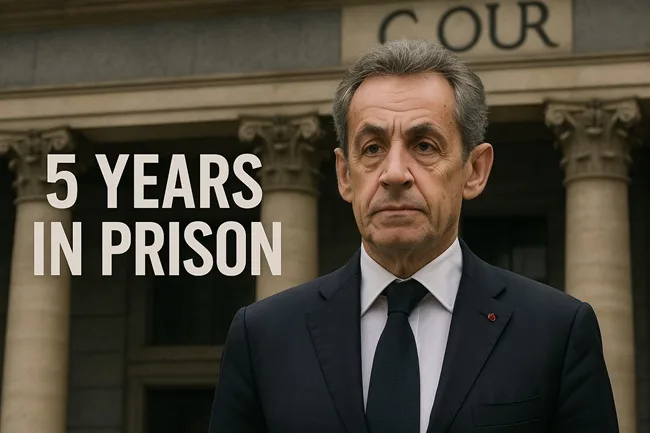
A Paris court on Thursday sentenced former French president Nicolas Sarkozy to five years in prison after finding him guilty of criminal conspiracy linked to alleged Libyan financing of his 2007 presidential campaign. The ruling marks the first time in modern French political history that a former head of state has been ordered to serve a custodial sentence for campaign financing crimes, a development that has sent shockwaves across France’s political establishment and reignited debates about corruption and foreign influence in European democracies. Sarkozy has vowed to appeal the judgment, but the court ruled that the prison term is not automatically suspended during the appeal process, signaling a rare hardline approach to a high-profile political case.
The verdict has been described as a watershed moment not only for France but also for the wider international community. The case has been under judicial investigation for more than a decade, with investigators tracing a complex web of alleged financial transfers, cash deliveries, and diplomatic backchannels connecting Sarkozy’s team to the regime of Muammar Gaddafi in Libya. The court ultimately convicted him on conspiracy charges but acquitted him on the more serious counts of passive corruption, illegal campaign financing, and misuse of public funds, narrowing the scope of liability while still confirming the existence of an illicit arrangement.
Why did the French court find Sarkozy guilty of conspiracy in the Libya campaign financing case?
The ruling stemmed from evidence presented by prosecutors suggesting that Sarkozy’s closest aides had conspired with Libyan officials to funnel millions of euros into his 2007 presidential bid. Testimony and financial records alleged that cash from Gaddafi’s inner circle was delivered to Sarkozy’s associates in the run-up to the campaign. The Paris court found that while direct evidence of Sarkozy personally accepting cash was limited, the conspiracy charge was proven through patterns of conduct, testimony, and corroborating documentation.
Former aides Claude Guéant and Brice Hortefeux were also convicted. Guéant received a six-year sentence, although health considerations delayed his immediate incarceration, while Hortefeux was handed a two-year term that may be served under electronic monitoring. Sarkozy himself was also fined €100,000 as part of the ruling. The presiding judge described the offenses as exceptionally serious given the way they undermined trust in democratic institutions and risked distorting France’s electoral process.
Sarkozy, however, dismissed the allegations as baseless, maintaining that the financing scheme was nothing more than speculation. In his statement following the verdict, he characterized the judgment as a scandal and said he would serve any imposed time with his head held high while preparing to challenge the ruling in France’s higher courts. He remains adamant that no Libyan money entered his campaign coffers.
What is the historical background of the alleged Libyan financing scandal?
The allegations surrounding Libyan financing first surfaced in 2011 following the fall of Gaddafi’s regime. French investigative outlet Mediapart published documents suggesting that the Libyan government had pledged €50 million to Sarkozy’s campaign in 2007. This claim was bolstered by testimony from Franco-Lebanese businessman Ziad Takieddine, who asserted that he personally transported briefcases containing millions of euros in cash from Tripoli to Paris. Although Takieddine later retracted and then reinstated his testimony at different stages, his involvement has remained central to the scandal.
The allegations have been particularly sensitive given Sarkozy’s role in authorizing France’s military intervention in Libya in 2011, which contributed to the collapse of Gaddafi’s regime. Critics have argued that Sarkozy’s foreign policy decisions may have been influenced by prior financial dealings, although this direct connection has never been legally proven. Nevertheless, the perception of conflict of interest and corruption has haunted Sarkozy’s post-presidential legacy.
This case adds to a string of legal troubles. In 2021, Sarkozy was convicted of corruption and influence peddling in a separate case involving attempts to bribe a judge. He also faced penalties for overspending during his unsuccessful 2012 re-election campaign. The accumulation of convictions has cemented his image as one of France’s most legally embattled leaders of the Fifth Republic.
How could this ruling reshape French politics and conservative leadership?
The conviction casts a long shadow over Sarkozy’s party, The Republicans, which has already been struggling to redefine itself in the era of Emmanuel Macron’s centrist dominance and the rise of Marine Le Pen’s far-right National Rally. Sarkozy had remained an influential figure behind the scenes, often acting as a kingmaker in party leadership contests. With a custodial sentence now looming, his capacity to shape the conservative movement’s trajectory will be severely diminished.
Political analysts in Paris noted that the court’s refusal to suspend incarceration pending appeal demonstrates judicial resolve to enforce accountability at the highest levels of government. This may embolden anti-corruption advocates while also deepening public skepticism toward mainstream political elites. At a time when populist rhetoric is reshaping the French electorate, the Sarkozy conviction may fuel narratives of establishment corruption, inadvertently strengthening more radical political forces.
Institutional sentiment is also at play. France’s judiciary has historically faced criticism for leniency toward senior politicians, but this ruling is viewed as evidence of increasing independence and assertiveness. Investors and European partners are closely watching to see whether the decision will destabilize the conservative bloc or spark broader reforms in political financing laws.
What does this mean for France’s position on campaign financing and global accountability?
Beyond its immediate political impact, the Sarkozy case underscores the challenges that Western democracies face in regulating campaign financing, especially when foreign governments attempt to exert influence. France has strict rules capping campaign donations and banning foreign contributions, but enforcement has historically been inconsistent. The revelations about Libyan money highlight vulnerabilities that could have broader implications for European electoral integrity.
Internationally, the case sets a precedent for accountability at the highest levels of political office. Sarkozy is one of the few leaders in a major Western democracy to be convicted in a case involving foreign campaign financing. The ruling may prompt further scrutiny of political funding across Europe and beyond, particularly in regions where Russian, Chinese, and Middle Eastern interests have sought to shape elections through financial channels.
Experts in governance argue that the judgment could encourage reforms in France and potentially at the European Union level, pushing for greater transparency in campaign donations, stricter monitoring of cross-border financial flows, and harsher penalties for violators. For institutional investors, the case adds a governance risk layer to political stability assessments in France, especially ahead of upcoming European and presidential elections.
What are the broader legal and reputational risks Sarkozy now faces?
Although Sarkozy intends to appeal, the cumulative weight of his convictions raises doubts about whether higher courts will fully overturn the ruling. His earlier convictions in corruption and campaign overspending cases mean that any future appeal may be evaluated in light of a broader pattern of misconduct. If the five-year sentence is upheld, Sarkozy would likely serve part of his term under house arrest or electronic monitoring rather than in a traditional prison, given French sentencing norms for older defendants and non-violent crimes. However, the reputational damage is already done.
The ruling not only undermines Sarkozy’s historical standing but also reopens debate about the legacy of his presidency, particularly the intervention in Libya. Critics argue that his role in Gaddafi’s downfall can no longer be separated from the shadow of financial impropriety. For France, this case could reshape public expectations of accountability, signaling that even the highest offices are not immune from judicial scrutiny.
What are the key takeaways from Sarkozy’s prison sentence for French politics and the global fight against foreign campaign financing?
The sentencing of Nicolas Sarkozy to five years in prison represents a turning point for France’s political and judicial history. It shows that the French judiciary is increasingly willing to challenge entrenched political power and enforce rules against corruption, even at the cost of destabilizing established parties. For The Republicans, the loss of Sarkozy’s guiding influence at a time of electoral fragmentation may deepen uncertainty about their future role in French politics. For the broader French public, the ruling reinforces the perception that elite politics has long been tainted by questionable practices, but it also demonstrates that institutional checks and balances can eventually prevail.
Globally, the Sarkozy case stands as a cautionary tale about the dangers of foreign influence in democratic elections and the reputational risks leaders face when financial improprieties come to light. As countries grapple with external pressures and rising populism, the enforcement of transparent financing laws will remain a litmus test for the health of democracies. Whether Sarkozy ultimately serves his sentence in full or succeeds in appeal, the verdict has already etched itself into history as a symbol of accountability at the highest level of power.
Discover more from Business-News-Today.com
Subscribe to get the latest posts sent to your email.