




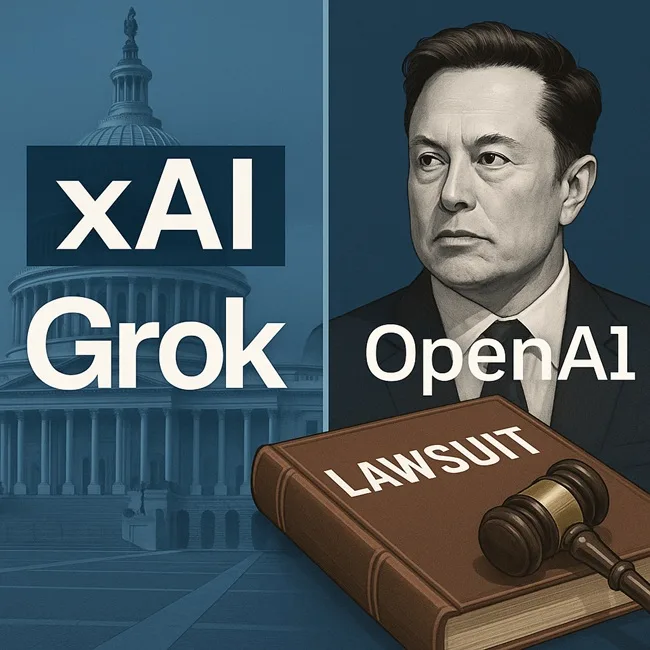
In a week that underscored both the promise and peril of the artificial intelligence race, Elon Musk’s startup xAI secured federal government approval to deploy its Grok chatbot across U.S. agencies, even as it launched a fresh lawsuit accusing OpenAI of stealing trade secrets. The twin developments highlight the high-stakes battle between two of the world’s most influential AI firms, one Musk co-founded and now relentlessly attacks, and the other he hopes to elevate through both government contracts and courtroom wins.
The U.S. General Services Administration (GSA) awarded xAI a governmentwide contract that clears Grok for use across multiple federal agencies. This puts Grok alongside rival platforms such as OpenAI’s ChatGPT and Anthropic’s Claude in a race to become the default conversational AI tool within the American bureaucracy. Hours later, Musk’s legal team filed suit against OpenAI in California federal court, accusing the company of orchestrating a campaign to poach key staff and extract confidential technology, from source code to data center blueprints.
What does federal clearance for Grok mean for U.S. agencies adopting AI?
The GSA contract effectively legitimizes Grok as an approved vendor for federal procurement, meaning agencies ranging from the Department of Defense to the Internal Revenue Service can purchase licenses without separate tendering processes. According to filings cited in the award notice, Grok 4 and Grok 4 Fast were offered at a sharply discounted rate—reportedly $0.42 per agency for an 18-month trial period, compared with OpenAI’s baseline of $1 per agency annually.
For xAI, this is not just a contract but an entry point into government work that often expands well beyond initial pilots. Federal AI procurement has been accelerating under the Biden and Trump administrations alike, with agencies under pressure to modernize service delivery and data analysis while adhering to security protocols. GSA clearance for Grok signals trust in its compliance standards, cybersecurity safeguards, and infrastructure readiness—an essential box to check before federal deployment.
Industry experts noted that government adoption can provide not only revenue but also reputational leverage. Once an AI system clears federal vetting, commercial clients often treat it as a signal of quality and resilience. For Musk, whose companies from Tesla to SpaceX have thrived on government contracts, this approval adds to a pattern of using public sector footholds as springboards into wider markets.
Why has xAI accused OpenAI of trade secret theft and employee poaching?
On the same day the federal clearance was announced, xAI filed suit against OpenAI in California federal court, alleging what it described as a “deeply troubling pattern” of recruiting its former employees to gain access to confidential technology. The complaint specifically accuses OpenAI of inducing engineers and a senior finance executive to breach non-disclosure obligations and transfer knowledge of Grok’s code and operational strategies.
Among the individuals named is former xAI engineer Xuechen Li, already a defendant in a separate lawsuit alleging the misappropriation of sensitive technical material. Another former staff member, Jimmy Fraiture, was also cited as a hire linked to potential trade secret exposure, though he was not listed as a defendant. According to the filing, OpenAI’s hiring strategy was not incidental but “a coordinated effort to undermine xAI’s competitive position.”
This lawsuit joins a web of ongoing litigation between Musk and OpenAI. Earlier suits included allegations that OpenAI’s conversion to a for-profit model violated its original nonprofit charter. OpenAI has counter-sued Musk for harassment. xAI has also accused Apple of conspiring with OpenAI to suppress rival platforms, though Apple has not responded publicly to the claim.
How does this legal battle fit into the broader AI talent and IP war?
The case highlights a central tension in Silicon Valley’s AI race: the scarcity of top-tier talent and the blurred lines around intellectual property when employees move between firms. AI models are not only shaped by algorithms but also by data pipelines, infrastructure designs, and operational expertise. When engineers carry that know-how to rivals, questions of trade secret theft inevitably arise.
Trade secret law hinges on whether a company can prove that competitors acquired confidential information through improper means rather than general expertise. Courts often struggle to balance fair employee mobility with legitimate corporate protections. If xAI can demonstrate deliberate inducement by OpenAI, it could set a precedent with chilling effects on hiring practices across the AI sector.
For investors, this raises the stakes. Litigation can consume executive focus, drain resources, and spook potential partners. Yet lawsuits can also serve as strategic tools to slow rivals. Observers note Musk’s history of using courts as battlegrounds to defend intellectual property or challenge regulatory frameworks, from Tesla’s autopilot cases to SpaceX’s NASA contracts.
How is federal procurement shaping competition between xAI, OpenAI, and Anthropic?
The GSA clearance positions xAI directly against OpenAI and Anthropic in vying for government workloads. Federal adoption matters not just for revenue but also for setting industry standards. Agencies prioritize security certifications, explainability of AI outputs, and resilience against adversarial attacks—criteria that could shape broader corporate preferences.
Anthropic’s Claude has already been tested in certain agencies, and OpenAI’s ChatGPT Enterprise variant has secured deals with parts of the intelligence community. By pricing Grok aggressively low, xAI is signaling a willingness to sacrifice near-term revenue for long-term footprint. This echoes Musk’s historic playbook: scaling adoption through subsidized entry points before monetizing ecosystem dominance.
Policy analysts suggest the federal government is intentionally diversifying its AI vendor base. Relying solely on OpenAI would invite concentration risk, while involving multiple providers fosters redundancy and competitive pricing. Grok’s entry therefore adds to a multipolar government AI strategy that reduces dependency on a single model.
What does Musk’s legal fight with OpenAI and Grok’s U.S. government entry signal for institutional sentiment?
For institutional investors, the juxtaposition of a government clearance and a legal offensive sends a mixed but intriguing signal. On one hand, federal contracts enhance xAI’s credibility and open recurring revenue streams. On the other, active litigation introduces uncertainty and potential reputational drag.
Market sentiment has been cautiously optimistic. Analysts tracking AI infrastructure note that Musk’s ability to align xAI with government clients could boost its valuation trajectory, especially if agencies expand use cases from text-based chat to analytical modeling and decision support. Yet legal exposure could weigh on capital raising efforts or partnerships with risk-averse corporations.
OpenAI, meanwhile, faces the prospect of defending itself not just against xAI but also in the court of public opinion. Allegations of trade secret theft, even if unproven, may erode trust among regulators and partners. With competitors like Anthropic emphasizing safety and governance, OpenAI cannot afford reputational turbulence as it pursues corporate deals.
What are the key takeaways from Grok’s U.S. government approval and Musk’s escalating trade secrets battle with OpenAI?
The same week that Grok earned the trust of federal procurement officers, Musk unleashed another salvo in his campaign against OpenAI. The outcome of these parallel tracks—one administrative, one judicial—will shape the trajectory of both xAI and the broader AI ecosystem.
For the U.S. government, Grok’s clearance reflects a pragmatic embrace of vendor diversity in AI. For Musk, it represents both a validation of his technical platform and a stage for escalating legal confrontation. And for OpenAI, it marks another chapter in a saga of lawsuits that highlight both the company’s dominance and the risks of attracting top talent.
In the months ahead, investors and policymakers alike will be watching how these threads converge. Will Grok gain traction across agencies, justifying its aggressive pricing? Will the courts accept xAI’s claims and constrain OpenAI’s hiring strategies? And will the federal government’s reliance on AI deepen to the point where these corporate battles directly shape public service delivery?
What is clear is that the AI arms race has moved beyond model benchmarks and venture capital rounds. It now encompasses federal procurement policy, intellectual property litigation, and a reputational contest between two of Silicon Valley’s most watched companies. Musk’s dual playbook—government contracts and courtroom offensives—suggests he sees AI not just as a technological frontier but as a battleground where public legitimacy and legal advantage matter as much as model performance.
Discover more from Business-News-Today.com
Subscribe to get the latest posts sent to your email.