




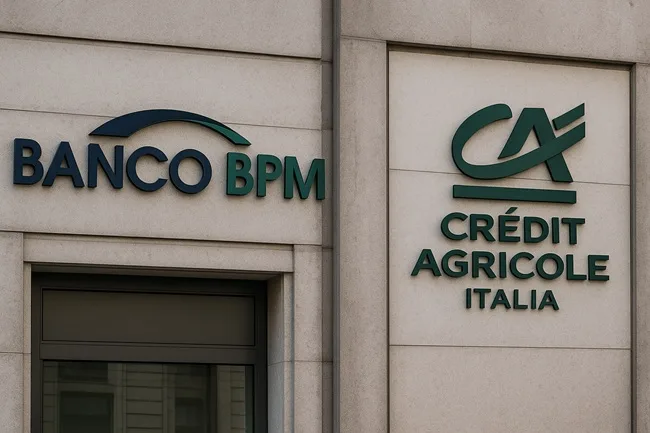
Italy’s banking system has once again found itself at a crossroads. The potential merger between Banco BPM (BAMI.MI) and Crédit Agricole Italia, flagged by Banco BPM Chief Executive Giuseppe Castagna as the “clearest opportunity,” is more than a headline about two banks. It is a story that illustrates how the country’s lenders have moved from crisis survival to a new phase of strategic battles for European scale. As per a Reuters report, Crédit Agricole has already hired Deutsche Bank and Rothschild to advise on its options, signalling that what began as exploratory talk is now hardening into financial engineering. Reports suggest Crédit Agricole, which already holds just above 20 percent of Banco BPM, could see its stake rise toward 35 percent if a full merger structure emerges. Rome, however, will not stand idly by. Under its “golden power” rules, the Italian state retains authority to intervene in deals that touch strategic industries, and few sectors are as sensitive as domestic banking.
How did Italy’s past banking crises and non-performing loan troubles set the stage for today’s consolidation wave?
The Italian banking sector’s current direction cannot be understood without revisiting its turbulent past. The global financial crisis of 2008 and the eurozone debt crisis that followed left Italy’s mid-sized and regional lenders deeply vulnerable. Non-performing loans ballooned across the system, balance sheets weakened, and capitalization lagged far behind European peers. By the early 2010s, the country faced what was effectively a slow-motion banking crisis. The European Central Bank responded by imposing tighter capital rules and by pushing banks to provision aggressively against loan losses.
This wave of regulation forced Italy’s fragmented network of savings and cooperative banks to accept that survival meant consolidation. One of the biggest results was the 2017 merger between Banco Popolare and Banca Popolare di Milano, creating Banco BPM. That deal was part of a broader restructuring effort intended to bring efficiency, scale, and stability to a system historically defined by localism and political ties. The restructuring set the template for future deals: mergers that could deliver resilience while still keeping Italy’s distinctive banking identity intact.
What economic pressures, regulatory costs, and profitability challenges are driving Italy’s 2025 banking consolidation wave?
Several factors now make consolidation not just a possibility but a necessity. Profitability margins are under constant strain as interest rates fluctuate and net interest income proves volatile. While the European Central Bank’s shift away from ultra-low rates has briefly widened margins, competitive pressure has eroded those gains. Costs, meanwhile, are moving sharply upward. Banks are spending heavily on digital transformation, cybersecurity, compliance, and customer-facing innovation, investments that are unavoidable but difficult to recover in thinly spread balance sheets.
Asset quality is also back in focus. Although many Italian banks fared well in recent ECB stress tests and now boast stronger capital buffers than a decade ago, macroeconomic risks still threaten a resurgence of non-performing loans. Italy’s slowing GDP growth and rising productivity concerns mean even well-capitalized lenders face downside risks. At the same time, bank valuations remain subdued, with several trading near book value. That dynamic makes mergers attractive from a pricing standpoint. Yet valuations cut both ways, because overpaying in stock or cash can quickly destroy value if promised synergies fail to materialize.
The governance dimension adds another layer of complexity. Italy’s golden power rules mean that even if both boards approve a deal, government oversight can shape its execution. Officials have already made clear that any banking merger must protect three priorities: household savings, lending to small and medium enterprises, and access to local banking services.
How does the Banco BPM–Crédit Agricole Italia potential merger fit this new paradigm?
The potential merger sits squarely within these pressures and opportunities. Castagna has openly described Crédit Agricole Italia as the most evident partner for Banco BPM, although he has not ruled out alternatives such as Monte dei Paschi di Siena. Crédit Agricole’s actions demonstrate seriousness. Earlier this summer, it raised its stake in Banco BPM to just above 20 percent with explicit approval from the ECB. While it has insisted that it does not intend a mandatory takeover, the French banking group’s position as Banco BPM’s largest shareholder signals more than passive interest.
By engaging Deutsche Bank and Rothschild to explore structures, Crédit Agricole has moved beyond speculation into deal planning. The rationale is clear. Banco BPM and Crédit Agricole Italia overlap in consumer finance, retail distribution, insurance, and credit to small businesses. Together, they could strip out overlapping costs while expanding product offerings. Analysts who follow European bank mergers suggest potential earnings per share accretion in the range of mid-single to low-double digits, though execution risks remain high.
How are Italian banks positioning themselves for the next round of mergers through stake building and government-backed deals?
The broader Italian banking sector has also seen momentum building. Monte dei Paschi di Siena recently acquired a controlling stake in Mediobanca in a €16 billion move, part of a government-backed strategy to bulk up mid-tier institutions. Such transactions underline how consolidation is no longer theoretical but actively reshaping the country’s financial architecture.
Crédit Agricole’s rising stake in Banco BPM itself came after a thwarted approach by UniCredit. That failed bid, blocked by the government, showed how political calculations can derail even technically sound proposals. For Rome, foreign interest is acceptable so long as national interests are safeguarded. For foreign banks like Crédit Agricole, the lesson is clear: any stake-building strategy must be careful not to trigger political backlash.
Italian banks have also made measurable improvements in balance-sheet quality. Ratings agencies note that non-performing loan ratios have declined, capital buffers have strengthened, and profitability metrics have improved modestly. But forecasts remain cautious. Rising costs and competitive challenges mean even a stronger system could find itself under renewed pressure without scale.
What regulatory hurdles, valuation risks, and integration challenges could derail Italy’s banking consolidation wave?
For all the optimism, risks are abundant. Regulatory friction sits at the top of the list. Italy’s golden power laws provide the government with broad authority to block or reshape mergers if they are deemed to compromise national interests. These powers have already been exercised in other strategic sectors, and banking is unlikely to be exempt.
Another critical risk is valuation fairness. Low valuations create opportunity, but any perception of overpayment could undermine shareholder support. Integration costs are always significant in banking, especially when IT systems, risk frameworks, and branch networks must be harmonized. Cultural mismatches between management teams and differing corporate governance structures can also dilute expected gains.
Macroeconomic headwinds further complicate the outlook. Italy’s GDP growth remains fragile, and a slowdown could erode asset quality just as banks are attempting to integrate. International uncertainties, including trade tensions and global credit conditions, add further layers of unpredictability.
What could this mean for investors, competition, and Italy’s banking future?
If consolidation accelerates, the rewards could be meaningful. Investors are likely to support institutions that prove able to scale effectively while maintaining capital discipline. A Banco BPM–Crédit Agricole Italia tie-up could emerge as Italy’s third-largest banking group, better positioned to compete with Intesa Sanpaolo and UniCredit. Scale could translate into stronger profitability, enhanced credit supply to SMEs, and broader financial stability.
Yet the opposite is equally possible. Political opposition or regulatory obstacles could dilute benefits, while integration failures could consume resources without delivering returns. For competition, the impact is stark: mid-sized banks face a simple choice between scaling up or sliding into irrelevance. For Italy as a whole, consolidation could bring resilience but also test the government’s ability to balance efficiency with local presence.
The trajectory of Italian banking has shifted decisively from crisis survival toward European scale battles. Banco BPM and Crédit Agricole Italia are now the focal point of this trend. If they can navigate political sensitivities, regulatory scrutiny, and integration challenges, their merger could redefine Italy’s financial map. If not, it risks becoming another cautionary tale in Europe’s long history of complicated bank tie-ups. Either way, the outcome will ripple across investors, savers, and the broader economy, making this consolidation story one to watch closely in the months ahead.
Discover more from Business-News-Today.com
Subscribe to get the latest posts sent to your email.