




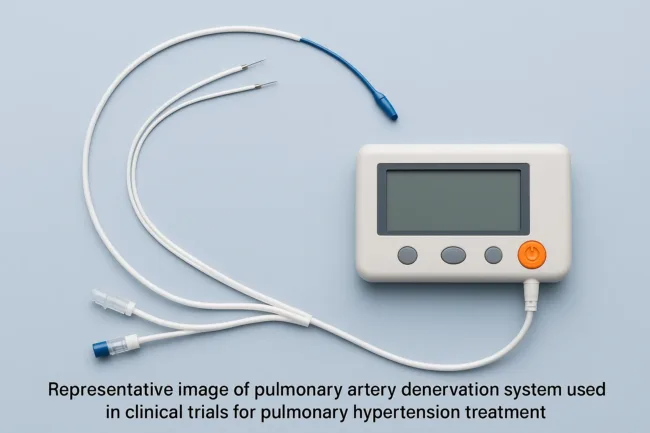
Pulnovo Medical, a leading global developer of cardiovascular medical devices, has received two Investigational Device Exemption (IDE) approvals from the U.S. Food and Drug Administration (FDA) for its Pulmonary Artery Denervation (PADN) system. The approvals authorize clinical trials for the PADN catheter and generator across Group I and Group II pulmonary hypertension (PH) populations, with full Centers for Medicare & Medicaid Services (CMS) coverage secured in parallel.
The regulatory greenlight is expected to fast-track the PADN system’s entry into the U.S. clinical landscape, validating its use in Pulmonary Arterial Hypertension (PAH) and PH due to left heart disease—two major and underserved patient populations.
How will Pulnovo’s IDE trials impact treatment for pulmonary hypertension patients in the U.S.?
Pulnovo Medical’s newly approved clinical trials will assess the safety and efficacy of the PADN system in two distinct patient groups. The first IDE covers a Humanitarian Device Exemption (HDE) study targeting Group I PH patients—those with PAH who often show limited response to drug therapy. The second IDE authorizes a Pre-Market Approval (PMA) study for Group II PH, addressing patients with pulmonary hypertension caused by left heart disease, for whom no dedicated pharmacological therapy currently exists.

Both IDEs come under the FDA’s broader Breakthrough Device Designation (BDD) granted to Pulnovo Medical in 2021, which spans Groups I, II, and IV PH populations. The dual approval underscores federal recognition of PADN’s clinical relevance and therapeutic novelty, as well as its potential to address significant unmet needs in pulmonary vascular disease.
Critically, the U.S. Centers for Medicare & Medicaid Services has granted full reimbursement coverage for both trials, signaling confidence in PADN’s potential public health impact and easing financial barriers for trial recruitment.
What does the PADN system offer compared to existing PH and HF treatment strategies?
The PADN system offers a catheter-based, device-driven approach to treating pulmonary hypertension, targeting the overactive sympathetic nerves in the pulmonary artery. This denervation technique has been increasingly explored as an adjunct or alternative to drug-based regimens, particularly in treatment-refractory cases or where drug toxicity poses long-term risks.
Pulnovo Medical, headquartered in Shanghai, has positioned PADN as a differentiated solution for patients who either fail to respond adequately to oral therapies or who fall outside current treatment paradigms. The device’s mechanism directly targets pulmonary arterial pressure modulation—bypassing some of the systemic side effects of pharmacological agents and offering a potential reduction in heart failure symptoms and right ventricular overload.
The Chinese medtech innovator has already secured regulatory traction globally, with PADN products having received CE Mark approval in Europe, National Medical Products Administration (NMPA) clearance in China, and FDA designation as a Humanitarian Use Device (HUD) in the U.S.
How has PADN performed in real-world settings and international clinical deployments so far?
Pulnovo Medical has deployed its PADN system in more than 1,000 procedures across various geographies, including China, Portugal, Georgia, Singapore, and Malaysia. Real-world data collected from these deployments has consistently shown a favorable safety profile, with measurable improvements in patient exercise tolerance and overall quality of life.
The international use of PADN has also highlighted its scalability in diverse healthcare systems and its feasibility as an interventional treatment option for heart failure and PH. These results have helped Pulnovo Medical build a compelling evidence base, which now feeds into the IDE studies in the U.S.
With pulmonary hypertension affecting millions globally and limited interventional options available, the PADN system’s consistent efficacy across both developed and emerging markets has amplified institutional interest.
Why does CMS reimbursement matter for trial acceleration and investor confidence?
The simultaneous CMS coverage approval is a strategic win for Pulnovo Medical. U.S. trial sites can now bill for patient procedures under Medicare, reducing economic friction for hospitals and boosting patient enrollment potential. This removes one of the most common hurdles faced by medtech firms conducting early-stage device trials in the U.S.
From an institutional perspective, CMS support acts as a strong market signal, suggesting alignment between regulatory and payer priorities—often a precursor to smoother market entry upon commercial approval. For investors and strategic partners, it also reduces the perceived reimbursement risk that often delays or dampens commercialization in high-cost therapeutic areas like cardiovascular interventions.
While Pulnovo Medical remains privately held, industry observers view the PADN program’s U.S. expansion as a key step toward long-term commercialization or possible partnerships with larger cardiovascular device firms.
What are the broader implications for Pulnovo’s U.S. strategy and the global PADN rollout?
The FDA IDE approvals and CMS reimbursement represent a pivotal moment in Pulnovo Medical’s global strategy to position PADN as a first-in-class interventional therapy for pulmonary hypertension and associated heart failure conditions.
In addition to validating the device’s safety and efficacy, the trials are expected to generate pivotal data necessary for future PMA filings. Positive outcomes from these studies could unlock U.S. market entry and potentially influence global treatment guidelines—particularly if PADN becomes the first approved interventional solution for Group II PH.
Institutional sentiment around PADN has remained cautiously optimistic, given its novel mechanism of action and regulatory momentum. While challenges remain in standardizing denervation protocols and long-term outcome measurement, the IDE approvals are seen as a step closer to establishing PADN as a platform technology across multiple PH subtypes.
What do experts expect next for Pulnovo Medical and the PADN clinical development roadmap?
Experts anticipate a structured rollout of the IDE trials in the coming months, with patient enrollment expected to begin across major U.S. cardiac centers pending local IRB approvals. The trials are designed to evaluate short- and long-term clinical endpoints, including mean pulmonary artery pressure, exercise capacity (6-minute walk test), and quality of life scores.
Assuming successful trial completion, analysts expect Pulnovo Medical to pursue a PMA submission for Group II PH and an HDE pathway for Group I PH, aligning with current regulatory strategy frameworks for rare and underserved disease indications.
Looking ahead, the company’s progress may also open discussions around future partnerships or licensing agreements with U.S.-based cardiovascular device leaders, particularly those seeking to diversify into structural heart and vascular neuromodulation portfolios.
Discover more from Business-News-Today.com
Subscribe to get the latest posts sent to your email.
