



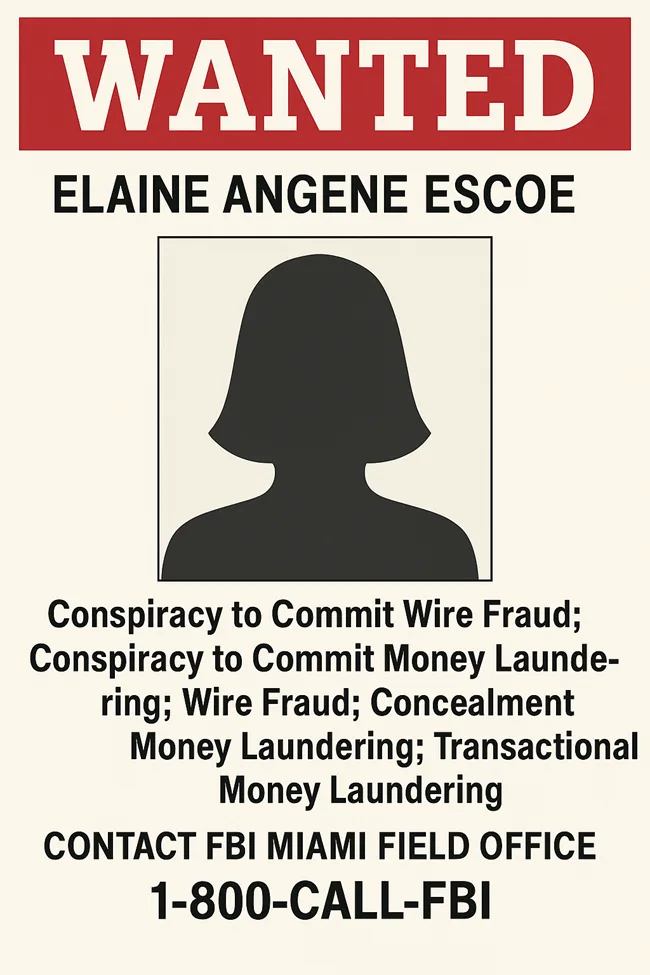
Why is the FBI seeking public help to locate Elaine Angene Escoe after her disappearance in Florida?
The Federal Bureau of Investigation has launched a fugitive search for Elaine Angene Escoe, a 40-year-old woman accused of orchestrating one of the largest pandemic fraud schemes uncovered in South Florida. According to federal authorities, she was last seen in Palm Beach County, Florida, on June 3, 2025, but failed to appear for a scheduled court hearing two days later. A federal arrest warrant had already been issued against her on May 22, 2025, in the United States District Court for the Southern District of Florida in West Palm Beach, listing charges of conspiracy to commit wire fraud, conspiracy to commit money laundering, wire fraud, and money laundering offenses.
Investigators have described Escoe as a serious flight risk, pointing to her access to large sums of illicit funds and her dual ties to Southern Florida and Jamaica, where she was born. Authorities say her disappearance just before a mandatory hearing suggests a deliberate effort to evade prosecution.
How did the alleged $34 million COVID-19 relief fraud scheme operate according to investigators?
Federal documents show that Escoe and a group of accomplices allegedly exploited several emergency pandemic aid programs between May 2020 and November 2021. During this period, they are accused of submitting more than ninety fraudulent applications for federal funds across different relief initiatives.
The programs included the Paycheck Protection Program, the Economic Injury Disaster Loans, the Restaurant Revitalization Fund, and the Shuttered Venue Operators Grant. By falsifying employee numbers, payroll costs, and business revenue figures, Escoe and her co-conspirators allegedly secured approvals for funds that legitimate businesses desperately needed during the height of the COVID-19 crisis.
The FBI estimates that the group fraudulently obtained around $29.1 million through Paycheck Protection Program loans, approximately $1.2 million from the Restaurant Revitalization Fund, and nearly $3.8 million from the Shuttered Venue Operators Grant. Investigators further allege that once the funds were disbursed, the defendants moved the money between accounts they controlled, withdrew significant sums in cash, and circulated blank signed checks in order to conceal the source of the funds. This pattern of concealment points to a deliberate laundering operation rather than opportunistic misuse of funds, which prosecutors say elevates the seriousness of the crimes.
What do we know about Escoe’s background, aliases, and distinguishing characteristics?
According to the FBI’s wanted notice, Escoe is described as a Black female, five feet four inches tall and weighing about 140 pounds. She has black hair, brown eyes, and multiple tattoos on her left wrist, abdomen, back, and right shoulder. She was born in Jamaica on November 15, 1984, and holds Jamaican nationality.
Authorities have revealed that she sometimes operated under aliases such as “Annie” and “Annie Palmer.” These identities may have been used to establish business entities, open accounts, and file loan applications. Law enforcement officials have expressed concern that such aliases make it easier for her to remain undetected while on the run, particularly given her links to both Florida and Jamaica. In past financial crime cases, fugitives have leveraged diaspora networks or offshore accounts to extend their time in hiding, which is why investigators are urging international vigilance in her case.
How does this case fit into the broader crackdown on pandemic relief fraud in the United States?
The United States government has significantly intensified its crackdown on pandemic relief fraud, as billions of taxpayer dollars were siphoned away through schemes that exploited the speed and scale of emergency fund disbursement. Dedicated task forces within the Department of Justice have been working alongside the FBI, the Small Business Administration, and the Secret Service to identify fraudulent claims, recover funds, and prosecute offenders.
South Florida has emerged as one of the key battlegrounds for these investigations. The region’s diverse economy, large immigrant population, and history of complex financial fraud cases have made it a hotspot for pandemic-related scams. Escoe’s case stands out not only for the sheer size of the alleged fraud—over $34 million—but also for its multi-program strategy. Rather than targeting a single relief initiative, investigators allege that her group submitted coordinated applications across multiple programs, exposing systemic vulnerabilities in the government’s pandemic response.
The broader concern is that Escoe’s case may be representative of organized networks that treated pandemic relief as a multi-billion-dollar opportunity. The Department of Justice has described similar schemes as criminal enterprises rather than one-off frauds, warning that pandemic fraud could have long-lasting consequences for public trust in federal assistance programs.
What are the legal stakes for Elaine Angene Escoe if she is apprehended and tried in court?
If Escoe is apprehended, she faces significant legal jeopardy. Each count of wire fraud and conspiracy to commit wire fraud carries a maximum penalty of twenty years in federal prison. Money laundering offenses also carry potential sentences of up to twenty years each, alongside fines and forfeiture of assets. If convicted on multiple counts, Escoe could spend decades in prison.
Federal judges have been handing down stiff sentences in COVID-19 relief fraud cases to send a clear deterrent signal. In South Florida, defendants convicted in comparable cases have received between five and fifteen years, depending on the scope of theft and cooperation with authorities. Escoe’s decision to skip her June 5 court appearance may significantly reduce her chances of negotiating a lighter plea deal. Courts typically view failure to appear as evidence of bad faith, and prosecutors are likely to pursue harsher penalties if and when she is captured.
How is the FBI engaging the public in the search for Escoe, and what should people do if they have information?
The FBI’s Miami field office has placed Escoe on its wanted list and is actively engaging the public in its search. Agents are encouraging anyone with knowledge of her whereabouts to come forward immediately. The Bureau has emphasized that she should be considered a flight risk, and that members of the public should exercise caution and not attempt direct contact.
Tips can be submitted through the FBI’s national hotline at 1-800-CALL-FBI, or through the secure online portal at tips.fbi.gov. People can also contact the nearest FBI field office, U.S. embassy, or consulate. The agency has stressed that even seemingly minor information could prove crucial in locating Escoe, particularly as she may be relying on aliases or networks outside the United States to remain hidden.
Why does the Escoe case resonate beyond South Florida, and what lessons does it offer for future crisis programs?
The search for Elaine Angene Escoe is more than a fugitive manhunt. It is a reminder of the vulnerabilities that emerged in the United States’ largest emergency relief effort. During the COVID-19 pandemic, trillions of dollars were distributed to stabilize the economy, but the speed of disbursement meant that oversight mechanisms were often weak. Fraudsters exploited this environment, leaving taxpayers to shoulder losses that may never be fully recovered.
Escoe’s case resonates beyond Palm Beach County because it represents a systemic challenge. For policymakers, it underscores the need to design future crisis relief systems that can move quickly without compromising accountability. For financial institutions, it highlights the importance of stronger verification processes, particularly when distributing aid at scale. And for the public, it is a reminder that funds intended to preserve jobs and livelihoods can be diverted by organized criminal activity if safeguards are insufficient.
As the United States prepares for future crises—whether they stem from pandemics, natural disasters, or economic shocks—the lessons from cases like Escoe’s may shape how federal relief programs are structured, monitored, and enforced.
Why this fugitive hunt matters for accountability in federal relief programs
The FBI’s pursuit of Elaine Angene Escoe is not merely about bringing one fugitive to justice. It is also a test of how effectively the government can enforce accountability in the aftermath of the COVID-19 crisis. With $34 million allegedly stolen from relief programs, the case is symbolic of the broader struggle to safeguard emergency funds in times of national crisis.
For South Florida, it underscores the region’s recurring role in financial crime investigations. For Washington, it serves as a warning of how quickly large relief programs can be exploited if not properly secured. And for the general public, it is a story about trust—trust that relief funds will be protected, trust that law enforcement will pursue offenders, and trust that future emergency programs will not repeat the same mistakes.
Until Escoe is located and brought before a federal judge, her case will remain a powerful symbol of the unfinished business of pandemic accountability.
Discover more from Business-News-Today.com
Subscribe to get the latest posts sent to your email.