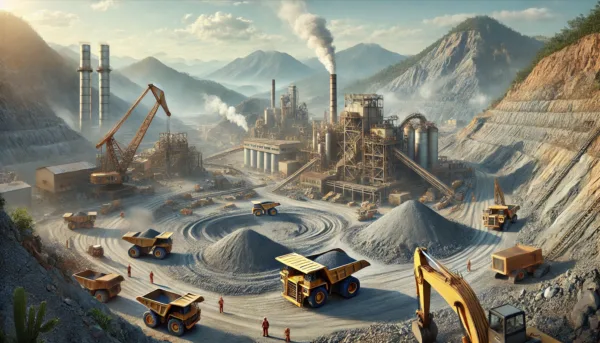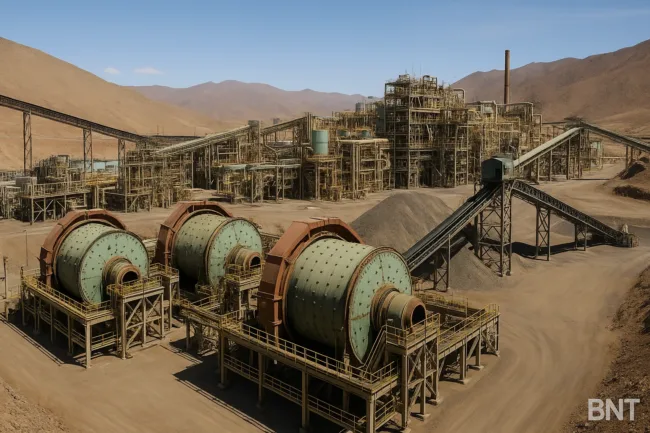



Australia’s mining industry has long been defined by its ability to move massive volumes of high-grade iron ore from the Pilbara to global markets, particularly China. Yet beneath the red dirt of Western Australia lie extensive lower-grade deposits—resources historically dismissed as uneconomic because of their high impurity levels and the prohibitive costs of transporting them thousands of kilometers to coastal smelters. These overlooked ores, often referred to as “stranded deposits,” may now represent a hidden trove worth billions of dollars if new technologies can unlock their potential.
The spotlight on stranded ore has grown brighter following the September 2025 announcement from Metal Logic, an Australian-founded company that has developed a modular, low-emission “smelting as a service” platform. By securing a strategic site in the Pilbara region, less than 20 kilometers from major iron ore rail lines leading to Port Hedland, Metal Logic plans to deploy its technology at an initial scale of one million tonnes per year. The company claims it can profitably process ores that traditional blast furnaces cannot, potentially adding as much as $400 in value per tonne of otherwise neglected ore if processing occurs locally.
How new smelting technologies could transform the economics of low-grade and stranded iron ore resources in Australia
For over a century, conventional steel production has relied on blast furnaces powered by metallurgical coal. While these furnaces remain the backbone of global steel supply, they are notoriously energy-intensive, achieving just 25% to 65% of the thermodynamic efficiency limit of roughly 7.5 gigajoules per tonne of iron. The reliance on coke and coal not only drives up costs but also locks in high levels of carbon dioxide emissions—over 2.8 billion tonnes annually worldwide, making steel one of the most carbon-intensive industrial activities.
This inefficiency is particularly problematic for Australia’s lower-grade ores, which contain more impurities such as silica and alumina. Processing these ores in traditional blast furnaces requires additional energy and fluxing agents, diminishing profitability and rendering many deposits unviable. As a result, significant reserves of iron ore across the Pilbara remain unmined, even as global demand for steel continues to climb.
Metal Logic’s array smelting technology proposes a different path. By integrating electrochemical, photonic, and molecular-scale separation methods into modular smelters, the platform promises higher efficiency and lower emissions. Crucially, it allows miners to process ore directly at or near the mining site, eliminating the need to transport raw, impurity-laden rock over vast distances. The company argues that this approach could extend mine life, bring dormant assets back into production, and create new revenue streams for resource owners.
The implications extend beyond miners. Localized smelting could generate significant downstream value for Australian manufacturers, who currently import much of the steel they use. By retaining more of the processing within the country, Australia could transition from a supplier of raw ore to a producer of competitively priced, low-carbon steel products, supporting domestic industries ranging from construction to renewable energy.
Investors and industry analysts have begun to take notice. While Metal Logic is not yet a publicly traded company—meaning no stock performance data is available—its model has attracted support from major steel and mining stakeholders. Analysts suggest that the “smelting as a service” approach could appeal particularly to mid-tier miners, who may lack the capital to build large-scale smelting infrastructure but control significant lower-grade or stranded deposits.
However, risks remain. Scaling an innovative technology to industrial levels in one of the harshest mining environments on earth is a formidable challenge. Even though Metal Logic insists its technology does not rely on subsidies thanks to its thermodynamic efficiency, skeptics point to the capital intensity of large-scale smelting projects and the history of delays and cost overruns in the sector. Some investors are waiting to see whether the initial one-million-tonne-per-annum deployment in the Pilbara can achieve stable operations before committing further capital.
Still, the broader industry context works in Metal Logic’s favor. Global manufacturers are increasingly seeking green steel as they prepare for carbon tariffs and stricter emissions disclosures. European Union policies like the Carbon Border Adjustment Mechanism are pushing producers worldwide to clean up their supply chains. Meanwhile, automakers and renewable energy developers are signaling willingness to pay premiums for traceable, low-carbon steel to meet their own environmental targets.
For Australia, the economic prize is significant. If even a portion of the stranded ore in the Pilbara can be processed domestically, the country could unlock billions of dollars in additional value while creating jobs in regional communities historically dependent on cyclical mining booms. By shifting from raw ore exports to local smelting, Australia could finally capture more of the value embedded in its vast mineral wealth, building a more resilient industrial base in the process.
The coming years will be decisive. If Metal Logic’s Pilbara deployment proves that modular, low-emission smelting can operate profitably at scale, the model could be replicated across other resource-rich but infrastructure-challenged regions. Success would not only extend the productive lifespan of mines but also strengthen Australia’s position in the global green steel economy, moving the country closer to a long-sought goal: converting natural abundance into sustained, diversified prosperity.
Share this:
Discover more from Business-News-Today.com
Subscribe to get the latest posts sent to your email.