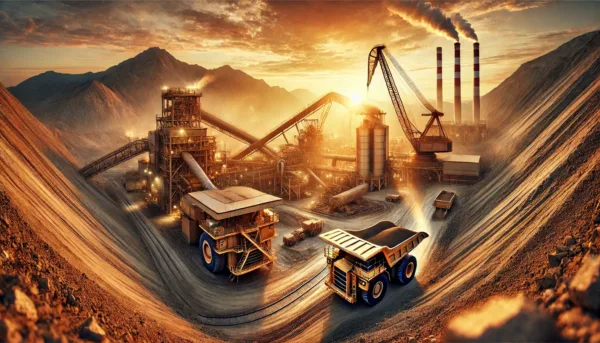



Australia has long been known as the world’s largest exporter of iron ore, with the Pilbara region in Western Australia serving as the beating heart of its mining industry. For decades, the country has relied on shipping hundreds of millions of tonnes of raw ore overseas, particularly to China, Japan, and South Korea, where it is converted into higher-value steel. The model has delivered enormous export revenues but left Australia with limited domestic steelmaking capacity and an enduring reputation as a supplier of raw materials rather than finished products.
This dynamic may soon be tested. On September 10, 2025, Australian-founded Metal Logic announced that it has secured a strategic site less than 20 kilometers from key rail lines in the Pilbara, which channel more than half of the region’s iron ore to Port Hedland, one of the world’s busiest bulk export hubs. The company plans to deploy its modular, scalable, low-emission smelting platform at an industrial scale, starting with an initial one-million-tonnes-per-annum (Mtpa) array. From there, it aims to ramp up mass production through its Melbourne base, introducing a new “smelting as a service” model that could redefine how Australia engages in the global steel supply chain.
Chief Executive Joel Nicholls explained that the company’s array smelting technology was invented and commercialized in Australia with a clear purpose: to process lower-grade ores that traditional blast furnaces have long dismissed as uneconomical. He suggested that this approach could extend the productive life of existing mines and unlock stranded deposits across the Pilbara that are currently idle. Nicholls also argued that the platform’s thermodynamic efficiency allows it to operate profitably without the subsidies often required by large-scale steel projects, freeing government funds for other national priorities like health, education, and advanced manufacturing.
Industry leaders in both iron ore and steelmaking have already backed Metal Logic’s approach, a sign that established players see commercial merit in the technology. Nicholls noted that the company is expanding its team and recruiting engineers, metallurgists, and resource assessors to support the deployment, positioning the Pilbara site as a launchpad for future growth.
Why global demand for green steel could turn the Pilbara into a hub for sustainable manufacturing
The timing of Metal Logic’s initiative is significant. Globally, steelmaking accounts for more than 2.8 billion tonnes of carbon dioxide emissions each year, roughly 8% of the world’s total. Traditional blast furnaces operate at just 25% to 65% of their thermodynamic potential, relying heavily on metallurgical coal and creating substantial environmental costs. Governments across Europe, North America, and Asia are now introducing carbon tariffs, such as the European Union’s Carbon Border Adjustment Mechanism, while global manufacturers in industries from construction to automotive are under pressure to prove their supply chains are sustainable.
This shift has created growing demand for so-called “green steel,” produced with lower emissions and accompanied by verifiable carbon footprints. Metal Logic’s array smelting platform directly addresses this demand, combining electrochemical, photonic, and molecular-scale separation processes to achieve higher efficiency and cleaner outcomes. By situating smelters close to mines, the company can minimize transport inefficiencies and keep more of the economic value within Australia. The firm estimates its approach could generate up to $400 in added value per tonne of ore retained domestically rather than exported in raw form.
For miners, this could mean new life for lower-grade deposits that previously failed to meet commercial cut-off thresholds. For regional economies in the Pilbara, it could mean greater resilience against global market swings, with more jobs tied to local processing and manufacturing rather than distant smelters. For steel buyers, it could offer a transparent, traceable supply of low-emission steel at competitive prices—a proposition that aligns with the climate commitments of multinational corporations.
While Metal Logic is privately held and not yet listed on any exchange, its project has caught the attention of global industry stakeholders. Analysts observing the move suggest there is cautious optimism: on one side, the opportunity to pioneer scalable clean steel production in a resource-rich region is compelling; on the other, the challenge of bringing an unproven technology to multi-million-tonne industrial scale carries real execution risks. The success of the Pilbara deployment will hinge on the company’s ability to demonstrate reliability, cost competitiveness, and consistent output.
If Metal Logic delivers on its promise, the Pilbara could evolve from being primarily an exporter of raw ore into a cornerstone of the global green steel revolution. For Australia, the rewards could include not only economic gains but also a repositioning as a leader in sustainable industrial manufacturing.
Discover more from Business-News-Today.com
Subscribe to get the latest posts sent to your email.