




Adani Power Limited (NSE: ADANIPOWER) and Druk Green Power Corporation Limited (DGPC), Bhutan’s state-owned power generator, have formalized their partnership for the 570 megawatt Wangchhu hydroelectric project, marking a significant step in the growing bilateral energy cooperation between India and Bhutan. The agreements, which include a Shareholders’ Agreement (SHA) and a Concession Agreement (CA), were signed on September 6, 2025, in the presence of Bhutanese Prime Minister Dasho Tshering Tobgay and Adani Group Chairman Gautam Adani.
Initial terms for a Power Purchase Agreement (PPA) have also been outlined, setting the stage for a cross-border energy trade arrangement that aims to address seasonal power shortfalls in Bhutan and supply clean energy to India during surplus periods. This milestone comes just four months after the Adani Group and DGPC signed a Memorandum of Understanding to jointly develop 5,000 MW of hydropower capacity in Bhutan.
The project will be developed on a Build-Own-Operate-Transfer (BOOT) model and is expected to attract an investment of approximately ₹6,000 crore (INR 60 billion), with construction scheduled to commence by the first half of 2026. The completion timeline has been pegged at five years post-groundbreaking.
What is the strategic relevance of the Wangchhu hydroelectric project for both Bhutan and India?
Located in Bhutan’s rugged Himalayan terrain, the Wangchhu project is designed as a peaking run-of-river hydroelectric facility, optimized for generating power during demand surges. For Bhutan, this project is not just another infrastructure asset—it is a keystone in its ambition to become a “High Income Gross National Happiness (GNH) Country” within the next decade. Hydropower is already Bhutan’s primary export and accounts for over 20% of its GDP.
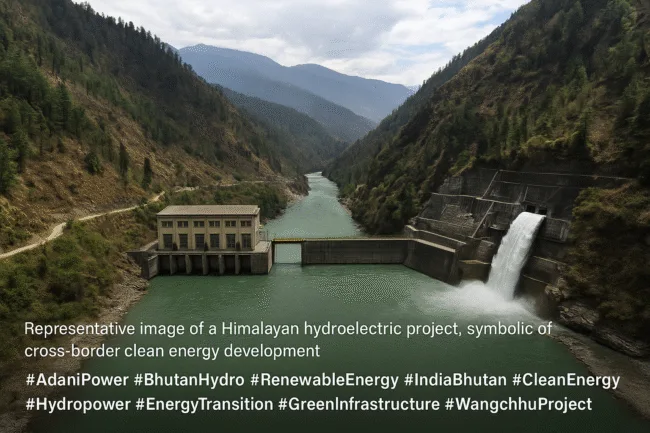
As Bhutan attempts to future-proof its economic model with sustainable energy exports, access to reliable and affordable electricity becomes critical. The 570 MW Wangchhu facility will enhance winter peaking supply when river flows are low—plugging the seasonal gap in domestic consumption. In summer months, surplus generation will be exported to India, which is actively seeking to scale its clean energy imports from neighboring countries as part of its energy transition strategy.
According to DGPC Managing Director Dasho Chhewang Rinzin, the partnership with Adani Power will bring much-needed technical and financial firepower to Bhutan’s next-generation power infrastructure. He emphasized that this could become a benchmark for future cross-border hydropower initiatives. Rinzin also reiterated Bhutan’s broader goal to add 15,000 MW in hydro and 5,000 MW in solar capacity by 2040.
How does this fit into Adani Power’s regional expansion and renewable energy roadmap?
For Adani Power Limited, this project represents its first large-scale foray into Himalayan hydropower—a technically complex but strategically critical domain that strengthens the company’s renewables portfolio. With India targeting 500 GW of non-fossil capacity by 2030, tapping into regional renewable corridors is becoming a competitive advantage.
Adani Power CEO S.B. Khyalia described the Wangchhu initiative as a vital bridge between Bhutan’s sustainable development goals and India’s demand for clean, dispatchable power. He noted that Bhutan serves as a “role model” in renewable energy utilization and that the peaking design of Wangchhu directly aligns with India’s grid balancing needs.
The Indian energy conglomerate’s entry into Bhutan comes at a time when regional players like NTPC Limited, SJVN Limited, and NHPC Limited are also scaling cross-border assets. However, Adani Power’s BOOT model and private-sector agility may position it differently in terms of execution speed and investment structuring.
What are the financial and operational details known so far about the Wangchhu project?
The capital expenditure for the Wangchhu hydroelectric project is estimated at INR 60 billion (approximately USD 720 million). A detailed project report (DPR) has already been completed, suggesting that most feasibility, technical, and environmental approvals are in place. The project will be jointly owned by Adani Power and DGPC, with precise equity structuring yet to be disclosed.
Power from the plant will be primarily allocated to Bhutan’s domestic grid during winter and exported to India during the high-flow summer months. While an official Power Purchase Agreement is still in draft, institutional observers expect a long-term bilateral contract under existing India-Bhutan electricity trade frameworks.
The BOOT concession agreement signed with the Royal Government of Bhutan indicates that Adani Power will eventually transfer ownership back to the Bhutanese state after a fixed operating period. This model has been historically used in other regional infrastructure projects to align long-term asset control with short-term private investment.
How does this project align with broader regional and institutional sentiment around Indo-Bhutan energy cooperation?
Institutional stakeholders view this project as a reaffirmation of India and Bhutan’s decades-long energy partnership that dates back to the Chhukha project in the 1980s. That collaboration laid the foundation for India’s support of Bhutanese hydropower, leading to the commissioning of several major plants such as Tala and Mangdechhu.
This latest partnership signals a shift from purely Indian public-sector investments in Bhutan toward private-sector-led models that can accelerate execution and diversify technology choices. Analysts see this as part of a broader transition in South Asian energy diplomacy—where faster execution, private capital, and regional grid interoperability are becoming more important than state-driven megaprojects alone.
Bhutan’s Prime Minister Tshering Tobgay and Adani Group Chairman Gautam Adani both emphasized the shared vision of clean energy leadership during the signing event. Analysts believe this alignment will be closely watched by multilateral lenders such as the Asian Development Bank and bilateral financing arms that have historically backed regional connectivity projects.
What are the future expectations around timelines, execution risks, and additional projects under this partnership?
The Wangchhu hydroelectric project is expected to break ground by mid-2026, with a projected construction period of five years. Analysts suggest this is an ambitious but achievable timeline, provided Bhutan’s high-altitude logistical challenges are managed efficiently.
Execution risks include monsoon-driven construction delays, complex tunneling requirements, and seasonal worker availability. However, both Adani Power and DGPC are expected to leverage international consultants and hydropower EPC contractors to mitigate these challenges.
Looking ahead, the Wangchhu project is only the first of a 5,000 MW development roadmap agreed upon in May 2025 between Adani Group and DGPC. Future projects are likely to include larger reservoir-based facilities and hybrid solar-hydro sites to enhance year-round energy supply resilience.
Discover more from Business-News-Today.com
Subscribe to get the latest posts sent to your email.