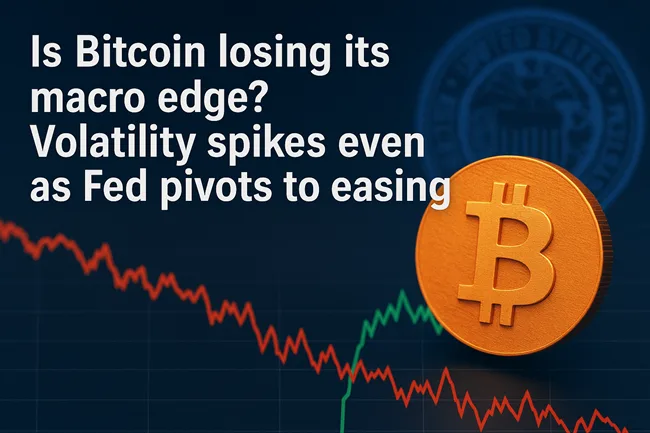
Bitcoin (BTC-USD) showed sharp swings through the weekend, underscoring fragile sentiment across cryptocurrency markets despite fresh evidence that the Federal Reserve is preparing to ease monetary policy after a disappointing August jobs report. The cryptocurrency briefly climbed above $113,000 before slipping back toward $110,700, as traders absorbed U.S. payrolls data showing just 22,000 new jobs added in August compared to forecasts of 75,000. The weak print pushed market odds of a September rate cut close to certainty, with CME FedWatch futures pricing a 25-basis-point move as the baseline and assigning a 12% chance to a deeper 50-basis-point cut.
Why did bitcoin fail to hold gains even as weak US jobs data increased the likelihood of rate cuts?
Historically, lower interest rates and dovish central bank signals have acted as tailwinds for Bitcoin and other risk-sensitive assets, since reduced yields make alternative stores of value more attractive. Gold, for instance, surged above $2,600 per ounce following the labor market disappointment, while U.S. Treasury yields fell sharply across the curve. Yet Bitcoin’s reaction diverged. The cryptocurrency spiked on initial headlines but met heavy selling pressure, suggesting that technical resistance levels and leveraged positioning continue to weigh on upside momentum. Traders noted that Bitcoin’s inability to sustain higher levels despite favorable macro catalysts reflects caution, particularly after several weeks of choppy trading.
How do institutional investors interpret the disconnect between rate-cut expectations and bitcoin’s price action?
Institutional sentiment has been mixed. While the weak jobs report bolstered expectations of a friendlier monetary environment, analysts pointed to structural concerns within crypto markets, such as concentrated leverage and thin weekend liquidity. Many institutional desks framed the recent move as a “fade the rally” setup, with Bitcoin futures open interest climbing to record levels, indicating that speculative positioning is stretched. Stablecoin inflows—an early indicator of potential buying pressure—surpassed $2 billion, yet much of that capital appeared to remain parked rather than rotating into spot BTC. This pause, investors believe, reflects a wait-and-see approach ahead of the September Federal Reserve meeting.
What role does historical volatility play in shaping current bitcoin trading strategies?
Bitcoin has a well-documented history of reacting to macroeconomic events with heightened volatility. During prior Fed easing cycles, the cryptocurrency tended to front-run expectations, often rising sharply ahead of policy decisions only to retrace once the news was confirmed. Market historians noted that in March 2020, when emergency Fed cuts accompanied pandemic relief measures, Bitcoin initially sold off before staging a recovery. The present backdrop—where macro data are weakening but inflation remains sticky—creates uncertainty over whether the Fed will deliver sustained support or a one-off adjustment. This environment encourages short-term tactical trading rather than strong directional conviction.
How is bitcoin’s price trajectory being influenced by technical levels and market structure?
From a technical perspective, Bitcoin’s rally toward $113,000 was capped by a confluence of resistance near prior highs, with chart watchers noting failure to close above key moving averages on daily timeframes. The rejection has reinforced bearish short-term signals, including declining relative strength indicators and reduced spot volumes on major exchanges. Market structure has also been affected by persistent selling from long-term holders locking in gains after a strong summer rally, while miners have increased coin sales to cover operating costs. Together, these factors create a ceiling on price action, despite favorable macro headlines.
What does bitcoin’s recent performance indicate about broader cryptocurrency sentiment in September 2025?
The broader digital asset market has mirrored Bitcoin’s uncertainty. Ethereum briefly tracked Bitcoin higher before losing steam, while altcoins showed a mixed performance, with Solana and XRP declining. Analysts said this dispersion indicates that capital remains concentrated in Bitcoin as the primary liquidity anchor, but without sustained flows into secondary tokens, broader sentiment is fragile. Institutional investors emphasized that exchange-traded fund inflows—particularly into U.S. spot Bitcoin ETFs—will be a decisive signal in September. While August recorded net inflows, the pace has slowed, suggesting retail enthusiasm is cooling even as institutional players selectively add exposure.
How do equity and bond market moves add context to bitcoin’s trading environment?
The jobs report rippled across asset classes. U.S. equity futures initially rose on the prospect of lower borrowing costs, with the S&P 500 registering modest gains before paring them later in the session. In fixed income, yields on two-year Treasuries fell by more than 15 basis points, reflecting repriced Fed expectations. Analysts observed that while Bitcoin has often traded as a “digital gold,” its correlation profile in recent months has shifted closer to equities, making it sensitive to risk-on and risk-off rotations. This explains why Bitcoin could not fully decouple from equity market volatility, even as gold rallied.
What future scenarios could shape bitcoin’s direction in the coming weeks?
Looking ahead, traders are positioning around three key triggers. The first is confirmation of Fed policy on September 17, where a dovish cut may provide short-term relief but could already be priced in. The second is inflation data due next week, which will determine how aggressively the Fed can ease. The third is on-chain signals, such as whether stablecoin inflows translate into sustained spot demand. Analysts cautioned that if Bitcoin fails to reclaim the $113,000 level decisively, it risks sliding toward $107,000–$108,000 support zones. Conversely, a breakout above resistance could reopen the path toward $118,000.
How is investor sentiment shaping up around bitcoin as a hedge and portfolio diversifier?
Institutional investors remain sharply divided on Bitcoin’s role within diversified portfolios, with the debate intensifying after the August jobs data and the latest macro shifts. On one side, proponents argue that Bitcoin has matured into a credible hedge against currency debasement and long-term monetary easing. They highlight the cryptocurrency’s algorithmically fixed supply of 21 million coins as a defining advantage compared to fiat currencies, which remain subject to central bank expansion. From this perspective, every new signal of Federal Reserve rate cuts strengthens the long-term thesis that Bitcoin can act as a digital store of value similar to gold, offering insulation against monetary dilution.
On the other hand, skeptics within the institutional community continue to stress that Bitcoin’s persistent volatility undermines its safe-haven narrative. Unlike gold—which surged in response to the weak payrolls data—Bitcoin has shown an inability to consistently track risk-off flows. Portfolio managers who prioritize capital preservation argue that Bitcoin’s sharp drawdowns during stress events, such as the March 2020 pandemic selloff and the 2022 tightening cycle, illustrate why it cannot yet be considered a reliable hedge. Instead, they view Bitcoin as a high-beta asset class that amplifies risk, more closely aligned with growth equities than with traditional defensive allocations.
The divergence between gold and Bitcoin in early September captures this tension vividly. While bullion pushed to fresh record highs above $2,600 per ounce, Bitcoin remained range-bound near $110,000–$112,000 despite similar macro catalysts. Analysts suggest this signals that professional investors still view Bitcoin as speculative exposure rather than a core macro hedge. Retail sentiment, however, paints a different picture. On crypto-focused forums and trading platforms, optimism about a seasonal “Uptober” rally remains high, with many retail participants betting on historical patterns that have often seen Bitcoin outperform in the fourth quarter.
Professional money managers, by contrast, remain cautious. Large institutions have increasingly incorporated Bitcoin through regulated spot ETFs and custodial platforms, but allocations are typically measured in basis points rather than broad portfolio weightings. Risk management frameworks emphasize liquidity discipline, diversification rules, and the recognition that Bitcoin’s price remains subject to exchange dynamics and sentiment cycles. Institutional desks have also pointed to the growing importance of derivatives markets, where leveraged long positions can create fragility that undermines Bitcoin’s appeal as a hedge.
The result is a market split between retail enthusiasm and institutional prudence. Retail investors tend to see Bitcoin as an asymmetric bet on long-term monetary easing, while professional allocators treat it as an alternative asset with specific risk controls attached. Until Bitcoin demonstrates consistent behavior during macro stress events and a more stable correlation with traditional safe-haven assets, the debate over its portfolio role will likely persist.
Discover more from Business-News-Today.com
Subscribe to get the latest posts sent to your email.