




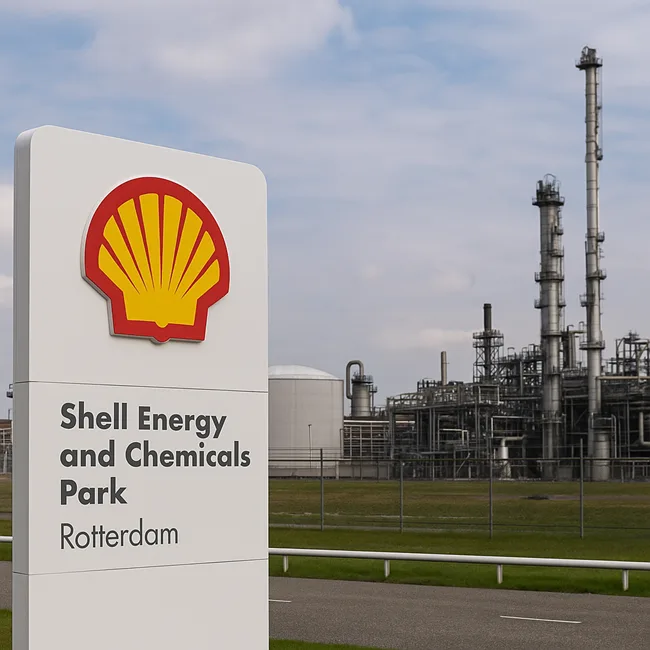
Shell plc (LON: SHEL) has formally cancelled the construction of its long-planned biofuels facility at the Shell Energy and Chemicals Park in Rotterdam, ending a project once billed as one of Europe’s largest sustainable fuel production hubs. Shell Nederland Raffinaderij B.V., a subsidiary of the oil major, confirmed the decision on September 3, 2025, following a months-long internal reassessment of the project’s commercial and technical viability.
The Rotterdam biofuels plant, initially announced in September 2021 and under construction since 2022, was expected to produce 820,000 tonnes per year of low-carbon fuels — split between sustainable aviation fuel (SAF) and renewable diesel. However, after suspending construction in mid-2024 due to market concerns, Shell has now opted to terminate the project altogether, citing its inability to meet affordability benchmarks or shareholder return expectations.
Machteld de Haan, Shell’s President of Downstream, Renewables and Energy Solutions, stated that although the company remains committed to biofuels and decarbonization, the Rotterdam project “would be insufficiently competitive to meet our customers’ need for affordable, low-carbon products.” She emphasized that capital will instead be redirected to higher-return, more scalable transition investments.
What challenges caused the Rotterdam project to falter, and how did cost and regulatory issues contribute?
The Rotterdam facility was envisioned to convert waste materials such as used cooking oil, animal fats, and other residual feedstocks into advanced low-emissions fuels. It was intended to be a cornerstone in Shell’s European transition strategy, supporting regional SAF mandates and industrial decarbonization.
But by 2024, escalating construction costs, limited SAF demand, and regulatory inconsistency across EU markets began eroding the plant’s financial case. Shell paused construction in July 2024 to conduct a full technical and economic re-evaluation. The company subsequently booked impairment charges of up to USD 1 billion, highlighting the project’s mounting capital burden and shifting risk profile.
Under CEO Wael Sawan, who took office in 2023, Shell has adopted a more disciplined capital strategy — prioritizing energy projects that deliver faster returns or align with scalable market opportunities. Analysts viewed the Rotterdam pause as the start of a strategic pullback, especially as SAF uptake remained sluggish without binding airline mandates.
What does the cancellation signal about Shell’s approach to SAF, biofuels, and capital deployment?
The Rotterdam decision does not reflect a retreat from the biofuels sector itself, but rather a shift in how Shell intends to participate. While cancelling this production facility, Shell emphasized its leading position in global low-carbon fuel trading and distribution. In 2024, the company traded more than 10 billion litres of low-carbon fuels — ten times its internal production — and became one of the largest SAF suppliers in North America and Europe, commanding close to 20% of the market.
Shell continues to favor capital-light, globally integrated operations that allow it to arbitrage feedstocks, scale distribution, and partner with corporates through platforms like Avelia — its blockchain-based SAF tracking and transaction system developed with Accenture and American Express Global Business Travel. As of Q1 2025, more than 57 corporations and airlines had transacted over 33 million gallons of SAF via Avelia.
The company also maintains physical production assets through its 44% stake in Raízen, a major Brazilian ethanol producer, and through its 2022 acquisition of EcoOils, which provides advanced biofuel feedstocks across Malaysia and Indonesia. In biogas, Shell owns 14 plants in Europe and three in the U.S. following its 2023 acquisition of Nature Energy.
What are the implications for Shell’s Dutch energy transition portfolio after cancelling Rotterdam?
Despite withdrawing from this major infrastructure project, Shell reaffirmed that the Netherlands remains a strategic priority for its transition roadmap. Since 2020, Shell has invested €6.5 billion in decarbonization projects across the country.
Shell’s strategic focus on the Netherlands remains strong despite the cancellation of the Rotterdam biofuels plant, with several high-impact energy transition projects still moving forward across the country. One of the flagship initiatives is the Porthos carbon capture and storage (CCS) project, which is designed to enable large-scale CO₂ sequestration from industrial clusters in the Port of Rotterdam. Porthos is expected to be one of Europe’s most critical CCS infrastructure hubs, offering emitters in sectors like refining and chemicals a viable pathway to reduce their carbon footprint. In parallel, Shell is advancing the Holland Hydrogen 1 project, a 200-megawatt renewable hydrogen electrolyser located on the Tweede Maasvlakte. Set for commissioning in 2026, Holland Hydrogen 1 is positioned to become the largest green hydrogen plant in Europe and will play a key role in decarbonizing heavy industry and mobility applications across the Benelux region.
In addition to these flagship efforts, Shell is implementing wide-ranging electrification upgrades at its Chemicals Park in Moerdijk, where it has begun installing new electric furnaces and replacing conventional steam reformers with lower-carbon alternatives. These changes are aimed at decarbonizing key manufacturing processes while future-proofing the facility for evolving EU environmental regulations. Collectively, these projects reflect Shell’s ongoing commitment to scaling low-carbon solutions within the Netherlands’ industrial backbone, even as individual assets like the Rotterdam biofuels facility are reassessed for cost-effectiveness and strategic fit.
Shell’s broader Dutch footprint spans upstream oil and gas, downstream distribution, mobility solutions, and hydrogen infrastructure — none of which are impacted by the Rotterdam plant cancellation.
How has institutional sentiment responded to the strategic pivot?
Investor reaction has largely aligned with Shell’s recent capital discipline message. Institutional sentiment suggests that mega-scale biofuels projects face heightened risk without guaranteed SAF demand or government offtake arrangements. Market watchers believe Shell’s pivot toward scalable, flexible, and policy-insulated trading operations may provide better downside protection in a fragmented regulatory environment.
Equity analysts have framed the Rotterdam exit as consistent with Shell’s recent downscaling of wind and retail power investments in favor of higher-margin hydrocarbons and green molecules like hydrogen and biofuels. By prioritizing tradeable low-carbon molecules rather than fixed-capital infrastructure, Shell is aligning with a capital-efficient energy transition playbook.
Still, some observers see the move as a sobering signal for Europe’s SAF rollout. Without infrastructure to produce affordable supply, EU blending mandates may fall short — raising pressure on regulators to incentivize construction or create risk-sharing frameworks with private players.
Could this decision set a precedent for future biofuels infrastructure in Europe?
Shell’s Rotterdam decision could trigger a wider rethink of how sustainable fuel infrastructure is financed, especially in the absence of long-term demand certainty. SAF, in particular, faces challenges from volatile feedstock pricing, poor airline uptake, and unclear global policy alignment. The European Commission has SAF blending targets (2% by 2025, 70% by 2050), but enforcement mechanisms and financial support remain fragmented.
Industry sources suggest that modular, regional, and feedstock-flexible facilities may become the preferred model — particularly for players lacking the scale or trading depth of Shell. For Shell itself, the shift away from static assets toward agile trading and cross-border platforms like Avelia signals a deep integration of digital tools into fuel decarbonization strategies.
Whether this reshaping accelerates or hinders SAF adoption will depend heavily on how quickly policy and private sector incentives can converge.
Discover more from Business-News-Today.com
Subscribe to get the latest posts sent to your email.
