


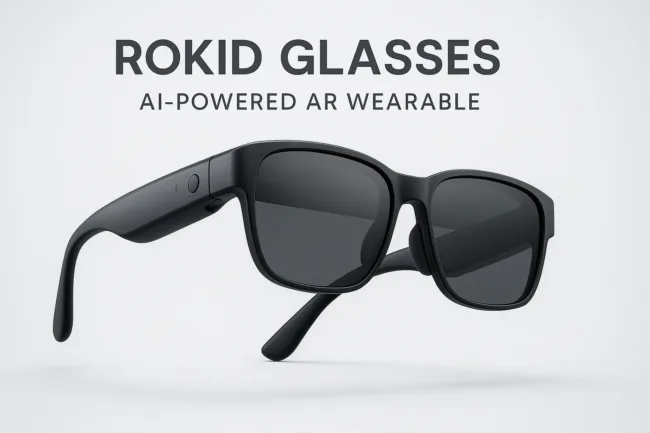
Rokid, a China-headquartered pioneer in augmented reality and human-computer interaction, has crossed a significant milestone with its latest product launch. The startup announced that its newly unveiled Rokid Glasses surpassed $1 million in crowdfunding pledges on Kickstarter within just four days, setting a strong early benchmark for consumer adoption of next-generation AI-powered smart glasses.
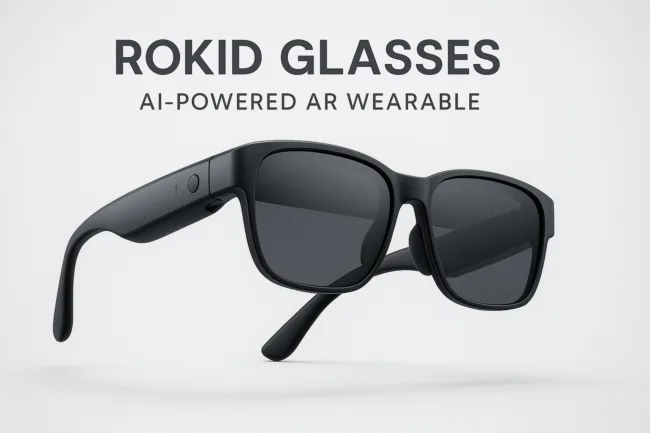
The achievement places Rokid firmly among a new class of hardware disruptors tapping into the fast-growing demand for lightweight, multifunctional wearable devices. Unveiled during the “Future in Sight” launch event in New York City earlier this week, the Rokid Glasses weigh just 49 grams but are packed with features that blend augmented reality (AR), artificial intelligence (AI), and real-time communication tools into a single, minimalistic form factor.
The successful Kickstarter campaign underscores growing institutional and developer confidence in consumer-grade AR platforms, which have historically struggled to bridge the hype-to-utility gap. For Rokid, it also signals the global relevance of its developer-first, AI-native ecosystem—one that has already seen strong traction in China and is now aiming to replicate that momentum overseas.
What are the key features of Rokid Glasses that drove early Kickstarter momentum and viral traction?
Rokid’s pitch for its new AR glasses hinges on a seamless blend of practical AI tools and real-world usability. Built on the Qualcomm AR1 platform, the glasses support instant multilingual translation, real-time live transcription, note-taking capabilities, contextual AR navigation, and productivity-boosting features like smart notifications and an AI-powered teleprompter. The addition of a 12MP first-person HDR camera with image stabilization enables hands-free video recording, object recognition, and even AR-enhanced content capture.
The glasses are designed for diverse settings, from professional use in corporate meetings and education, to travel assistance, creator workflows, and daily lifestyle scenarios. Rokid has emphasized that its hardware is not merely a visual gimmick, but a fully realized extension of AI-powered computing—portable, voice-enabled, and smart-context aware.
The Kickstarter surge is also being linked to a wave of high-impact promotional activity. On Bloomberg TV, Rokid’s Global General Manager Zoro Shao discussed how AI wearables are reshaping daily interaction and moving the tech stack “from pockets to faces.” The segment drew attention to Rokid’s broader campaign strategy, which included a headline-grabbing Times Square activation featuring live demos and experiential installations.
That campaign later gained virality traction on Trendhunter, which rated the launch activation a perfect 10/10 for its blend of product marketing and cultural spectacle. Trendhunter described it as an example of “high-profile live performance marketing,” commending Rokid’s fusion of hype, product clarity, and brand storytelling.
How is Rokid positioning itself in the competitive wearable tech space beyond China?
While much of Rokid’s historical success has been rooted in the Chinese XR ecosystem, the current product cycle marks a deliberate shift to global market penetration. The AR company already boasts the largest extended reality (XR) developer base in China, with over 15,000 active developers and 5,000 enterprise partners. Now, it is actively courting global developer support with plans to onboard over 1,000 overseas contributors into its open SDK ecosystem.
By targeting the international developer community through Kickstarter—and bundling early access with a $100 discount—Rokid is trying to seed a grassroots adoption strategy that mirrors the playbooks of early hardware successes like Oculus Rift and Pebble. The firm’s SDK supports custom application development and offers integrations with third-party productivity, language, and mapping tools.
This expansion push also reflects a broader market context. According to analysts, North America and parts of Europe are entering a new cycle of interest in AR wearables as the hype around AI assistants converges with form-factor miniaturization. Institutional sentiment suggests that this second wave of smart glasses—unlike early-generation, enterprise-only devices—may have clearer consumer pathways if pricing, comfort, and app ecosystems can mature in tandem.
What makes the AI-powered feature set of Rokid Glasses stand out in the wearable computing category?
The defining feature of Rokid Glasses isn’t just AR—it’s the intelligent fusion of AI capabilities into real-world use cases. For instance, multilingual translation happens in near real time, with the glasses overlaying translated text into the wearer’s visual field. This makes them particularly appealing for travelers, international workers, and educators.
AR navigation combines GPS with contextual visual overlays, helping users orient themselves in unfamiliar urban environments or transit systems. The real-time transcription and note capture functions serve knowledge workers, students, and journalists, positioning the device as more than a passive consumption layer.
For content creators and video-first professionals, the glasses’ 12MP camera and AI-powered teleprompter enable hands-free scripting, live-streaming, and object tagging—use cases that are increasingly common in TikTok- or YouTube-driven content workflows. Meanwhile, productivity applications can display contextual cues, smart notifications, or AI-generated insights directly into the user’s field of view without needing a phone or laptop.
In many ways, Rokid is pushing the vision of a truly “head-up” computing paradigm—one where AI is accessible without screens, taps, or swipes.
How does this Kickstarter success impact institutional sentiment around consumer AR wearables?
The $1 million milestone within four days has drawn attention across both consumer and investor circles, though analysts remain cautious about long-term delivery timelines, support infrastructure, and device churn typical of first-generation hardware launches. However, early traction on Kickstarter often acts as a litmus test for consumer readiness—especially for high-touch, habit-shifting devices like smart glasses.
Investor sentiment around wearable AR has been historically cyclical. Previous efforts—such as Google Glass, Magic Leap, and North—faced challenges in sustaining adoption beyond initial curiosity. However, the intersection of AI-native design, better optics, cloud integration, and more efficient chipsets appears to be reversing some of that skepticism.
Rokid’s strategic framing as an AI company, not just an AR hardware firm, also helps differentiate its trajectory. By aligning itself with broader AI compute narratives rather than purely visual or XR ones, Rokid taps into funding and ecosystem momentum that extends beyond the volatile hardware cycle.
Some industry watchers noted that Rokid’s pop-up marketing, developer-first SDK strategy, and enterprise use-case layering could offer it an edge over earlier entrants that prioritized either niche verticals or overdesigned consumer concepts.
What is the future roadmap for Rokid’s global expansion and product availability?
As of now, the Kickstarter campaign is still active, offering early backers a limited-time $100 discount before the product’s full commercial rollout. The wearable is expected to be available to supporters ahead of wider retail availability, though specific shipping dates were not confirmed at press time.
Rokid has stated that it aims to deepen its presence in the U.S., Europe, and Southeast Asia through strategic partnerships, developer grants, and software localization. The firm also hinted at future enterprise deployments—particularly in logistics, education, and retail—where AI-powered AR glasses can provide hands-free productivity gains.
Rokid is also expected to participate in upcoming international tech expos including CES 2026 and MWC Barcelona, where further iterations or enterprise-class accessories could be previewed. As interest in agentic AI, voice-first computing, and screenless UX grows, Rokid appears intent on positioning itself as a category shaper rather than a trend follower.
Whether the company can maintain this momentum after crowdfunding ends will depend heavily on developer uptake, update cadence, and the strength of third-party integrations.
Can Rokid’s Kickstarter success translate into sustainable global adoption for AI smart glasses?
The early momentum behind Rokid Glasses paints a promising picture for AI-first wearables, especially in a world where the boundaries between personal computing, productivity, and communication are blurring. Rokid’s ability to deliver a sleek form factor with practical, real-world utility has differentiated it from legacy AR attempts that focused more on novelty than necessity.
However, sustaining this pace will require more than early interest. Analysts will be watching closely to see how Rokid handles hardware scaling, software robustness, and long-term user engagement. If its China-to-global developer strategy translates well, Rokid may very well have positioned itself as a sleeper contender in the race to define next-generation computing.
As AI-infused wearables move from novelty to necessity, Rokid is betting that the face is the new frontier—and so far, the bet appears to be paying off.
Discover more from Business-News-Today.com
Subscribe to get the latest posts sent to your email.