How significant is Belararox’s drilling start at the Kalahari Copper Project for its long-term value creation?
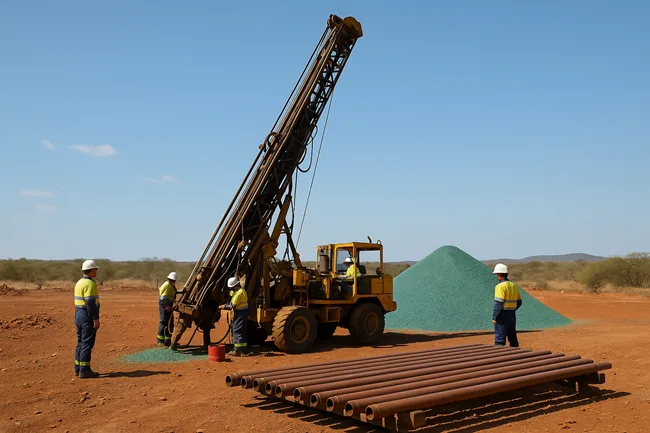
Belararox Limited (ASX: BRX), a mineral exploration company with projects across Australia, Argentina, and Botswana, has officially commenced its maiden drilling campaign at the Kalahari Copper Project in Botswana. The announcement comes at a pivotal time for the junior explorer, whose stock has shed more than 61% over the past 12 months, reflecting cautious institutional sentiment despite global optimism for copper’s role in the clean energy transition.
The Kareng West tenement (PL0085) will be the focal point of the 2025 exploration program. Belararox confirmed that drilling began during the week of August 25, with ten reverse circulation (RC) drill holes scheduled to reach depths of 300 metres. These holes will test four priority copper targets along the D’Kar and Ngwako Pan contact zones, stratigraphic horizons known to host copper-silver mineralisation within the broader Kalahari Copper Belt.
Why is the Kareng West drilling program viewed as a milestone for Belararox’s copper strategy?
The Kalahari Copper Project spans 4,268 square kilometres across fourteen exploration licences in northern Botswana. The project sits within the Ghanzi-Chobe belt, a copper-rich corridor extending 500 kilometres northeast to southwest, and hosts significant sedimentary copper-silver deposits. The D’Kar Formation and Ngwako Pan Formation contacts, where mineralisation typically concentrates, have already attracted investment and exploration from major copper players including BHP, Sandfire, and MMG.
Belararox’s program will initially target six priority zones identified through detailed geophysical interpretation. Four of the most prospective have been earmarked for the maiden campaign. Technical advisor Dr. Quinton Hills noted that the program reflects “a significant step in Belararox’s strategy to achieve a discovery,” adding that the team’s targets were selected on the back of robust gravity and magnetics analysis supported by regional datasets.
How is the drill program structured and what outcomes could redefine project potential?
The drilling schedule calls for ten holes totaling approximately 3,000 metres, to be completed within a month. Using a Super Rock 5000 drill rig capable of 100–150 metres per day, Belararox intends to move sequentially across target zones T3b, T3a, and T1. Each fence of drill holes has been designed at 200-metre spacings, with a 60-degree dip angle to maximise intercepts across the D’Kar–Ngwako contact.
The strategy emphasises systematic testing: three fences of three holes each, plus a tenth hole positioned along a gravity-defined line, offer early indications of mineralisation potential. Depending on results, Belararox may expand the program to include additional fences. The company expects that the initial geochemical and geological data could help validate the geophysical anomalies and potentially upgrade targets to resource definition drilling.
How does this drilling campaign align with sector trends in copper exploration and energy transition demand?
Copper has emerged as one of the most critical commodities in the energy transition. With demand forecast to surge in electric vehicles, renewable power infrastructure, and grid modernisation, institutional investors have been scouring the globe for projects with scale. The Kalahari Copper Belt is increasingly viewed as one of Africa’s most promising copper provinces, with its geology offering parallels to other sediment-hosted copper districts that have historically delivered tier-one discoveries.
Belararox’s decision to advance drilling positions it alongside larger peers pursuing the same stratigraphic horizons. Analysts suggest that success could not only validate its licence holdings but also improve its visibility in a competitive exploration field. At present, however, the firm remains a junior player with a market capitalisation of just A$17.8 million, ranking 1,620 out of 2,322 companies on the ASX and 599 out of 1,064 within the Basic Materials sector.
What is investor sentiment around Belararox given its recent share price decline and sector volatility?
Despite advancing its project pipeline, Belararox shares have struggled. As of August 28, 2025, the stock trades at A$0.11 per share, within a 52-week range of A$0.052 to A$0.325. The company has 162 million ordinary shares on issue, translating into a modest free float and relatively thin liquidity, with daily volumes averaging just over one million shares.
The one-year return of –61.4% reflects a broader skepticism around early-stage explorers without defined JORC resources. Institutional sentiment remains cautious, with investors weighing the high-risk exploration phase against the upside potential of a copper discovery. While analysts recognise the geophysical quality of the targets, most investor commentary frames Belararox as a high-beta copper play—one that could re-rate dramatically on discovery, but equally faces dilution or capital constraints if drilling proves inconclusive.
What does the outlook look like for Belararox after the maiden drilling campaign?
The next 30 days of drilling will be critical for Belararox’s near-term valuation. If mineralisation is intersected, the company could attract joint venture interest or expand its capital base through a more favorable raising. Conversely, the absence of promising results could weigh further on its share price, which is already near the lower end of its one-year range.
From a sector standpoint, the Kalahari Copper Project’s location within Botswana’s established copper belt provides Belararox with a structural advantage. The region has been steadily gaining recognition as a global copper growth corridor, attracting heavyweights such as Sandfire Resources, MMG, and BHP, all of whom are targeting the same sediment-hosted copper-silver systems along the D’Kar–Ngwako Pan contact. This clustering effect often creates a halo of credibility for junior explorers, since proximity to active discoveries improves geological confidence and raises the odds of commercially viable mineralisation.
For Belararox, any positive drill results could quickly shift its positioning in the investor landscape. Institutional investors frequently view juniors in proven jurisdictions as potential farm-in or takeover candidates once mineralisation is confirmed. In the African copper context, majors have shown a willingness to secure pipeline projects early, particularly as global supply chains come under pressure from surging demand in electric vehicles, renewable power cabling, and grid modernisation. If Belararox demonstrates continuity of mineralisation similar to nearby peers, analysts believe it could transform from a speculative explorer into a credible junior partner within the copper development cycle.
At the same time, the market remains disciplined. Investors are weighing copper’s bullish long-term fundamentals against the practical realities of exploration financing. Belararox’s A$17.8 million market capitalisation, relatively modest cash resources, and history of share price volatility mean that until drill core assays confirm mineralisation, sentiment is likely to remain speculative. This speculative sentiment reflects a broader theme in junior resource markets: optimism in copper’s structural role in decarbonisation balanced against caution over execution risks, dilution through future capital raisings, and the timeline from discovery to production.
If the Kalahari Copper Project delivers promising intercepts, Belararox could see a rapid re-rating, attract joint venture offers, or position itself as a strategic acquisition target. Until then, its valuation will remain closely tied to the outcome of this maiden drilling program, making the next 30 days of exploration activity a decisive test for both management credibility and long-term shareholder confidence.
Share this:
Discover more from Business-News-Today.com
Subscribe to get the latest posts sent to your email.