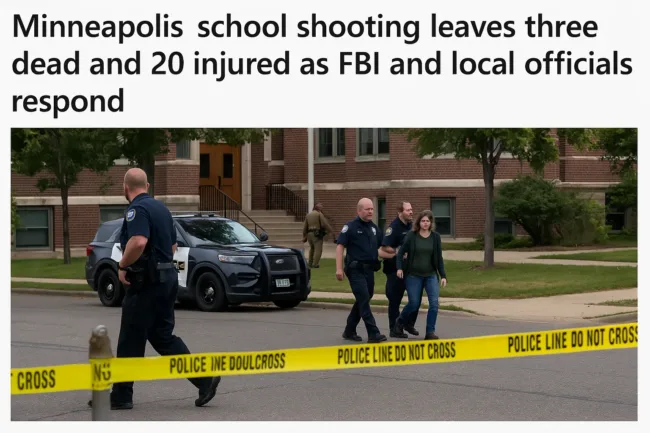
How did the Minneapolis school shooting unfold and what is known about the casualties so far?
A school community in Minneapolis, Minnesota, was left reeling on Monday after a mass shooting claimed at least three lives and injured 20 others at the Annunciation Church campus, which also houses a grammar school. Federal and state law enforcement officials confirmed that the shooter was among those killed in the incident, bringing some immediate relief that the threat had been contained.
The shooting took place on the city’s south side, with initial reports suggesting that students, staff, and community members were caught in the chaos as the new academic year began. The City of Minneapolis posted on X, formerly Twitter, that there was no ongoing danger to the community, stressing that the shooter was “contained.” Families of children attending the school were directed to a reunification zone set up at the Annunciation School site.
Officials said the focus was now on providing medical attention to the injured, many of whom were taken to nearby hospitals. The incident added Minneapolis to the growing list of U.S. cities grappling with school shootings that have shaken communities across the country in recent years.
What was the immediate response from the White House and how did President Trump frame the situation?
United States President Donald Trump said he had been fully briefed about the Minnesota tragedy, adding that the Federal Bureau of Investigation (FBI) was on the ground and working closely with local law enforcement.

In a post on Truth Social, President Trump described the situation as “tragic” and urged the country to join him in prayer. He emphasized that the White House was closely monitoring developments and that the FBI’s rapid deployment underscored the seriousness of the event. His remarks sought to reassure the public that federal agencies were responding decisively while extending empathy to the families affected.
The president’s statement reflected the heightened political attention mass shootings often attract, especially when they occur in educational settings. Trump’s call for national prayer highlighted how such tragedies frequently stir broader debates on school safety, mental health, and firearm access—though in this instance, his focus remained on solidarity with victims and the law enforcement response.
How did the FBI and law enforcement agencies react to the Minneapolis school shooting?
FBI director Kash Patel confirmed that agents had arrived at the scene and were actively coordinating with local authorities. Writing on X, Patel said that the agency was aware of the reports and asked the public to keep potential victims, whether civilians or law enforcement, in their thoughts.
Patel further noted that the FBI would provide updates as more verified information became available. His statement underlined the bureau’s dual role in such crises: immediate tactical response and longer-term investigative oversight.
On the ground, state-level reinforcements were also deployed. The Minnesota Bureau of Criminal Apprehension (BCA) and State Patrol joined local police in securing the scene and assisting with emergency management. Their presence demonstrated the layered response system in place for large-scale violent incidents in U.S. communities.
What did Minnesota Governor Tim Walz say about the attack and how did he address community concerns?
Minnesota Governor Tim Walz said he had been briefed on the shooting and confirmed that state resources were being directed to assist Minneapolis authorities. Posting on X, the governor said both the BCA and State Patrol were present, and he pledged to continue providing updates as information unfolded.
Governor Walz expressed sorrow that the “first week of school” had been marked by violence, framing the incident as a breach of what should be a safe space for children and educators. He also offered prayers for students and teachers, echoing community grief while attempting to reassure families about the state’s commitment to supporting investigations and recovery.
Walz’s comments aligned with a broader pattern in which governors highlight the availability of state resources while emphasizing the emotional toll of school shootings. His message appeared to be aimed at both the local community and a wider national audience following the tragedy through news outlets and social media.
Why does the Annunciation Church shooting stand out in the broader pattern of school violence in the United States?
While mass shootings in the United States have tragically become more common, the Annunciation Church case carries particular weight due to its location at a Catholic grammar school within a place of worship. Such institutions are traditionally seen as sanctuaries for children and families, intensifying public shock.
The fact that the shooter was reportedly among the dead may have prevented even greater loss of life, but the casualty count—three dead and 20 injured—underscores the scale of the tragedy. Analysts suggested that the timing of the event, coinciding with the start of a new academic year, may amplify its emotional resonance across the country.
Educational institutions, both public and private, have been under pressure for years to upgrade security measures in response to recurring gun violence. However, incidents like this one in Minnesota show that even faith-based schools remain vulnerable despite community perceptions of safety.
How have institutional investors and policymakers typically reacted to the recurring problem of school shootings?
Institutional investors, while not directly involved in crisis response, have frequently flagged the long-term economic and reputational risks that such violence poses to local communities. Analysts note that repeated tragedies can strain public resources, increase insurance costs for schools, and depress community confidence in education systems.
Policymakers, meanwhile, remain divided on the solutions. While some push for stricter gun control and expanded mental health services, others emphasize armed security presence and enhanced surveillance in schools. The Minneapolis shooting has reignited those discussions, with early signals pointing to renewed calls for bipartisan action—though history suggests that immediate consensus may remain elusive.
What is the outlook for the investigation and the wider community response in Minneapolis?
Authorities indicated that the next phase would involve a detailed investigation into the shooter’s background, motives, and access to weapons. Given that the FBI is already embedded in the case, federal prosecutors could play a role depending on the findings.
For the Minneapolis community, the immediate focus is on healing. Schools, churches, and civic organizations are expected to coordinate vigils and counseling services for affected families. Analysts note that such responses often help rebuild a sense of community resilience but do little to stem broader national debates on violence prevention.
From an institutional perspective, Minneapolis authorities will likely face questions on how quickly they contained the incident and what preventive measures were in place before the shooting. The answers could shape future state-level policy on school security, especially within faith-based institutions.
Discover more from Business-News-Today.com
Subscribe to get the latest posts sent to your email.