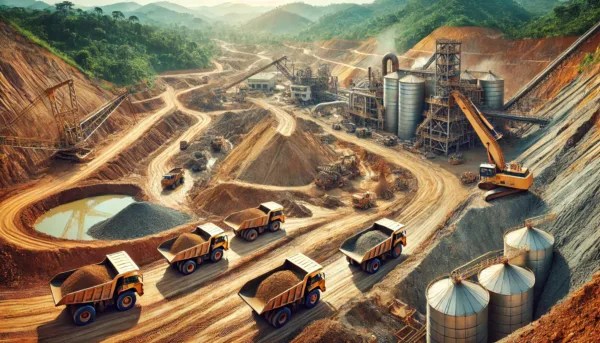




Northern Graphite Corporation (TSXV: NGC) has secured a CAD 6.225 million investment from the Government of Canada to expand and modernize operations at its Lac-des-Îles graphite mine in Quebec, the only active natural graphite production site in North America. The federal funding is structured as a repayable contribution and will be delivered by Canada Economic Development for Quebec Regions (CED) under the Regional Economic Growth through Innovation program.
The announcement was jointly made by Minister of Industry Mélanie Joly and Minister of Energy and Natural Resources Tim Hodgson, underscoring Ottawa’s focus on reinforcing Canada’s critical mineral production base to serve energy transition, defence, and clean technology supply chains. The funds originate from Natural Resources Canada (NRCan) and are intended to extend the mine’s life by up to a decade, stabilizing domestic production of approximately 20,000 tonnes of natural graphite per year.
How does Northern Graphite’s Lac-des-Îles project support Canada’s critical minerals strategy?
The investment in Northern Graphite’s wholly owned Quebec subsidiary, Graphite Nordique Inc., aligns with the federal government’s Critical Minerals Strategy, a multi-billion-dollar initiative aimed at boosting domestic supply chains for minerals essential to electric vehicles, batteries, defence systems, semiconductors, and renewable technologies.
Lac-des-Îles is currently the only producing natural graphite operation in North America, and the expansion project seeks to optimize existing extraction infrastructure and expand the current pit. This will not only secure long-term supply but also reinforce Canada’s ambition to become a global leader in the production of ethically sourced, high-purity critical minerals.
According to NRCan, the support comes in the form of an interest- and collateral-free repayable contribution — a financial structure intended to support economic development while allowing for future reinvestment into regional innovation. The expanded mine operations are expected to directly retain 55 skilled jobs, reinforcing employment in the Antoine-Labelle region of Quebec.
What does Northern Graphite’s CEO say about this government support?
Hugues Jacquemin, CEO of Northern Graphite Corporation, emphasized that the funding represents foundational support for the company’s long-term strategy to become a tier-one supplier of graphite for both industrial and emerging battery markets. Jacquemin stated that the Lac-des-Îles mine is not only a legacy asset but the anchor for Northern Graphite’s growth ambitions.
He added that the investment validates Canada’s commitment to advancing its critical minerals potential, stating the funding will allow the company to maintain operations, deliver to long-standing customers, and tap into newer high-growth sectors like EV battery production and national defence.
The graphite produced at Lac-des-Îles is already used across a range of industrial sectors. With demand for natural graphite forecast to rise sharply — particularly in lithium-ion battery anode manufacturing — the project could evolve into a strategic supply node in North America’s energy transition ecosystem.
How does this investment tie into Canada’s broader economic and national security goals?
Graphite is categorized as a strategic critical mineral by both the Canadian and U.S. governments. Its use spans lithium-ion batteries, solar and wind energy systems, semiconductors, and electromagnetic shielding for defence applications. As global competition intensifies for secure access to such minerals, Ottawa’s move signals a deeper integration of economic development with national security and climate priorities.
Minister Joly framed the investment as part of a broader effort to secure Canada’s economic sovereignty and lead in clean energy manufacturing. She emphasized the tangible impact on Quebec’s workforce and communities, noting that the initiative supports not just resource extraction but also value-added processing within Canada.
Echoing that sentiment, Minister Hodgson highlighted the national implications of the investment, positioning it as a dual win for both economic strength and national resilience. He reiterated that Canada’s ability to supply responsibly sourced critical minerals gives it leverage in global trade and clean tech diplomacy.
What is the current institutional sentiment toward Northern Graphite Corporation?
Northern Graphite Corporation is publicly listed on the TSX Venture Exchange under the symbol NGC. The firm is also traded on OTCQB (NGPHF) and German exchanges (FRA: 0NG, XSTU: 0NG), reflecting moderate visibility among international retail and institutional investors.
As of August 2025, Northern Graphite’s stock performance has shown volatility consistent with broader trends in junior mining equities. However, analysts following the critical minerals sector note that the government’s support may boost investor confidence in the company’s operational stability and market positioning.
The firm’s ability to scale and secure offtake agreements for EV and battery supply chains — especially in the context of U.S. Inflation Reduction Act (IRA) incentives for North American-sourced materials — is likely to attract further institutional scrutiny.
Market observers believe that sustained government backing, paired with rising graphite demand for anode materials, could strengthen Northern Graphite’s visibility in ESG-aligned portfolios. However, the company will need to execute on its operational milestones and demonstrate processing scalability to justify a shift from speculative to growth-stage classification among buy-side players.
What does the future hold for Canada’s graphite ambitions and clean technology leadership?
With global graphite demand projected to increase more than sixfold by 2035, Canada’s control over a domestic source places it in a unique position to influence North American supply chains. Analysts expect additional downstream investments — such as spherical graphite processing or battery anode manufacturing — to follow projects like Lac-des-Îles if government policy continues to de-risk early-stage production.
Northern Graphite’s expansion project could also serve as a blueprint for other mid-tier mining firms seeking public-private partnerships to fund critical mineral development. The emphasis on modernizing existing assets rather than developing greenfield sites could prove more capital efficient in meeting near-term demand.
In this context, Ottawa’s interest- and collateral-free repayable contribution model could emerge as a preferred framework for stimulating private investment while preserving taxpayer accountability.
From a geopolitical lens, Canada’s graphite play complements U.S. efforts to diversify away from Chinese supply chains, which currently account for over 65 percent of global mined graphite and more than 90 percent of processed anode-grade graphite capacity. China’s dominance has raised concerns among Western policymakers about supply security, given graphite’s essential role in electric vehicle batteries, defence technologies, and renewable infrastructure. By expanding production at the Lac-des-Îles mine in Quebec, Canada positions itself as one of the few alternative suppliers within a secure and politically stable jurisdiction.
This shift adds diplomatic weight to Northern Graphite’s operations, as the mine becomes not only an industrial asset but also a strategic partner in clean energy cooperation between Canada and the United States. With the U.S. Inflation Reduction Act incentivizing North American–sourced critical minerals, cross-border alignment on graphite supply has taken on greater urgency. Analysts argue that projects like Lac-des-Îles could serve as testing grounds for deeper trade agreements, joint stockpiling initiatives, and even co-investments in downstream processing facilities, thereby reinforcing continental energy independence.
For Canada, the geopolitical stakes go beyond commercial output. Establishing itself as a reliable graphite supplier enhances its leverage in global climate negotiations and strengthens its hand in building alliances with other mineral-rich democracies such as Australia. The Lac-des-Îles mine therefore represents a convergence of economic development, industrial strategy, and foreign policy, amplifying Canada’s influence in the global clean technology race.
Discover more from Business-News-Today.com
Subscribe to get the latest posts sent to your email.