





Why did Cheteshwar Pujara decide to retire from cricket after more than a decade of representing India?
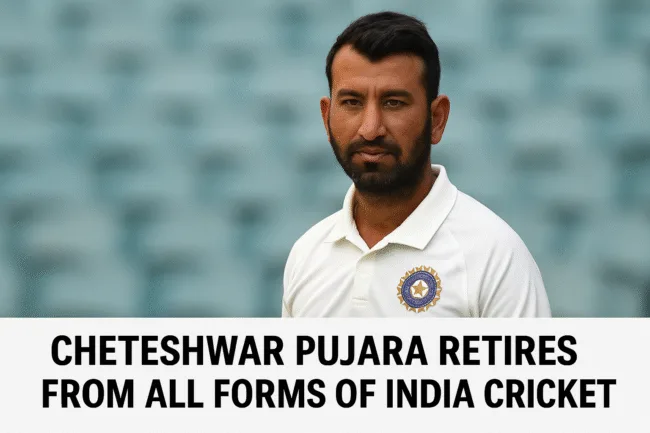
Cheteshwar Pujara, one of India’s most consistent Test batsmen of the modern era, announced on Sunday that he is retiring from all forms of Indian cricket. The decision marked the end of a career that spanned nearly 15 years at the international level and saw him emerge as the backbone of India’s batting order in the longest format of the game. Pujara’s retirement was not entirely unexpected, but it still carried the weight of an era-defining departure. His decision came with a note of gratitude, as he reflected on his journey from Rajkot to the Indian Test team, where he played 103 matches, scored 7,195 runs, and averaged 43.60 with 19 centuries and 35 fifties.
The 36-year-old last represented India in the World Test Championship final against Australia in June 2023, and since then had largely been on the fringes of the national setup. With his departure, Indian cricket closes the chapter on one of its most reliable No. 3 batsmen since Rahul Dravid, a comparison that Pujara often lived under but rarely shied away from.
What made Pujara’s Test career significant for Indian cricket in the modern batting era?
Cheteshwar Pujara’s legacy rests on his role as the anchor of India’s Test side at a time when aggressive stroke play increasingly dominated world cricket. In an age of T20 leagues and attacking approaches, Pujara embodied the classical virtues of patience, resilience, and long spells at the crease. His contribution was particularly critical in away tours where conditions demanded adaptability and technique over flair.
His match-saving and match-winning innings include a pivotal role in the 2018–19 series win in Australia, where he scored 521 runs across four Tests at an average of over 74. That series is often regarded as India’s most historic overseas achievement in Test cricket, and Pujara’s ability to wear down the Australian attack across long sessions drew admiration even from rivals. Analysts often noted that his presence at the crease provided a platform for stroke-makers like Virat Kohli, Ajinkya Rahane, and Rishabh Pant to flourish around him.
How did Pujara’s ODI career compare with his Test achievements and why was it limited?
While Pujara’s numbers in Test cricket earned him comparisons with India’s greats, his journey in limited-overs formats was brief and unremarkable. He played only five One-Day Internationals between 2013 and 2014, all away from home, and scored just 51 runs with a highest score of 27. His classical style, which relied more on attritional play, did not translate well into the faster-paced ODI and T20 arena where power hitting and strike rotation were prioritized.
Despite these limitations, Pujara continued to contribute in first-class cricket, where he remained prolific for Saurashtra and county sides in England. Many observers noted that his sustained performances at the domestic level prolonged his Test career even as competition for spots in India’s middle order grew intense.
What did Cheteshwar Pujara emphasize in his retirement statement and who did he thank?
In his retirement statement, Pujara described his cricketing journey as a boy from Rajkot who once only dreamt of playing for India. He said the game had given him “invaluable opportunities, experiences, purpose, love, and above all a chance to represent my state and this great nation.” He added that wearing the Indian jersey and singing the national anthem before stepping on the field were moments that would remain impossible to describe in words.
Pujara expressed gratitude to the Board of Control for Cricket in India (BCCI) and the Saurashtra Cricket Association for giving him the opportunity to represent both his state and his country. He also acknowledged teammates, support staff, ground staff, and the many others who contributed behind the scenes. Importantly, he credited mentors, coaches, and his spiritual guides for shaping his career, while also highlighting the sacrifices made by his wife, daughter, parents, and extended family.
How is the cricketing fraternity and institutional sentiment reacting to Pujara’s retirement?
Although immediate official tributes are still emerging, the cricketing community has widely acknowledged Pujara’s retirement as the departure of a player who carried the torch for Test cricket’s traditional ethos. Former teammates have often described him as a calming influence in the dressing room, while institutional sentiment among cricket analysts remains that his value extended beyond runs to the resilience he brought to India’s Test strategy.
Institutional investors and analysts in the cricketing ecosystem—those who measure the sport in terms of commercial sustainability and audience retention—often argue that players like Pujara were crucial in maintaining Test cricket’s relevance in India. His ability to draw respect for attritional cricket in an age dominated by limited-overs entertainment helped the five-day format retain prestige in the Indian market.
What does Pujara’s departure mean for India’s Test batting depth going forward?
Pujara’s exit leaves a gap in India’s Test lineup at the crucial No. 3 position. While players like Shubman Gill and KL Rahul have been trialed in similar roles, Pujara’s discipline and ability to absorb pressure are not easily replicable. Analysts believe India’s bench strength is promising, but they caution that grooming a player with the same level of temperament for long-format cricket could take time.
The challenge for the Indian Test side will be balancing the modern approach of aggressive batting with the need for stability in overseas conditions. Experts suggest that Pujara’s retirement accelerates the ongoing generational shift in Indian cricket, where players more suited to multi-format cricket will dominate selections.
How will Pujara’s career be remembered in Indian and global cricket history?
Cheteshwar Pujara’s career will be remembered as a tribute to the art of Test batting. His 19 centuries, many of them crafted against top-tier opposition in challenging conditions, underline a career that consistently delivered when patience was at a premium. For India, he represented continuity after Rahul Dravid’s retirement, ensuring the side retained a reliable No. 3 through a decade of intense competition and changing formats.
Globally, cricket historians will place Pujara in the category of specialists who remained loyal to the format that best suited their strengths. His retirement serves as both a reminder of the evolving priorities in cricket and a celebration of the resilience needed to succeed at the highest level in Test cricket.
Discover more from Business-News-Today.com
Subscribe to get the latest posts sent to your email.

