


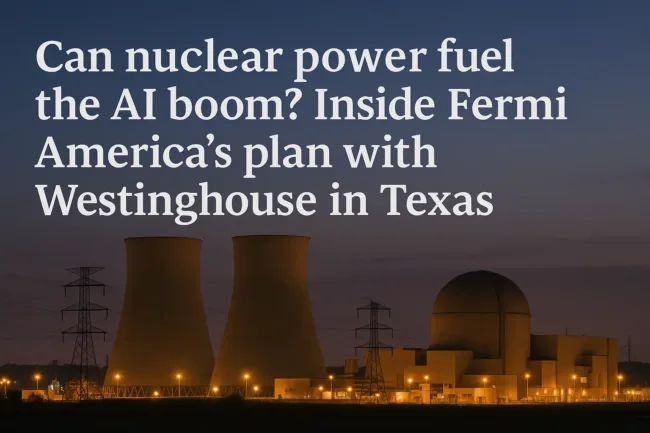
Fermi America believes it can. The Texas-based developer of gigawatt-scale private grid infrastructure has joined forces with Westinghouse Electric Company to advance plans for four AP1000 modular reactors at its Amarillo hyperscale campus. The collaborationfocuses on completing and supporting the U.S. Nuclear Regulatory Commission’s review of Fermi America’s Combined Operating License Application, filed earlier in June. If approved, the project could mark one of the first large-scale efforts to power AI-driven data infrastructure with advanced nuclear technology in the United States.
This development represents one of the most significant private nuclear energy initiatives in the United States, marking a convergence between next-generation computing demand and advanced reactor technology. The initiative also reflects Washington’s policy backdrop, with President Donald Trump reiterating his administration’s push to “Make America Nuclear Again,” signaling regulatory momentum for new nuclear projects.
How does this collaboration support the regulatory process and long-term deployment strategy for advanced reactors?
The partnership formalizes Westinghouse’s role in assisting Fermi America with finalizing COLA documentation, while also helping to navigate the NRC’s review and approval stages. Beyond licensing, both firms have agreed to create a phased deployment plan that will ensure the reactors can be delivered in alignment with the anticipated growth of AI-driven hyperscale data infrastructure.
According to Mesut Uzman, Fermi America’s Chief Nuclear Construction Officer, Westinghouse’s technical expertise and proven delivery record provide strong confidence in the regulatory process. He emphasized that the collaboration marks a milestone in execution strategy, enabling the Amarillo project to maintain both safety and efficiency targets.
Why is the Amarillo site strategically important for nuclear energy and hyperscale data?
Fermi America’s Amarillo site is located adjacent to the Pantex facility, a U.S. Department of Energy complex that has managed America’s nuclear weapons stockpile since 1951. Co-founder Toby Neugebauer described this proximity as symbolic of the region’s deep nuclear and energy heritage. He noted that Amarillo benefits from a skilled labor force rooted in Texas’s energy economy, as well as strong local support for industrial expansion.
The campus has also been designed to draw on traditional Texas Tech University-inspired Spanish architecture, blending advanced nuclear infrastructure with local cultural identity. Supporters argue that this makes the site not only technically suitable but also symbolically aligned with Texas’s leadership role in energy production.
What makes the AP1000 reactor technology critical for Fermi America’s AI-driven energy demand?
Westinghouse’s AP1000 is the only fully licensed Generation III+ advanced modular reactor currently operating globally. Its key differentiators include fully passive safety systems, modular construction methods, and the smallest footprint per megawatt of electricity generated.
Six AP1000 reactors are in commercial operation worldwide, with an additional 14 under construction and five under contract. The technology has also been selected by nuclear programs in Poland, Ukraine, and Bulgaria, with interest from utilities in the United Kingdom, continental Europe, and North America.
Westinghouse Energy Systems President Dan Lipman stated that the AP1000 is uniquely positioned to meet the needs of hyperscale AI operators, as it provides stable, carbon-free power at a pace compatible with rapid digital infrastructure growth. By leveraging modular construction and streamlined licensing, the Amarillo project aims to demonstrate how advanced nuclear can support the data economy’s escalating power requirements.
How are institutional investors and energy analysts viewing the Fermi America–Westinghouse collaboration?
While Fermi America is privately held, institutional observers have closely watched the role of nuclear in powering hyperscale data centers. Analysts suggest that this partnership represents an early template for pairing private nuclear capacity with AI workloads, creating a business model that may influence broader capital flows into advanced nuclear.
The sentiment around Westinghouse’s involvement has been described as cautiously optimistic. Investors recognize that licensing remains the biggest hurdle for nuclear projects, but Westinghouse’s established track record with the NRC provides reassurance. The U.S. regulatory environment under Trump’s second term is also seen as increasingly favorable for advanced reactor approvals, aligning federal support with private-sector investment.
What are the financial and strategic implications of this nuclear deployment for the U.S. energy mix?
Although financial terms of the partnership were not disclosed, the deployment of four AP1000 units would represent a multi-billion-dollar investment in the U.S. nuclear sector. Each unit has the potential to generate over 1 GW of electricity, giving the Amarillo campus a combined output sufficient to anchor both private AI workloads and broader grid resilience in the Texas Panhandle.
For Westinghouse, the collaboration reinforces its role as a leader in commercializing advanced reactor technology in Western markets. For Fermi America, it provides a pathway to secure long-term, carbon-free baseload power that avoids the volatility of fossil fuel markets.
Sector experts have highlighted that nuclear-backed AI infrastructure could redefine private power purchasing in the U.S. energy market. Rather than relying on intermittent renewables or contracted natural gas supplies, data operators could lock in decades of predictable, zero-emission energy.
What role does policy and geopolitical context play in this initiative?
The Trump administration’s support for nuclear power has been framed as both a domestic industrial policy and a geopolitical strategy to counterbalance China and Russia’s expanding nuclear exports. Fermi America’s initiative aligns with this agenda by demonstrating U.S.-based nuclear construction capacity, job creation, and energy independence.
Furthermore, as Europe accelerates nuclear investment in Poland, Ukraine, and Bulgaria with AP1000 technology, the Amarillo project signals that the U.S. intends to maintain leadership in nuclear innovation. Analysts suggest that if successful, the partnership could strengthen America’s hand in global nuclear diplomacy by showcasing commercial deployments of advanced reactors.
What challenges and risks could impact the progress of the Amarillo nuclear project?
Despite optimism, the Amarillo project faces several challenges. Licensing remains complex, with the NRC process often extending over multiple years. Financing will also require significant capital commitments, with nuclear construction known for cost overruns and delays. Public sentiment, while more favorable toward nuclear amid climate concerns, still carries reputational risks related to waste management and safety.
Institutional analysts warn that while the AP1000’s design emphasizes passive safety and reduced complexity, execution will be critical in ensuring costs and schedules remain controlled. The project’s success will also depend on aligning workforce training, supply chain readiness, and long-term waste storage solutions.
How does this initiative position nuclear energy in the AI-driven digital economy of the future?
The collaboration between Fermi America and Westinghouse is more than a licensing exercise—it represents a potential shift in how nuclear power is integrated into digital infrastructure. By directly linking advanced reactors with hyperscale data campuses, the project illustrates a pathway to meet the exponential power needs of artificial intelligence while decarbonizing energy supply.
If successful, the Amarillo deployment could establish a new class of private nuclear-backed grid infrastructure in the U.S., potentially replicable at other hyperscale hubs. Analysts see this as a milestone in redefining nuclear’s role, moving beyond traditional utility frameworks toward AI-driven demand centers.
Discover more from Business-News-Today.com
Subscribe to get the latest posts sent to your email.