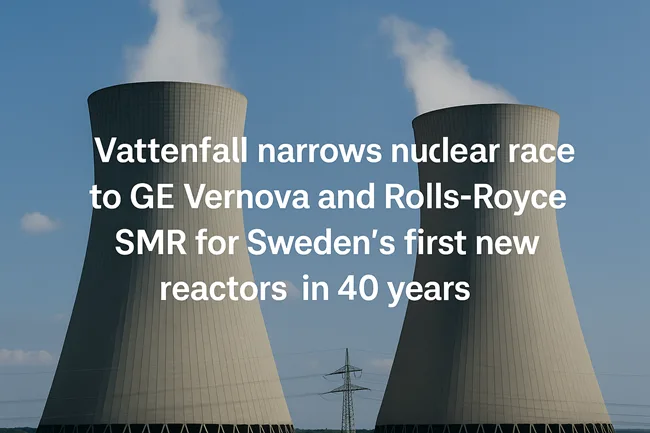
Why has Vattenfall chosen GE Vernova and Rolls-Royce SMR as final contenders for Sweden’s nuclear expansion plans?
Vattenfall AB, Sweden’s state-owned energy company, has advanced its search for next-generation nuclear power suppliers by selecting GE Vernova and Rolls-Royce SMR as the final contenders to build new small modular reactors (SMRs) on the Värö Peninsula. The move marks the most significant step toward new nuclear construction in Sweden in more than four decades, reflecting both energy security priorities and the need to meet rapidly rising electricity demand.
Vattenfall said the decision followed a multi-stage evaluation that initially began with 75 potential suppliers before being reduced to four and now to two finalists. Both GE Vernova’s BWRX-300 reactor and Rolls-Royce’s modular SMR system are considered to offer the best combination of proven design, grid compatibility, fuel availability, and construction feasibility within a constrained timeframe and budget.
The new reactors are expected to supplement Sweden’s Ringhals nuclear power plant, which already operates on the Värö Peninsula and is regarded as the optimal location due to available grid capacity, technical competence, and concentrated industrial demand for electricity in the region.
How do GE Vernova and Rolls-Royce SMR technologies compare in Sweden’s nuclear context?
GE Vernova, through its Hitachi Nuclear Energy joint venture, is offering the BWRX-300, a boiling water reactor with an output of 300 MW. The design has already gained traction internationally, with construction underway at Ontario Power Generation’s Darlington site in Canada, where four units are planned. The U.S. Nuclear Regulatory Commission is also reviewing an application from the Tennessee Valley Authority for deployment at its Clinch River site in Tennessee.
By comparison, Rolls-Royce SMR proposes a “factory-built” reactor rated at 470 MW per unit, with a projected deployment of three units for Vattenfall, delivering a total of around 1,500 MW. The British engineering group has already been selected for projects in the United Kingdom and the Czech Republic, signaling growing acceptance of its modular reactor platform.
Vattenfall noted that building a series of smaller units provides distinct cost and logistical advantages. SMRs generally require less space, fewer personnel, and offer simplified construction phases, which helps reduce budget overruns and mitigate staffing shortages during large-scale infrastructure projects.
What role does the Värö Peninsula play in enabling new nuclear power projects for Sweden?
The Värö Peninsula, home to the Ringhals nuclear power plant, has emerged as the epicenter of Sweden’s nuclear revival. The site combines grid integration capacity, skilled labor pools, and proximity to energy-intensive industries, making it the logical choice for initial reactor deployment.
However, Vattenfall executives highlighted site limitations, particularly in space and infrastructure, which make SMRs preferable over traditional gigawatt-scale reactors. The modular approach not only fits within physical constraints but also supports phased deployment to match Sweden’s incremental electricity demand growth.
CEO Anna Borg said the project represents Sweden’s first concrete step toward nuclear construction since the 1980s and emphasized that successful execution at Värö would pave the way for additional units at the former Ringhals 1 and 2 reactor sites.
How does institutional sentiment view Vattenfall’s nuclear move in terms of risk and opportunity?
Institutional investors and analysts have interpreted Vattenfall’s decision as a strong signal that Sweden is willing to embrace nuclear energy as part of its long-term transition strategy. With electricity demand projected to rise by 100–250 TWh over the next 25 years, nuclear is increasingly seen as a necessary complement to intermittent renewables.
Investors appear encouraged by the choice of established technologies with proven supply chains. Both GE Vernova and Rolls-Royce SMR rely on licensed fuels already available through Vattenfall’s procurement channels, which reduces project risk compared to untested reactor designs.
That said, some caution remains regarding regulatory approvals, state financing guarantees, and potential delays tied to supply chain bottlenecks. Analysts noted that Vattenfall’s request for state risk-sharing reflects the financial complexities of nuclear development and underlines the importance of political stability in sustaining momentum.
How are GE Vernova and Rolls-Royce SMR positioning themselves in the global SMR race?
GE Vernova has highlighted the BWRX-300’s position as the only small modular reactor currently under active construction in the Western world. The company has secured partnerships with Ontario Power Generation, Tennessee Valley Authority, Duke Energy, and Synthos Green Energy in Poland to promote the standardized design, underscoring its global scalability.
Meanwhile, Rolls-Royce SMR has leveraged recent wins in the UK and Czech Republic to strengthen its credibility. Its factory-based production model is marketed as a way to minimize on-site construction risk, an approach that resonates with countries seeking faster timelines and predictable costs. CEO Chris Cholerton described Vattenfall’s selection as evidence of international confidence in Rolls-Royce SMR’s modularization strategy.
Both companies are also tapping into rising geopolitical interest in nuclear energy as Europe seeks to reduce reliance on Russian energy imports and meet climate neutrality targets. Sweden’s decision to evaluate these suppliers therefore aligns with broader European energy diversification objectives.
What does the Industrikraft consortium’s involvement signal for Swedish industrial demand?
Vattenfall has partnered closely with Industrikraft, a consortium of 17 Swedish industrial companies, to ensure demand-side support for its nuclear projects. Industrikraft Chair Tom Erixon stressed the importance of stable long-term political conditions for the investment, highlighting industry’s readiness to co-invest through a joint project company.
The involvement of industrial stakeholders signals that Sweden’s manufacturing and heavy industry sectors—ranging from steel to chemicals—are increasingly prioritizing access to stable, low-carbon electricity as a competitiveness issue. Their participation is expected to provide additional financing stability and reinforce the case for nuclear as part of Sweden’s energy mix.
How are Sweden’s nuclear expansion plans likely to evolve over the next decade?
Vattenfall is currently weighing two deployment paths: five GE Vernova BWRX-300 units or three Rolls-Royce SMRs, both totaling around 1,500 MW of new capacity. The company has also indicated plans to build an additional 1,000 MW at the decommissioned Ringhals 1 and 2 sites.
The next steps include final supplier selection, submission of applications for state-backed risk-sharing mechanisms, and eventual final investment decisions. With political debate around nuclear in Sweden continuing, Vattenfall’s projects will likely serve as a bellwether for broader European SMR adoption.
Analysts suggest that if Vattenfall successfully delivers the first wave of reactors on time and within budget, it could unlock additional projects across Scandinavia and position Sweden as a leader in modular nuclear deployment.
What is the stock market and investor sentiment toward nuclear-linked companies after Vattenfall’s decision?
While Vattenfall itself is state-owned and not publicly traded, its supplier choices have implications for listed companies. GE Vernova, recently spun off from General Electric, is listed on the New York Stock Exchange under ticker GEV, while Rolls-Royce Holdings plc trades on the London Stock Exchange under ticker RR..
Following Vattenfall’s announcement, both companies’ shares showed modest upward momentum, reflecting optimism around potential contract awards. Institutional sentiment remains cautiously bullish, with investors noting that inclusion in Sweden’s nuclear program strengthens both firms’ positions in the global SMR race. Analysts caution, however, that final investment decisions and financing guarantees will be key milestones for sustained stock performance.
Discover more from Business-News-Today.com
Subscribe to get the latest posts sent to your email.