




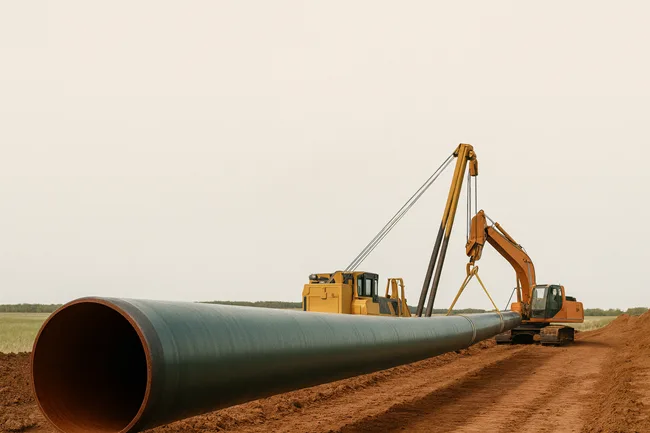
ATCO Ltd. (TSX: ACO.X, TSX: ACO.Y) announced on August 22, 2025, that its subsidiary Canadian Utilities Limited (TSX: CU) has received approval from the Alberta Utilities Commission (AUC) for the Need Assessment Application tied to the Yellowhead Pipeline Project. The regulatory decision represents the first major hurdle cleared in advancing one of the largest natural gas infrastructure projects in Alberta’s recent history.
The Yellowhead Pipeline is designed to expand Alberta’s highly integrated natural gas transmission system by adding more than 230 kilometres of capacity between the Peers region and Fort Saskatchewan. With a planned throughput of 1,200 terajoules—or approximately 1.1 billion cubic feet—of natural gas per day, the project is positioned to support both industrial expansion and population growth in Canada’s energy heartland.
ATCO’s Chair and Chief Executive Officer Nancy Southern described the AUC decision as validation of the pipeline’s strategic role in ensuring Alberta’s energy resilience. She noted that Canadian Utilities engaged extensively with communities along the proposed route, shaping a project that balances local priorities with long-term economic needs.
How does the Yellowhead Pipeline fit into Alberta’s broader energy infrastructure and economic plans?
The Yellowhead Pipeline, sometimes referenced by ATCO Energy Systems as the Yellowhead Mainline, is envisioned as a backbone for Alberta’s industrial economy. Beyond delivering gas for residential and industrial use, the line is expected to provide crucial feedstock access for petrochemical facilities, building material plants, and emerging hydrogen projects. Many of these downstream investments are tied to carbon capture and low-emissions production pathways, aligning Alberta’s hydrocarbon sector with global decarbonization targets.
Economic modelling presented by Canadian Utilities suggests that the project could generate approximately 2,000 direct jobs during the construction phase and underpin an average of 12,000 jobs annually through associated downstream activity. Once operational, the downstream investments supported by the pipeline are estimated to contribute $3.9 billion to Alberta’s annual GDP.
The project also overlaps with major third-party industrial investments, including Dow’s Path2Zero project, which is focused on deploying carbon capture technology in petrochemical production. By integrating natural gas and carbon capture into its industrial base, Alberta is aiming to maintain competitiveness while positioning itself as a hub for lower-emissions manufacturing.
What are the next regulatory steps before construction of the Yellowhead Pipeline can begin?
The approval of the Need Assessment Application is only the first of two regulatory hurdles. Canadian Utilities’ operating entity, ATCO Energy Systems, will need to file a facilities application with the Alberta Utilities Commission later this year. That filing will focus on construction specifics, environmental impact, and operational protocols.
If the facilities application is approved on schedule, ATCO anticipates construction could begin in 2026. The timeline aligns with Alberta’s near-term industrial expansion and with Canada’s national goals for energy security. For ATCO, the project also represents its single largest energy infrastructure undertaking to date.
In May 2024, ATCO Energy Systems had already positioned the Yellowhead Mainline as central to its three-year capital investment guidance. The firm indicated that the project would enable more than $20 billion in customer-driven investments in Alberta, ranging from petrochemical complexes to hydrogen facilities.
How does this project affect ATCO’s growth strategy across energy, housing, and defence?
ATCO’s diversified portfolio spans energy infrastructure, workforce housing, and defence contracting. Within this framework, the Yellowhead Pipeline enhances the group’s reputation as an essential energy enabler. The infrastructure not only strengthens ATCO’s regulated utility base but also deepens its ties with industrial clients whose projects require stable, long-term natural gas access.
Analysts point out that the pipeline aligns with ATCO’s strategy of balancing regulated returns with exposure to growth sectors like low-emissions fuels and industrial decarbonization. By embedding itself in Alberta’s industrial growth story, ATCO may also be creating long-term synergies with its housing and modular solutions businesses, which frequently support major construction projects.
How are institutional investors and market participants viewing the Canadian Utilities approval?
Canadian Utilities shares (TSX: CU) are closely followed by income-focused investors due to the company’s history of stable dividends. Institutional sentiment after the announcement suggested cautious optimism, with investors interpreting the approval as a step toward earnings visibility in the latter half of the decade.
Market participants noted that the project, once in operation, could deliver long-term regulated returns while strengthening Alberta’s industrial growth prospects. However, investors also remain attentive to regulatory timelines, construction risks, and capital allocation. Analysts generally expect the pipeline to attract stable financing due to its regulated nature, but they caution that execution discipline will be key.
ATCO’s dual-class share structure and diversified operations mean that sentiment is shaped not only by Canadian Utilities’ regulated utility returns but also by the performance of other ATCO subsidiaries. The pipeline approval, however, provides a rare anchor project that could influence ATCO’s capital investment narrative well into 2027 and beyond.
What is the outlook for the Yellowhead Pipeline and its role in Alberta’s future energy mix?
Looking ahead, the Yellowhead Pipeline is expected to function as both a domestic energy lifeline and a catalyst for industrial decarbonization. By securing natural gas feedstock for Alberta’s industries while enabling the integration of carbon capture and hydrogen projects, the pipeline underpins a hybrid vision: sustaining hydrocarbon competitiveness while aligning with global net-zero commitments.
Institutional investors are already weighing the long-term impact of Alberta’s dual-track approach—leveraging fossil fuel strengths while embedding clean-energy pathways. In this context, the Yellowhead Pipeline approval signals regulatory alignment with a pragmatic energy transition.
Construction of the Yellowhead Pipeline is not scheduled to commence until 2026, leaving a critical two-year window for regulatory scrutiny and stakeholder engagement. The upcoming facilities application will be the decisive stage, addressing not only technical construction details but also environmental assessments, land use rights, and community impact consultations. Historically, large-scale pipeline projects in Alberta have faced delays due to environmental reviews and opposition from landowners or Indigenous groups, and while ATCO Energy Systems has emphasized early engagement along the proposed route, the potential for extended hearings or conditional approvals remains.
Despite these risks, the project benefits from unusually strong political and regulatory alignment. Alberta’s government has consistently highlighted natural gas infrastructure as essential for economic diversification, petrochemical investment, and energy security. The Alberta Utilities Commission’s early approval of the need assessment underscores institutional recognition of the project’s strategic importance in meeting long-term demand. This regulatory tailwind, combined with ATCO’s established track record in building and operating regulated assets, gives the pipeline momentum that many infrastructure developers in Canada lack.
From an investor standpoint, attention now turns to the financial mechanics of delivery. Questions remain around how ATCO and Canadian Utilities will structure funding—whether through a mix of debt, equity, or project financing—and how capital expenditures will be phased to minimize balance sheet strain. With inflationary pressures continuing to raise construction costs across North America, disciplined capital cost management will be key in protecting returns. For income-oriented investors, the real focus lies in the eventual earnings contribution. Once operational, the Yellowhead Pipeline is expected to add a stable, regulated revenue stream that could support dividend growth at Canadian Utilities while reinforcing ATCO’s broader capital investment strategy.
Discover more from Business-News-Today.com
Subscribe to get the latest posts sent to your email.