




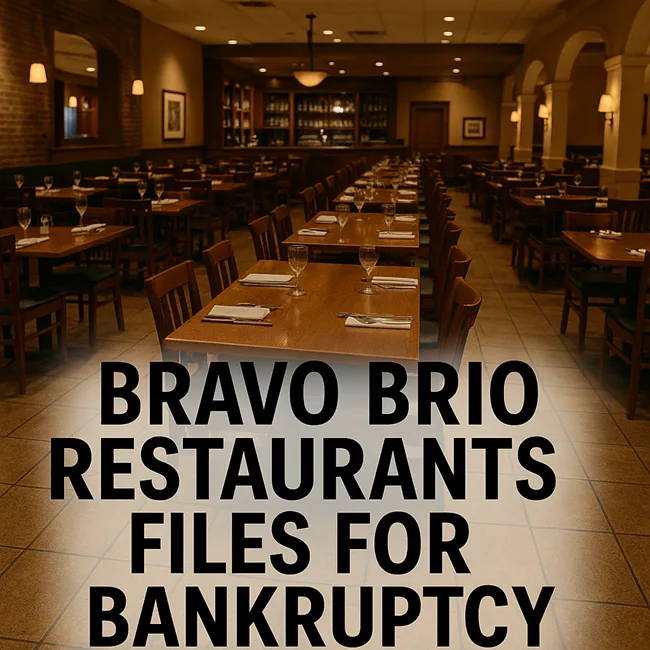
Why has Bravo Brio Restaurants filed for Chapter 11 bankruptcy for the second time in just five years?
Bravo Brio Restaurants, the Orlando-based parent company behind Bravo! Italian Kitchen and Brio Italian Grille, has once again filed for Chapter 11 bankruptcy protection in the United States. The decision, announced in late August 2025, marks the company’s second bankruptcy in just five years, underscoring the deep structural challenges faced by traditional sit-down dining chains in a post-pandemic market.
The restaurant group currently operates roughly 50 outlets across its two brands, down significantly from its peak footprint in the 2010s. In its filing, Bravo Brio attributed the decision to mounting financial pressures, including rising food and labor costs, declining sales, shrinking mall foot traffic, and intensified competition from both fast-casual rivals and delivery-first players.
While the bankruptcy will allow the group to restructure debt obligations, close underperforming stores, and pursue fresh investment, it also raises serious questions about whether legacy casual dining brands can survive without major reinvention.
How badly have Bravo Italian Kitchen and Brio Italian Grille been affected by declining sales and inflationary pressures?
Court filings reveal the full scale of Bravo Brio’s decline. Bravo Italian Kitchen saw its annual sales fall by 7.1% in 2024, adding to a staggering 47% collapse since 2019. Brio Italian Grille fared only slightly better, posting a 5.5% revenue decline in 2024 and mirroring the same near-halving of sales over the past five years.
The downturn has been compounded by macroeconomic conditions. Inflationary spikes in food commodities, rising energy bills, and an industry-wide labor shortage have collectively eroded margins. Leases in high-vacancy shopping centers, where many Bravo Brio outlets are located, have only intensified the pressure, as low mall foot traffic translates into weaker table turnover and diminished profitability.
Creditors listed in the filing number between 200 and 999, with food distributor Sysco Corporation emerging as the largest unsecured creditor, owed approximately USD 1.9 million. This highlights how deeply supply chain obligations are tied into the brand’s survival, further complicating the restructuring process.
What role has Earl Enterprises played in Bravo Brio’s ownership and why has its turnaround strategy stumbled?
This is not Bravo Brio’s first brush with insolvency. In 2020, the group filed for Chapter 11, ultimately emerging under the ownership of Earl Enterprises. The Florida-based restaurant holding company, led by industry veteran Robert Earl, also controls other casual dining brands including Buca di Beppo, Planet Hollywood, and Bertucci’s.
At the time, the acquisition was pitched as a stabilizing move that would bring operational expertise and portfolio synergies. Yet just five years later, Bravo Brio is back in bankruptcy court, raising doubts about whether Earl Enterprises’ turnaround playbook is still viable in today’s harsher market conditions.
Adding to investor concerns, Bertucci’s—another Earl-owned chain specializing in Italian dining—also entered bankruptcy earlier in 2025. The repeated failures within the same portfolio suggest that the challenges are systemic, not isolated. Institutional observers argue that incremental cost-cutting and modest menu tweaks are no longer sufficient when consumer behavior has fundamentally shifted away from mid-tier, full-service dining.
How does Bravo Brio’s bankruptcy reflect wider pressures across the casual dining sector in 2025?
Bravo Brio’s struggles are part of a broader pattern across the casual dining industry. Red Lobster, another iconic name in the segment, filed for Chapter 11 earlier this year after a string of disappointing quarters. TGI Fridays has been exploring strategic alternatives following declining traffic, while chains like Hooters have been forced to slim down footprints and experiment with delivery-only formats.
The sector’s troubles trace back to the COVID-19 pandemic, when forced closures and reliance on takeout permanently shifted consumer preferences. Younger diners in particular have gravitated toward fast-casual concepts that promise speed, affordability, and digital convenience. Established players such as Chipotle Mexican Grill and Panera Bread have captured this demand by investing in app-based ordering, drive-thru lanes, and menu innovation.
By contrast, sit-down restaurants anchored in malls or suburban retail strips have struggled to modernize. Analysts note that while higher-end fine dining continues to rebound, mid-tier players like Bravo Brio face a “squeezed middle,” caught between budget-friendly fast casual and premium experiences that consumers are still willing to pay for on special occasions.
What are analysts and institutional investors saying about Bravo Brio’s prospects after its latest restructuring attempt?
Institutional sentiment toward Bravo Brio’s second bankruptcy filing is cautious at best. Analysts broadly agree that Chapter 11 protection provides the restaurant group with breathing room, but they emphasize that simply reducing debt or shuttering unprofitable locations will not address the core problem of consumer irrelevance.
From an investor perspective, casual dining stocks and bonds have been treated as high-risk assets in 2025, with debt spreads widening and equity valuations lagging broader market benchmarks. Private equity firms, which once saw opportunity in consolidating restaurant chains, have become far more selective. Many now prefer franchise-driven fast casual concepts with scalable, capital-light models.
In Bravo Brio’s case, the lack of public listing means there is no direct stock to evaluate. However, sentiment across the sector—mirrored in Red Lobster’s creditors and landlords facing significant losses—suggests that debt restructuring alone may not be enough to attract fresh capital. Without a differentiated growth plan, institutional appetite to fund another turnaround appears limited.
What future strategies could Bravo Brio pursue to regain relevance and financial stability in the changing dining landscape?
Industry experts believe Bravo Brio must pursue bold changes if it hopes to survive beyond restructuring. Digital transformation is seen as a minimum requirement: loyalty apps, delivery partnerships, and tech-enabled reservations are now table stakes in casual dining. Menu innovation—ranging from healthier items to more culturally diverse offerings—could also help attract younger diners.
Another potential path is geographic repositioning. Several Bravo Brio outlets are located in declining shopping centers, a structural disadvantage. Relocating to mixed-use developments, urban hubs, or high-traffic suburban corridors could improve visibility and demand.
Franchising could also emerge as a strategic lever. By converting company-owned stores into franchise operations, Bravo Brio could reduce capital exposure while leveraging local operators’ market knowledge. However, this approach requires strong brand equity—something the group has struggled to maintain amid declining sales.
Ultimately, Bravo Brio’s survival will hinge on whether Earl Enterprises can rethink its entire mid-tier casual dining strategy. Without a sharp pivot, the group risks repeating the cycle of bankruptcy and restructuring without ever achieving true transformation.
Is this Bravo Brio bankruptcy the end of the road or a second chance for reinvention?
Bravo Brio’s second Chapter 11 bankruptcy filing is more than just a financial restructuring. It is a litmus test for whether traditional casual dining brands can evolve in a market increasingly defined by speed, convenience, and novelty.
The numbers—sales nearly halved since 2019, creditors in the hundreds, and mounting liabilities to suppliers like Sysco—illustrate a formula that is no longer sustainable. The fact that Earl Enterprises, despite its track record with multiple restaurant brands, could not stabilize Bravo Brio over five years adds another layer of skepticism.
From my perspective, Bravo Brio still has a chance to survive, but only if it embraces reinvention rather than incremental fixes. The path forward may involve bold experimentation with digital-first strategies, menu reinvention, and re-anchoring locations in thriving consumer corridors. Anything less risks making this Chapter 11 filing a prelude to permanent closure.
Discover more from Business-News-Today.com
Subscribe to get the latest posts sent to your email.
