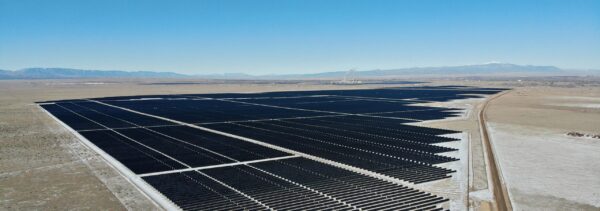



China’s carbon dioxide emissions dropped around 1% year on year in the first half of 2025, a trend that analysts say is significant given the scale of the world’s largest emitter. Data from the Centre for Research on Energy and Clean Air indicated that the country’s renewable power output, particularly from wind and solar, expanded at such a rapid pace that it outweighed the growth in national electricity demand.
The decline came even though coal-fired power plants maintained a large share of the generation mix, showing how incremental renewable gains can translate into system-wide reductions. For Beijing, this reinforces the narrative that industrial-scale clean energy deployment is central to meeting climate goals without stalling economic activity.
The report also highlighted that the steel and cement industries—historically among the most carbon-intensive segments of China’s industrial base—managed to reduce emissions during the same period. These reductions were linked to efficiency upgrades, slowing construction activity, and regulatory pressure to cut energy intensity.
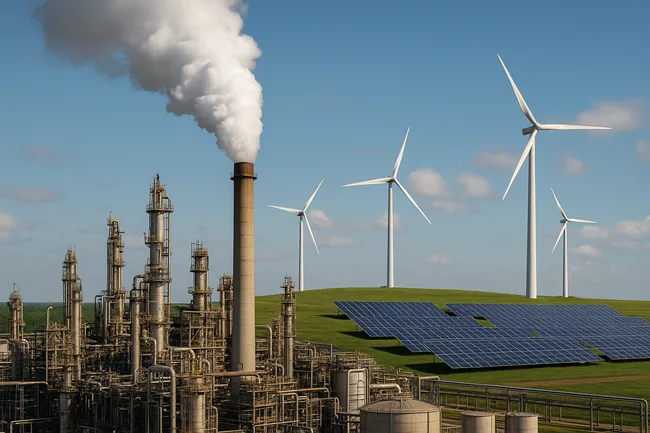
How did renewable power expansion influence China’s energy mix and industrial emissions?
The most striking feature of the 2025 emissions data is the speed of renewable integration. Wind and solar additions outpaced electricity demand growth, meaning that new clean capacity did not merely meet incremental demand but displaced fossil generation.
This is a shift from earlier years, when rising electricity needs often swallowed renewable additions, leaving coal output largely unchanged. Analysts suggest that China’s power sector is now at a tipping point: the scale of renewables is sufficiently large that it can bend the emissions curve downward.
The steel and cement industries also responded to a softer real-estate cycle by producing less clinker and crude steel, which naturally lowered emissions. Policymakers had encouraged a rationalization of capacity, particularly in provinces where air quality targets were missed, adding further downward pressure on industrial output.
Institutional observers noted that the combined effect of these dynamics demonstrates China’s capacity to make measurable emissions progress without broad-based economic disruption.
Why is the coal-to-chemical sector now emerging as China’s new emissions hotspot?
Despite encouraging progress in power generation and heavy industry, the chemical sector emerged as a counterweight. Coal-to-chemical facilities—plants that transform coal into synthetic fuels, plastics precursors, and fertilizers—saw a sharp rise in coal use. Consumption was up 20% in the first six months of 2025 after a 10% increase in 2024.
These facilities are highly carbon-intensive because they rely on gasification and liquefaction processes that emit significantly more carbon dioxide per unit of output than conventional petrochemical methods. In 2024 alone, coal-based chemical production emitted roughly 690 million tonnes of carbon dioxide, around 410–440 million tonnes more than alternative production pathways.
The growth of this subsector reflects government policies aimed at reducing reliance on imported oil and gas feedstocks by leveraging abundant domestic coal reserves. However, the climate trade-off is stark. Researchers said the emissions from coal-to-chemical plants are now large enough to offset much of the progress being made in the power sector.
What challenges does China face in balancing economic growth with emissions control?
Beijing faces a policy dilemma. On one side, it is committed to peak carbon dioxide emissions before 2030 and achieving carbon neutrality by 2060. On the other, coal-to-chemical facilities are considered strategic for energy security, industrial resilience, and regional employment. Provinces like Inner Mongolia and Shaanxi, where many of these plants are located, depend heavily on the industry for jobs and fiscal revenues.
Institutional analysts said this dual mandate complicates policymaking. Curtailing coal-to-chemical expansion could be seen as undermining energy independence, while letting it grow unchecked risks undercutting climate credibility. A likely compromise is sector-specific regulation that pushes coal-to-chemical plants toward efficiency upgrades or carbon capture solutions, while slowing the pace of new approvals.
How does China’s emissions profile compare with other major economies in 2025?
China’s 1% emissions decline in early 2025 stands out when compared to other large economies. The United States, for instance, is expected to see flat or slightly rising emissions this year due to robust industrial activity and higher natural gas consumption after a cold winter. The European Union continues to post declines, but its rate of reduction has slowed amid efforts to stabilize energy prices following years of volatility.
What makes China’s trend notable is scale: a 1% reduction equates to hundreds of millions of tonnes of carbon dioxide, comparable to the entire annual emissions of mid-sized economies. This demonstrates that even modest percentage changes in China’s trajectory have global implications for climate arithmetic.
Global observers also note that China’s pace of renewable deployment dwarfs that of most countries. The International Energy Agency estimates that more than half of the world’s new wind and solar capacity in 2024 was installed in China, positioning it as the main driver of global clean energy growth.
How are institutional investors and global observers interpreting China’s emissions trend?
Investor sentiment is nuanced. On the positive side, the emissions decline validates the case for renewable developers, grid equipment suppliers, and related value chains. International capital has already been flowing into Chinese clean energy manufacturers, including turbine and photovoltaic suppliers, which have reported order books extending into 2026.
On the risk side, coal-to-chemical expansion creates uncertainty for investors exposed to China’s broader industrial complex. Many institutions worry that Beijing could impose abrupt restrictions if the sector’s emissions trajectory threatens national climate pledges. That would translate into stranded-asset risks for companies and regions heavily invested in the coal-to-chemical value chain.
For global investors, the message is that exposure to China’s green sectors remains attractive, but industries tied to coal conversion carry heightened regulatory and reputational risk.
What policy measures or technological pathways could address coal-to-chemical emissions?
Several options are on the table. Carbon capture, utilization, and storage (CCUS) has been promoted as a potential solution for coal-heavy industries, though its deployment remains limited and costly. Another pathway is co-firing with biomass or developing integrated processes that reduce carbon intensity per unit of output.
Policy analysts suggest that targeting coal-to-chemical facilities for emissions control could deliver outsized benefits. Unlike distributed emissions sources, these plants are point sources that could be fitted with capture technologies if the economics improve. Early signs of regulatory tightening include stricter permitting requirements and pilot projects exploring cleaner process routes.
Institutional sentiment indicates that policymakers are unlikely to shut down existing plants abruptly, but they may cap new capacity and direct more funding toward technological retrofits.
What is the likely policy and market outlook for China’s emissions strategy through 2025 and beyond?
Looking ahead, China’s emissions strategy is likely to combine aggressive renewable expansion with selective industrial interventions. The power sector will continue to decarbonize as more wind and solar come online, supported by advances in ultra-high-voltage transmission and energy storage. Heavy industries like steel and cement will face incremental pressure to modernize, with production caps used as a blunt instrument when needed.
The wildcard remains coal-to-chemical production. If unchecked, it could reverse the emissions decline. If managed with targeted policies, it could become the single largest lever for near-term reductions.
Institutional investors will be watching closely for signs of policy direction in the next Five-Year Plan updates, expected in 2026. Until then, markets are pricing in both opportunity in renewables and risk in carbon-intensive chemicals.
For the global climate community, China’s trajectory underscores a familiar reality: progress is possible, but sector-specific hotspots must be addressed for gains to be durable.
Discover more from Business-News-Today.com
Subscribe to get the latest posts sent to your email.