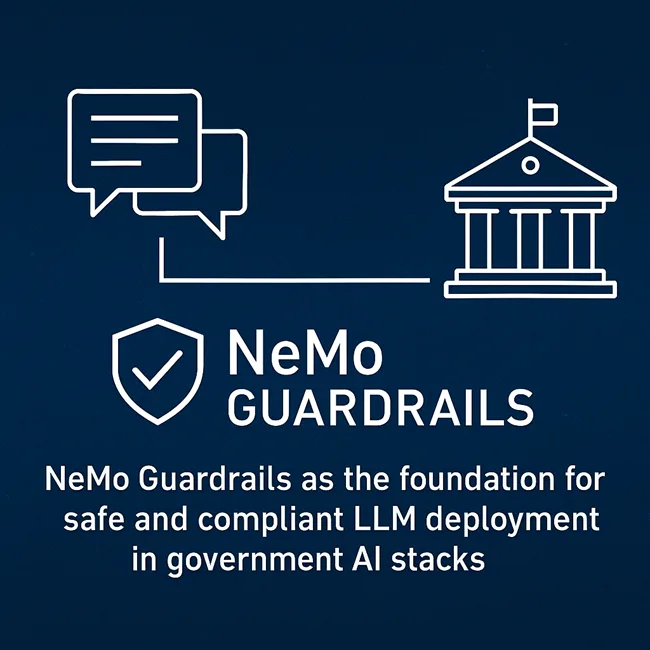
As public institutions and governments increasingly turn to large language models (LLMs) for digital service delivery, the question of trust and safety in generative AI systems has become unavoidable. With major economies adopting national AI policies that stress alignment, explainability, and risk mitigation, the technical and regulatory spotlight has shifted to runtime controls. At the center of this evolving conversation is NVIDIA Corporation (NASDAQ: NVDA), whose open-source framework—NeMo Guardrails—is now emerging as a foundational safety layer for enterprise and government AI deployments.
NeMo Guardrails offers a programmable architecture for enforcing trust boundaries around LLM behavior. Rather than relying solely on fine-tuning or prompt engineering, the framework introduces a runtime governance model that can intercept, redirect, or suppress undesirable output in real time. For governments, this creates a blueprint to safely operationalize LLMs while meeting statutory obligations, especially in areas involving citizen interaction, defense, legal reasoning, or healthcare triage.
NVIDIA’s positioning of NeMo Guardrails is not just a product launch—it represents a broader recalibration of the generative AI value chain, where safety, observability, and policy compliance are not just technical add-ons but enterprise-grade requirements.
How does NeMo Guardrails work and why does it matter for AI oversight in government?
At its core, NeMo Guardrails is designed to create “rails” or enforcement policies that constrain LLM output across three key dimensions: topicality, factual consistency, and safety. Developers can define rules in YAML-like configurations, specifying what topics are allowed, how conversations must flow, and which language patterns should be blocked.
This architecture allows public-sector teams to encode regulatory policies, ethical standards, or domain-specific logic directly into the system without retraining models. Instead of relying on probabilistic output filtering or brittle prompt phrasing, NeMo Guardrails offers a deterministic enforcement mechanism that can function across a wide array of foundation models—including open-source options like Llama 3 and proprietary APIs.
Government deployments—especially in areas like legal services, social benefits portals, military support bots, or tax guidance tools—often face a non-negotiable requirement: zero tolerance for hallucinations, toxic outputs, or unauthorized disclosure. NeMo Guardrails introduces a structured, auditable layer that sits between the model and the end-user, creating a real-time buffer zone where unsafe or non-compliant behavior can be neutralized before exposure.
In addition to compliance, this design has performance implications. NVIDIA’s tests indicate that for LLMs like Llama 3–8B running on H100 GPUs, the guardrails framework introduces under 500 milliseconds of latency while increasing policy adherence by up to 1.5× in regulated prompt scenarios. This positions the solution as a low-friction, high-impact layer that doesn’t compromise on speed or user experience—both critical for high-volume government use cases.
What real-world use cases and partners are validating NeMo Guardrails for institutional deployment?
Multiple AI governance vendors and partners are already integrating NeMo Guardrails into their broader safety platforms. For instance, AutoAlign has layered its visual no-code interface onto the Guardrails stack, enabling security and compliance officers in the public sector to create content filters, user restrictions, and privacy policies without needing developer intervention. This is particularly useful in jurisdictions where procurement cycles favor plug-and-play configurations over custom builds.
Another validation comes from Fiddler AI, whose Trust Platform is now natively integrated with NeMo Guardrails. By scanning inputs and outputs for toxicity, bias, hallucination risk, and jailbreak attempts within milliseconds, Fiddler offers runtime moderation that aligns well with the operational needs of government agencies. These integrations support rapid response models, such as those used in call centers, social assistance bots, or healthcare triage systems—where every millisecond counts and human safety is at stake.
Moreover, several healthcare and defense agencies have reportedly begun testing Guardrails in pilot environments, where LLMs are being explored for limited-scope advisory roles. While these deployments remain under confidentiality, the ecosystem momentum signals strong interest from policy-heavy sectors.
What are the known limitations and risks of NeMo Guardrails in mission-critical use cases?
Despite its strengths, NeMo Guardrails is not immune to flaws. According to third-party audits and internal NVIDIA documentation, certain guardrails—especially those relying on generic flow templates—can be bypassed by cleverly crafted prompts. This is not a fault of the tool itself but a byproduct of LLM unpredictability and the challenge of encoding comprehensive, edge-case-proof logic.
Organizations such as Robust Intelligence have documented how slight variations in phrasing or prompt context can produce outputs that circumvent topic restrictions. In scenarios involving sensitive military or legal queries, such gaps could translate into real-world risk. As such, Guardrails is best viewed not as a silver bullet but as one component in a layered security and compliance architecture.
Additionally, NeMo Guardrails is distributed with a cautionary note: the default templates are for experimentation and are not production-certified. NVIDIA emphasizes that production deployments must undergo red teaming, stress testing, and manual policy refinement. For government buyers, this implies the need for implementation partners or in-house AI safety teams capable of customizing the framework before full deployment.
Why is NeMo Guardrails becoming central to sovereign AI narratives and public trust strategies?
With geopolitical tensions and data sovereignty concerns shaping national AI policy, the ability to govern LLM behavior locally—on infrastructure you control—is becoming a strategic imperative. NeMo Guardrails aligns with this vision by being open source, model-agnostic, and infrastructure-independent. Governments can deploy it on sovereign GPU clouds, hybrid architectures, or secure data centers without needing to route requests through hyperscaler APIs.
In the context of the European Union’s AI Act or India’s Digital Personal Data Protection framework, such control over AI behavior becomes a non-negotiable compliance requirement. Similarly, U.S. Executive Orders now direct agencies to ensure that generative AI systems reflect American values, privacy principles, and safety expectations—objectives that require configurable, observable control planes like NeMo Guardrails.
The broader trend is clear: as LLMs move from experimental prototypes to operational government tools, the demand for runtime governance will surge. Whether in DMV chatbots, judicial advisory systems, military briefings, or citizen-facing AI agents, policy-aligned behavior cannot be left to chance. NeMo Guardrails represents a programmable substrate on which safe, regulated AI can be reliably deployed.
What is the long-term outlook for NeMo Guardrails as a default safety layer in government AI stacks?
As regulatory frameworks harden and public trust becomes a defining factor in digital transformation programs, runtime guardrails will likely shift from optional enhancements to baseline requirements. NeMo Guardrails may evolve into a critical infrastructure layer—akin to firewalls in network security or identity systems in cloud infrastructure.
Its open architecture makes it extensible, allowing third parties to build policy libraries, audit tools, and domain-specific rails on top of the base platform. Already, cybersecurity firms, legal AI vendors, and civic tech startups are exploring vertical integrations that could turn Guardrails into a trusted intermediary across sectors.
By 2026, it’s plausible that major AI procurement frameworks in defense, healthcare, and justice will require runtime safety enforcement tools as part of their technical evaluation. In that environment, NVIDIA’s early investment in NeMo Guardrails may yield a first-mover advantage—not just as an AI innovator, but as a governance enabler.
Share this:
Discover more from Business-News-Today.com
Subscribe to get the latest posts sent to your email.