




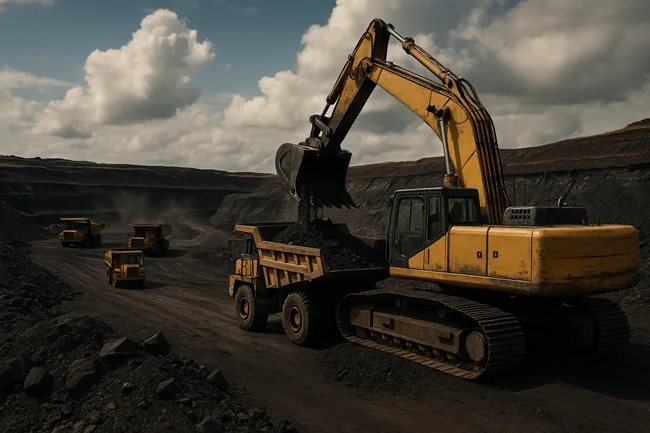
MC Mining Limited (ASX: MCM, JSE: MCZ) has crossed a defining threshold in August 2025, moving from explorer to producer with the start of open pit operations at its flagship Makhado steelmaking coal project in South Africa’s Limpopo Province. The transition marks the country’s first large-scale domestic supply of hard coking coal, a critical material for steelmaking, and is being closely watched by investors, steel producers, and policymakers who see the project as a lever to reduce costly imports and revive South Africa’s industrial competitiveness. With the first box-cut completed, a 122-strong workforce in place, and the coal preparation plant on track for year-end commissioning, the project signals both economic promise and execution risk in equal measure.
Civil works at the coal handling and preparation plant, built under a build-own-operate-transfer model by Enprotec (Pty) Ltd, are complete, with structural steel and mechanical installations already in progress. The project is running on budget and on schedule, targeting first coal by the end of 2025 without any reported lost-time injuries.
How does the scale and phased structure of MC Mining’s Makhado project redefine South Africa’s domestic coking coal supply outlook?
The first phase of the Makhado project is focused on the East Pit, a deposit with a strike length of 5.5 kilometres and a width of 400 metres. MC Mining plans to achieve a run-of-mine production of 4 million tonnes annually, yielding around 880,000 tonnes of hard coking coal per year over a 14-year life of pit. Later stages will unlock the Central and West Pits, extending the total project life to nearly three decades. The coking coal will be supplied mainly to South African steelmakers, many of whom currently rely on imports from countries such as Australia and Mozambique. By reducing transport costs and improving supply security, the project could deliver a significant competitive advantage for local steel producers. Alongside coking coal, the project will also yield middlings thermal coal, which can be marketed to power stations or industrial buyers, providing MC Mining with an additional cash flow stream.
Why is local production of hard coking coal considered pivotal to the future cost competitiveness of South African steelmakers?
Globally, coking coal remains indispensable for blast furnace steel production, even as alternatives such as green hydrogen and electric arc furnaces advance. Prices for metallurgical coal have been volatile in recent years, shaped by fluctuating Chinese demand and supply bottlenecks in Australia, Canada, and the United States. South Africa, while endowed with vast thermal coal reserves, has historically lacked domestic hard coking coal production. This supply gap has made steel manufacturing more expensive, undermining the competitiveness of local steelmakers. The South African government’s Steel and Metal Fabrication Master Plan explicitly highlights the need to lower input costs and boost beneficiation in order to revitalise the steel sector. By starting production at Makhado, MC Mining aligns with these policy ambitions, supporting industrial growth, job creation, and regional development. Interim chief executive Christine He underlined that domestic supply of coking coal could provide a “quantum input cost reduction” for steelmakers, strengthening the competitiveness of South African industry in global markets.
What operational priorities and community engagement measures are shaping the early execution phase of the Makhado project?
From the start of construction in November 2024, MC Mining has emphasised health and safety performance. The project has so far reported no lost-time injuries, with strict compliance to occupational standards. Infrastructure development, including bulk water and power connections, access roads, and environmental controls such as dirty water containment, is progressing on schedule. Importantly, the contractor has prioritised local employment, with over 120 jobs created to date. The project is also expected to catalyse indirect economic benefits across Limpopo Province, ranging from services and logistics to community development initiatives. MC Mining has pointed to the Makhado project as the launchpad for its broader Greater Soutpansberg Projects, which include additional coking coal and thermal coal deposits. If these are successfully developed, the company could become South Africa’s leading domestic supplier of steelmaking coal, cementing its role in the industrial value chain.
How are MC Mining’s shares reacting to the Makhado launch and what does investor sentiment reveal about its risk-reward profile?
MC Mining trades on both the Australian Securities Exchange under ticker MCM and the Johannesburg Stock Exchange as MCZ. In the week of the announcement, the stock closed at ZAR 149.00 on 14 August, rising by 2.76 percent from the prior session. Following the open pit commencement update, it spiked to ZAR 168.00, suggesting increased investor optimism about the project’s progress. Trading volumes, however, remain low, a sign of the stock’s limited liquidity relative to larger global mining peers. Analysts note that the company represents a high-risk, high-reward investment opportunity. On one hand, successful ramp-up could deliver strong cash flows and establish MC Mining as a unique South African coking coal supplier. On the other hand, delays, cost overruns, or coal price weakness could undermine valuations. For speculative investors with a tolerance for volatility, the stock is viewed as a “speculative buy,” while existing holders may prefer to “hold” until stable production is proven. Institutional investors are likely to remain cautious, given the project’s scale-up risks and reliance on a supportive regulatory framework.
What ramp-up milestones and strategic decisions will determine MC Mining’s ability to transition from project developer to sustainable coal producer?
Over the next 12 months, key milestones will include completing the coal processing plant, delivering first coal, and finalising off-take agreements with domestic steelmakers. Securing long-term contracts will be crucial to underpin stable revenues. Funding for the remaining build-out and expansion phases is another priority, with MC Mining potentially seeking additional capital or considering joint ventures. Strategic partnerships may also help accelerate development of the broader Soutpansberg resource base. Longer-term, success at Makhado would establish MC Mining not only as a supplier but as a strategic enabler of South Africa’s industrial ambitions. Yet risks remain. The project’s viability depends on consistent demand from steelmakers, a stable regulatory environment, and infrastructure reliability in a region where power and logistics are ongoing concerns. For investors, monitoring cost control, production performance, and contract signings will be vital indicators of the company’s progress.
How does current market sentiment toward MC Mining balance the upside of domestic coking coal supply with execution and financing risks?
At current valuations, MC Mining is priced as a speculative small-cap with limited analyst coverage but significant upside potential. Market reaction to the Makhado start has been positive, reflected in the near-13 percent price increase following the update. Institutional investors appear intrigued by the strategic importance of domestic coking coal supply but remain wary of execution risk. Foreign institutional inflows are limited given the stock’s small market capitalisation and low liquidity, while local institutional sentiment is cautiously optimistic in line with national industrial policy. Retail investors are showing increased interest, particularly those seeking exposure to South Africa’s industrial revival themes. Overall, sentiment can be characterised as a cautious “buy” for long-term investors with high risk tolerance, while more conservative market participants are likely to remain on the sidelines until steady-state production and cash flows are proven.
Could the success of Makhado shift South Africa’s role in the global steelmaking coal market and strengthen its long-term industrial ambitions?
The commencement of open pit operations at Makhado marks more than just a corporate milestone for MC Mining. It represents a structural shift for South Africa’s steel supply chain, promising reduced reliance on imports, lower input costs for steelmakers, and a stronger foundation for industrial growth. With a planned mine life of nearly three decades across three pits, the project could transform MC Mining into a cornerstone supplier of coking coal in the region. Yet execution risks, market volatility, and regulatory uncertainty mean the journey is only beginning. If successful, Makhado could position South Africa not only as a consumer but as a producer of critical steelmaking inputs, aligning resource development with broader economic policy. For investors, the project presents a speculative but potentially transformative opportunity, one that could reshape both company fortunes and the steel sector’s competitive landscape.
Discover more from Business-News-Today.com
Subscribe to get the latest posts sent to your email.